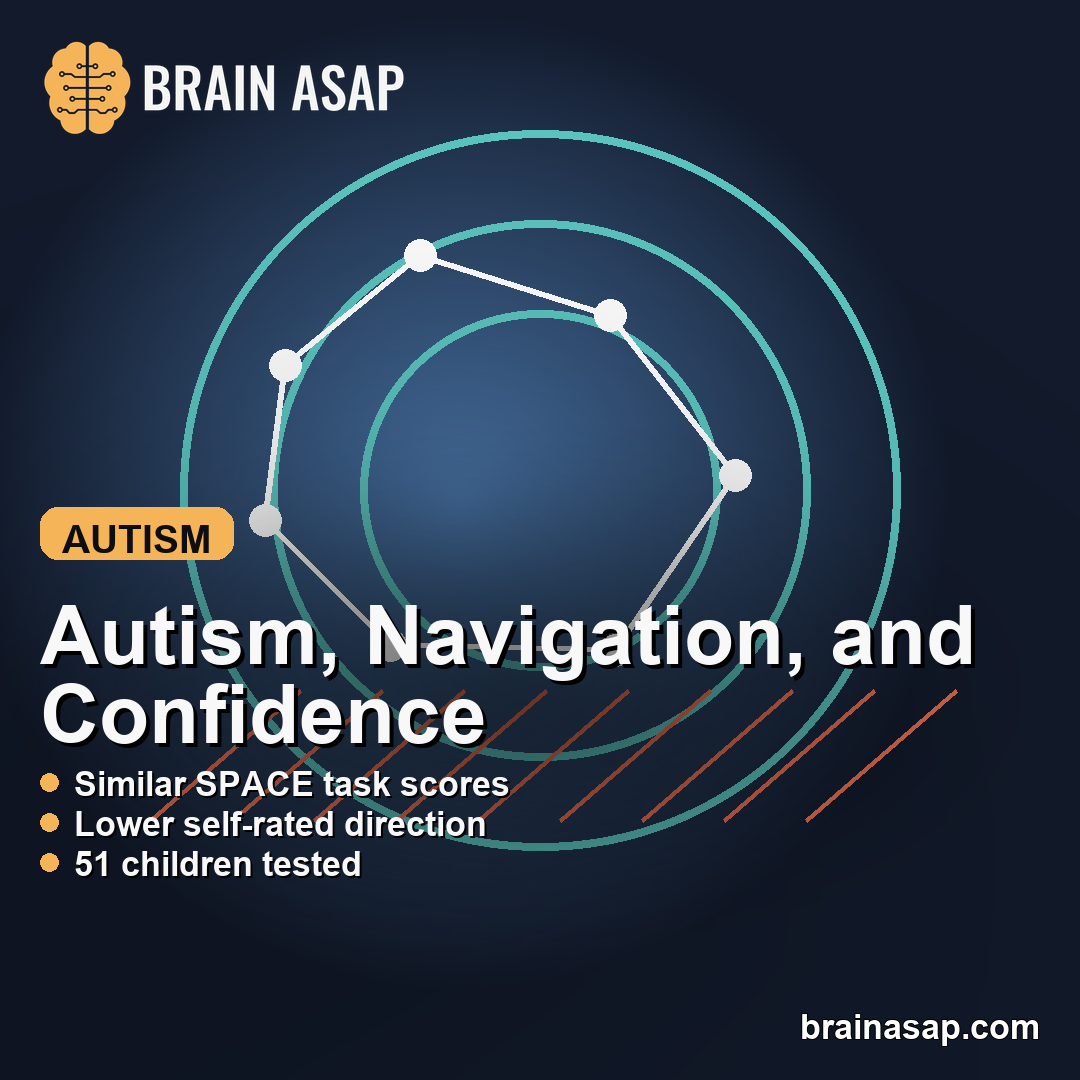
TL;DR: A 2026 preprint in medRxiv found that 26 autistic children and 25 typically developing peers performed similarly on iPad-based navigation tasks, but the autistic group rated its own sense of direction lower.
Key Findings
- Objective navigation performance did not differ between autistic and typically developing children across path integration, egocentric pointing, mapping, or perspective taking.
- The sample included 51 children, with 26 autistic children and 25 age- and gender-matched typically developing peers from secondary schools in Brisbane, Australia.
- Perceived navigation ability was lower in the autistic group on the Santa Barbara Sense of Direction scale, with condition predicting total score at p < .001.
- Age mattered for some tasks: older children had smaller errors in path integration and perspective taking, suggesting continued spatial-updating development in late childhood.
- The source is a preprint, so the result should be treated as early evidence that self-report and task-based spatial cognition can diverge in autistic children.
Source: The preprint tested children with the Spatial Performance Assessment for Cognitive Evaluation (SPACE), an iPad game covering path integration, egocentric pointing, mapping, associative memory, and perspective taking.
Autistic Children Matched Peers on SPACE Navigation Tasks
Spatial navigation depends on several cognitive systems at once. Children have to update where they are, remember landmarks, switch perspectives, and sometimes build a map-like representation of an environment.
Researchers tested whether those abilities differed in 26 children with high-functioning autism spectrum disorder and 25 typically developing children. The groups were matched on age and gender, and the average age was about 12 years.
The task battery was called SPACE, short for Spatial Performance Assessment for Cognitive Evaluation. It was delivered as an iPad-based game in which children explored a virtual planet and completed several navigation challenges.
- Path integration: Children returned to a starting location after moving through the virtual environment.
- Egocentric pointing: Children judged landmark positions from a self-centered viewpoint.
- Mapping: Children placed landmarks into a map-like layout.
- Perspective taking: Children estimated landmark locations from another viewpoint.
The main task result was a null group difference. Condition was not a significant predictor for path integration, egocentric pointing, mapping, or perspective taking.
Associative memory was excluded from later analysis because all participants reached 100% accuracy.
SBSOD Scores Were Lower in the Autistic Group
The self-report measure produced the contrast. Children completed the Santa Barbara Sense of Direction (SBSOD), a 15-item questionnaire about everyday navigation confidence, map use, and direction giving.
On the SBSOD total score, the model was significant at F(2, 47) = 9.32 with p < .001 and R2 = .253. Group condition was a significant predictor, with autistic children reporting lower subjective navigation ability than typically developing peers.
The self-rating gap did not match the task results. The SPACE tasks suggested comparable controlled-environment navigation, while the questionnaire suggested lower confidence or everyday self-perception in the autistic group.
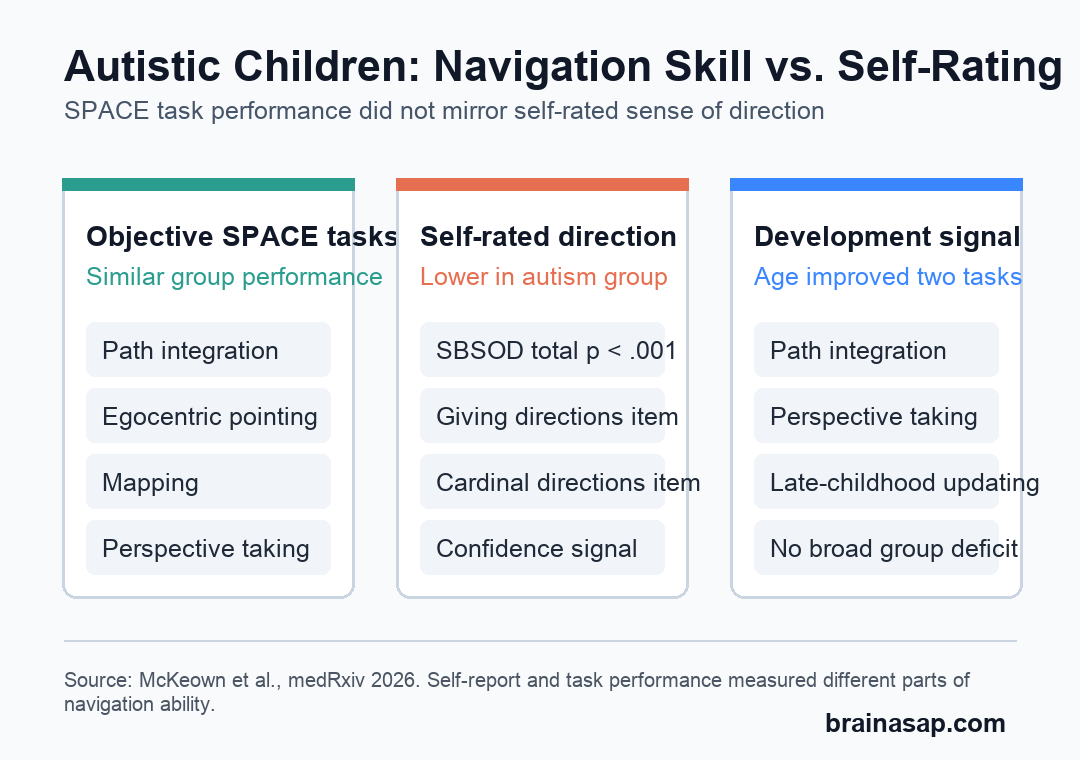
The strongest item-level differences came from two SBSOD statements: “I am very good at giving directions” and “I tend to think of my environment in terms of cardinal directions”. Those items point toward confidence with flexible directions and map-like orientation rather than a broad inability to navigate.
Age Improved Path Integration and Perspective Taking
Age was linked to two objective navigation measures. Older children made smaller errors on path integration, with age predicting lower distance error at p = .047.
Older children also made smaller errors on perspective taking, with age predicting lower angular error at p = .023. The robust models kept the same direction when residual assumptions were violated.
- Path integration: This task requires children to update their position after movement, so improvement may reflect better dynamic spatial updating.
- Perspective taking: This task requires flexible viewpoint transformation, which can keep improving through later childhood.
- Egocentric pointing and mapping: These measures did not show the same age pattern in this restricted age range.
The age effect is not the same as an autism effect. Both groups appeared to follow a developmental pattern in which some spatial transformations were still maturing around early adolescence.
Task-Based Assessment Separates Skill From Confidence
These data support using task-based measures when evaluating spatial cognition in autistic children. A questionnaire can capture real experiences, anxiety, confidence, or strategy preferences, but it may not estimate controlled task performance accurately.
The researchers noted that spatial anxiety could be relevant because anxiety disorders are more common in autistic populations. If a child feels less confident about directions, that belief can shape daily choices even when a structured task shows intact performance.
- For assessment: A low self-rating should not automatically be treated as proof of poor navigation performance.
- For support: Confidence, anxiety, and strategy coaching may matter even when objective navigation is preserved.
- For research: Studies should separate everyday self-perception from performance on specific egocentric, allocentric, and perspective-taking tasks.
This distinction is especially important in autism research because everyday function can be affected by confidence, sensory context, stress, and preference for familiar routes. Controlled task performance is only one part of that picture.
Limits Include Preprint Status and Overlapping ADHD
The study was a preprint, which means it had not yet completed peer review. The sample was also small, with 51 total children from one regional school setting.
The autistic group included many children with co-occurring ADHD, and the researchers did not have enough statistical power to separate ADHD-related effects. Attention, impulsivity, and executive control can influence navigation tasks.
The task order was not randomized because SPACE used a game story that required earlier exploration before later tasks. That preserves the task flow but leaves order effects as a possible limitation.
- Sample boundary: The results may not generalize to younger children, adults, children with higher support needs, or more diverse school settings.
- Measure boundary: SPACE measured controlled virtual navigation, not crowded real-world route finding.
- Interpretation boundary: Lower SBSOD scores may reflect confidence, anxiety, personality, strategy preference, or daily experience, not one isolated cognitive deficit.
The cleanest reading is that autistic children in this sample could navigate the controlled SPACE tasks about as well as their peers, while rating their own everyday navigation ability lower. Assessment should keep those two signals separate.
Citation: DOI: 10.64898/2026.04.09.26350542. McKeown et al. Perceived vs. actual navigation ability: Differences between autistic and typically developing children. medRxiv. 2026.
Study Design: Cross-sectional comparison of autistic and typically developing children using SPACE navigation tasks plus SBSOD self-report.
Sample Size: 51 children: 26 autistic children and 25 age- and gender-matched typically developing peers.
Key Statistic: Group condition did not significantly predict objective SPACE task performance, while condition predicted lower SBSOD total score in autistic children at p < .001.
Caveat: Preprint status, small school-based sample, co-occurring ADHD in the autism group, and virtual task conditions limit how broadly the findings can be applied.