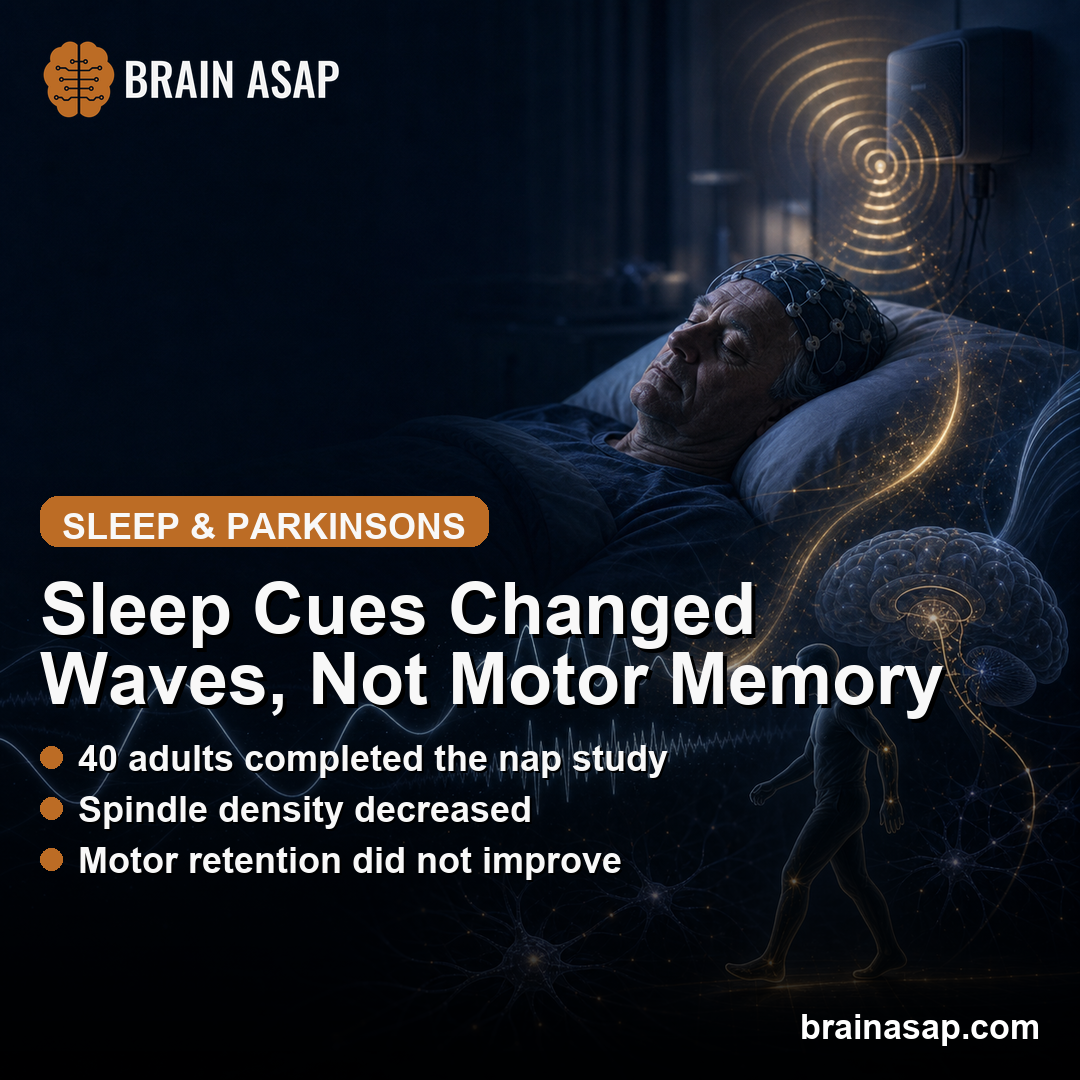
TL;DR: A 2026 medRxiv preprint found that targeted memory reactivation (TMR), replaying learned sounds during non-REM sleep, changed spindle and slow-wave density during a nap but did not improve motor memory retention in Parkinson’s disease or healthy older adults.
Key Findings
- Parkinson’s and healthy older adults were compared: The experiment included 20 people with Parkinson’s disease and 20 healthy older adults.
- TMR used auditory cues: Each person practiced two finger-tapping motor sequences, and only one sequence’s melody was replayed during a 2-hour nap.
- Motor retention did not improve: The reactivated sequence did not show better post-nap or 24-hour retention than the non-reactivated sequence.
- Spindle density decreased: Auditory stimulation periods had lower spindle density than silent periods (BF10 = 13.93; P < 0.01).
- Slow-wave density increased: Auditory stimulation periods had higher slow-wave density than silent periods (BF10 = 3.24; P = 0.01).
Source: medRxiv (2026) | Micca et al.
Targeted memory reactivation (TMR) pairs a sound, smell, or other cue with learning, then replays that cue during sleep. The goal is to nudge the sleeping brain to reactivate the newly learned memory trace.
In Parkinson’s disease, motor learning can be complicated by striatal dysfunction. The researchers tested whether a sleep-based cueing strategy could support motor-sequence consolidation during a daytime nap.
Parkinson’s Participants Practiced Two Finger-Tapping Sequences
The study included 20 people with Parkinson’s disease and 20 healthy older adults. The Parkinson’s group had mild-to-moderate disease severity, with Hoehn and Yahr stages II to III.
Participants practiced two serial reaction time task sequences before the nap. Each sequence was linked to a distinct melody, which made it possible to replay one sequence cue during sleep and leave the other as a within-person control.
- Pre-nap learning: Participants practiced both motor sequences before sleeping.
- Nap intervention: During NREM2 and NREM3 sleep, one melody was replayed in repeated auditory stimulation blocks.
- Follow-up testing: Motor performance was tested immediately after the nap, after 24 hours, and under a dual-task condition.
NREM means non-rapid eye movement sleep. NREM2 and NREM3 are the sleep stages where spindles and slow waves are especially relevant to memory-consolidation models.
TMR Did Not Improve Motor Retention in Parkinson’s Disease
Reaction time and accuracy improved across sessions, but the improvement did not depend on whether a sequence had been reactivated during sleep. The reactivated sequence did not outperform the non-reactivated sequence.
This null result appeared in both groups. People with Parkinson’s disease and healthy older adults showed no TMR-specific advantage for immediate post-nap retention or 24-hour retention.
Dual-task performance also did not benefit from TMR. Adding a working-memory task after the nap and at 24-hour retention did not reveal a hidden automaticity advantage for the cued sequence.
Auditory Cues Reduced Spindle Density and Increased Slow Waves
The sleep physiology result was clearer than the behavior result. During periods with auditory stimulation, spindle density decreased and slow-wave density increased compared with silent sleep periods.
For spindles, the evidence favored a stimulation effect: BF10 = 13.93, F(1,34) = 10.49, and P < 0.01. The effect did not significantly differ between Parkinson’s and healthy older adult groups.
For slow waves, auditory stimulation increased density with BF10 = 3.24, F(1,31) = 6.87, and P = 0.01. Again, the group interaction was not significant.
- Spindles: Brief 12-16 Hz sleep rhythms often linked with memory consolidation.
- Slow waves: Large 0.5-2 Hz non-REM sleep waves that can coordinate memory-related neural events.
- Amplitude: TMR did not significantly change spindle or slow-wave amplitude.
Slow-Wave Amplitude Predicted Accuracy Gains Only in Healthy Older Adults
The researchers also tested whether sleep metrics predicted behavioral changes. Spindle and slow-wave density did not predict post-nap performance changes for the reactivated or non-reactivated sequence.
Slow-wave amplitude during TMR periods was different. In healthy older adults, higher slow-wave amplitude predicted better post-nap accuracy changes for the reactivated sequence, with β = 0.26 and a 95% confidence interval from 0.16 to 0.36.
That relationship was not seen in the Parkinson’s group, where the estimate was negative and not significant. The group-by-slow-wave-amplitude interaction had BF10 = 29.24 and P < 0.01.
Auditory TMR Changed Sleep Physiology Without Improving Motor Retention
The main interpretation is direct: auditory TMR during a 2-hour nap altered non-REM sleep microarchitecture, but the altered sleep physiology did not translate into better motor-sequence retention in this experiment.
The distinction matters for rehabilitation ideas in Parkinson’s disease. A sleep intervention can affect spindles and slow waves without automatically improving motor learning, especially in older adults or clinical populations.
The study does not rule out all sleep-based rehabilitation approaches. It suggests that auditory TMR may need different timing, stimulation parameters, task design, practice dose, or patient selection before it produces a measurable behavioral advantage.
The Parkinson’s TMR Result Is Preliminary
The preprint sample was modest, and not every sleep metric was available for every participant. Spindle-density analyses included 17 people with Parkinson’s and 17 healthy older adults during TMR periods; slow-wave-density analyses included 16 and 17, respectively.
The study used a daytime nap, not overnight sleep, and the task was a specific finger-tapping sequence. Parkinson’s disease is also heterogeneous, so disease stage, sleep symptoms, medication state, and baseline learning ability may influence whether TMR helps.
- No behavioral gain: The main motor-memory result was negative.
- Physiology changed: Auditory cues shifted spindle and slow-wave density.
- Translation unresolved: Better stimulation protocols may be needed before TMR can be considered a rehabilitation add-on.
The useful result is not that TMR improved motor memory. It is that the same auditory cues changed sleep physiology in Parkinson’s disease and healthy aging, giving future studies a measurable sleep target to refine.
Citation: DOI: 10.64898/2026.04.22.26351552. Micca et al. Targeted memory reactivation during sleep modulates spindle and slow wave density, but not motor memory consolidation, in Parkinson’s disease. medRxiv. 2026.
Study Design: Experimental sleep and motor-learning study using auditory targeted memory reactivation during a 2-hour nap.
Sample Size: 20 people with Parkinson’s disease and 20 healthy older adults.
Key Statistic: TMR decreased spindle density (BF10 = 13.93; P < 0.01) and increased slow-wave density (BF10 = 3.24; P = 0.01), but did not improve motor retention.
Caveat: The preprint is not peer reviewed, and the behavioral motor-memory result was negative despite sleep-physiology changes.