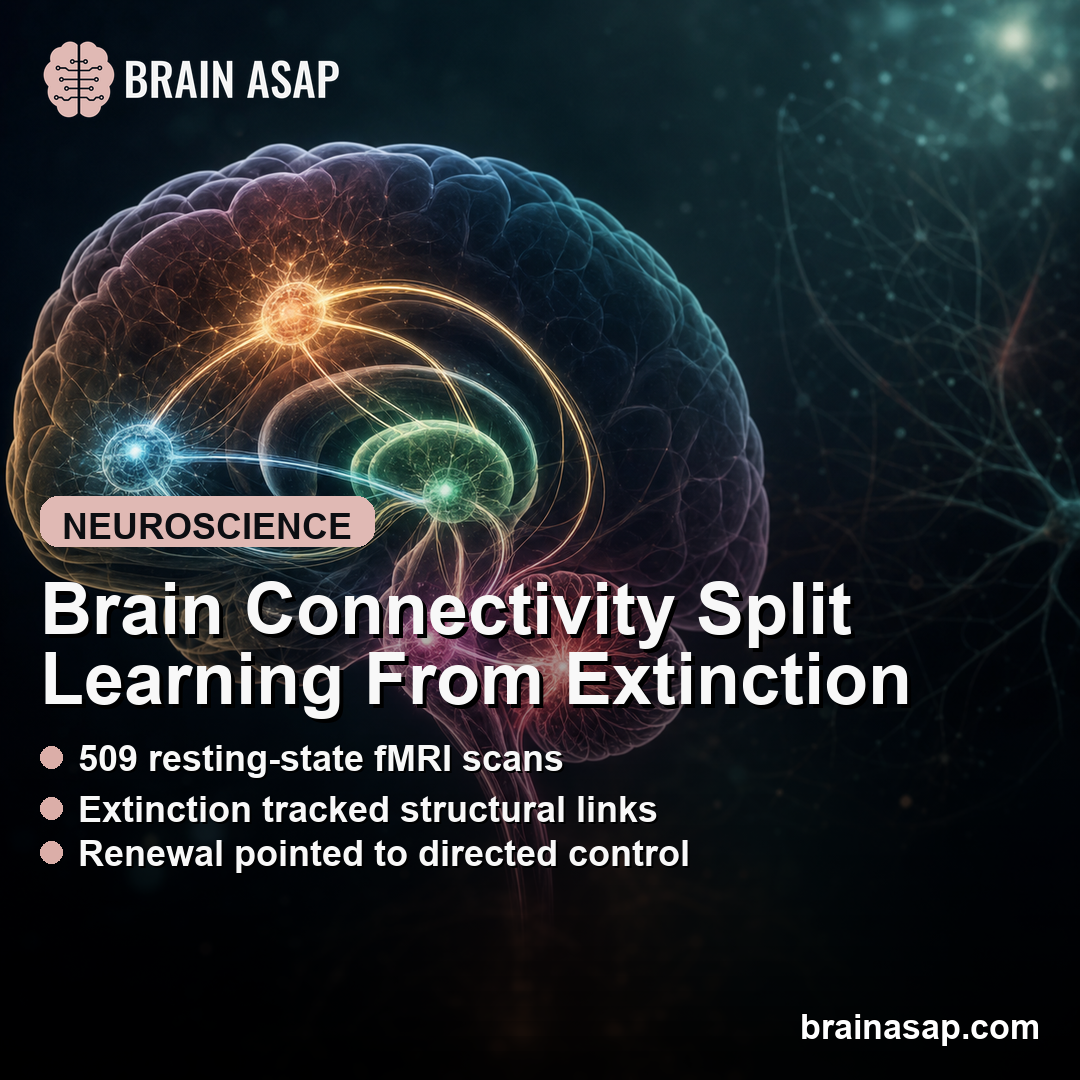
TL;DR: A 2026 study in Nature Communications found that different brain-connectivity measures predicted different parts of associative learning: functional connectivity predicted acquisition, structural connectivity predicted extinction learning, and effective connectivity was most informative for renewal.
Key Findings
- 509 resting-state fMRI scans: Researchers analyzed resting-state functional MRI data from 509 participants across six learning studies.
- 463 diffusion scans: Structural-connectivity modeling used diffusion-weighted imaging data from 463 participants.
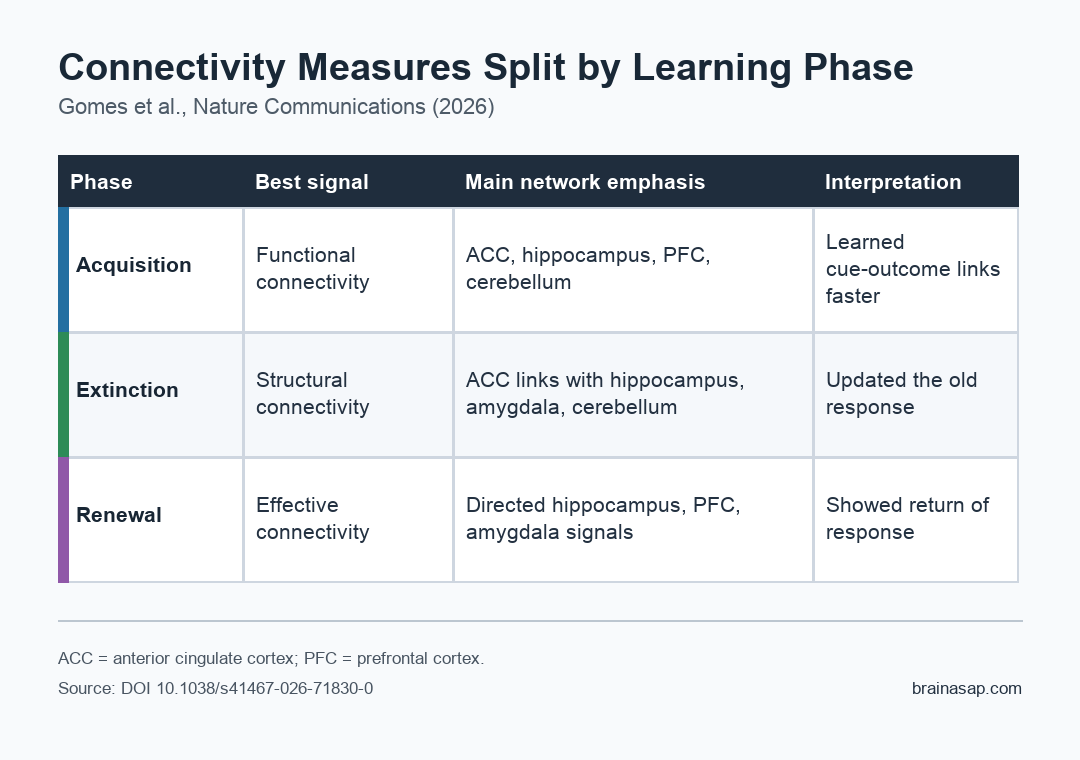
- Functional connectivity: Connections involving the anterior cingulate cortex and hippocampus predicted acquisition, the phase when participants first learned cue-outcome associations.
- Structural connectivity: Extinction learning was most consistently predicted by white-matter connections involving the anterior cingulate cortex, hippocampus, amygdala, and cerebellum.
- Effective connectivity: Renewal, the return of a learned response after extinction, was most sensitive to directed connectivity involving the hippocampus, prefrontal cortex, and amygdala.
Source: Nature Communications (2026) | Gomes et al.
Learning and extinction are not the same brain process wearing different labels. Acquisition means learning that a cue predicts an outcome.
Extinction means learning that the old cue no longer predicts the same outcome. Renewal means the old response can return when the context changes again.
This distinction is clinically relevant for anxiety and other affective disorders because exposure-based treatments depend on extinction learning. If the brain systems that support extinction differ from those that support initial learning, then a one-process explanation of “better learning” misses the clinical problem.
Researchers Combined Fear Learning and Predictive Learning Data
Researchers analyzed a large multicenter dataset from the SFB1280 “Extinction Learning” project. Participants completed variations of fear learning, where cues predicted aversive stimuli such as electric shock or visceral stimulation.
Another group completed cognitive predictive learning, where food cues predicted a stomach-ache outcome.
The imaging dataset included two main MRI streams:
- Resting-state fMRI: 509 participants contributed data for functional connectivity, which estimates how strongly regions fluctuate together.
- Diffusion-weighted imaging: 463 participants contributed data for structural connectivity, which estimates white-matter pathways between regions.
- Effective-connectivity modeling: Researchers used spectral dynamic causal modeling to estimate directed influence between brain regions.
The analysis focused on a core learning network: the amygdala, hippocampus, dorsal anterior cingulate cortex, ventromedial prefrontal cortex, and cerebellar nuclei. These regions are already implicated in fear, context, safety learning, and prediction-error processing.
Functional Connectivity Predicted Acquisition
For acquisition, functional connectivity was the clearest whole-sample predictor. The relevant connections included cerebellum-prefrontal, hippocampus-prefrontal, anterior-cingulate-prefrontal, amygdala-anterior-cingulate, cerebellum-hippocampus, and bilateral hippocampus-anterior-cingulate links.
In plain terms, the brain’s resting communication pattern helped predict who learned cue-outcome associations more strongly. The anterior cingulate cortex and hippocampus appeared repeatedly in the predictive connections, consistent with roles in appraisal, context, and memory formation.
The group-level learning signal was also measurable. In skin-conductance studies, cue responses increased more steeply for reinforced cues during acquisition, with a corrected result of t(4519) = 4.03.
Individual acquisition estimates also exceeded chance in permutation tests.
Extinction Learning Relied More on Structural Connectivity
Extinction showed a different pattern. Researchers did not find significant functional- or effective-connectivity predictors across all paradigms.
Instead, structural connectivity was the most consistent predictor of individual extinction learning.
The strongest extinction-related structural links involved the anterior cingulate cortex:
- Hippocampus to anterior cingulate: This connection links context memory with appraisal and control systems.
- Cerebellum to anterior cingulate: This pathway may matter because the cerebellum helps track prediction errors and timing.
- Amygdala to anterior cingulate: This link connects emotional salience with the circuitry that helps update responses.
Post hoc models pointed to the anterior cingulate cortex as the main hub for structural-connectivity prediction of extinction, with reported region-count comparisons above z > 8 after correction.
That does not make the anterior cingulate a standalone extinction center. Its white-matter connections explained more individual variation than other network nodes in this model.
Directed Connectivity Was Most Informative for Renewal
Renewal is the clinically uncomfortable part of extinction: a response that seemed reduced can return when the context changes. In this study, renewal data came from two of the six experiments, so the evidence base was smaller than for acquisition or extinction.
Even with that narrower dataset, effective connectivity was more informative than functional or structural connectivity for renewal.
The analysis suggested that renewal was stronger when the hippocampus was more disinhibited by the amygdala and prefrontal cortex. Higher prefrontal inhibition of the anterior cingulate was linked to lower renewal.
Leave-one-group-out validation supported the broader split between phases:
- Acquisition: Functional-connectivity prediction generalized best, with r = 0.14 after correction.
- Extinction: Structural-connectivity prediction generalized best, with r = 0.23 after correction.
- Renewal: Effective-connectivity prediction was directionally strongest, with r = 0.12, but it did not survive the same multiple-comparison correction.
The Result Supports Phase-Specific Learning Models
The phase split was specific: different learning phases had different connectivity signatures. Acquisition looked most tied to functional coordination.
Extinction tracked structural pathways, and renewal tracked directed influence between regions.
That phase-specific pattern fits the psychology. Initial learning can depend on how efficiently a network coordinates in the moment.
Extinction may depend more on the anatomical routes available for updating a learned response. Renewal may depend on directional control signals that allow context-linked memory to re-emerge.
For clinical translation, the study points toward individualized exposure-treatment research rather than immediate patient testing. Connectivity profiles might eventually help explain why one person extinguishes fear responses quickly while another person shows relapse-like renewal, but this paper did not test a treatment population.
Large Dataset, But Still a Modeling Study
The design had several strengths: a large combined sample, multiple learning paradigms, harmonized MRI protocols, and cross-paradigm generalization tests. Researchers also tested task-based functional connectivity in a subset of 137 participants, and the selected resting-state predictors explained acquisition performance in that task-fMRI analysis.
The limitations are equally important:
- Different paradigms: Combining fear and cognitive learning improves generality but also adds heterogeneity.
- Renewal sample: Renewal was available in only two studies, so renewal conclusions are less stable than acquisition or extinction conclusions.
- Prediction size: Cross-validated correlations were statistically significant but small, not diagnostic-level biomarkers.
- Clinical gap: The work informs affective-disorder mechanisms, but it does not show that these connectivity measures guide treatment yet.
Still, the study gives a useful map for future work. If researchers want to understand exposure learning, relapse after extinction, or individualized anxiety interventions, they may need to measure acquisition, extinction, and renewal separately instead of treating learning ability as one brain-wide trait.
Citation: DOI: 10.1038/s41467-026-71830-0. Gomes et al. Predicting individual differences of fear and cognitive learning and extinction. Nature Communications. 2026;17:3780.
Study Design: Multicenter neuroimaging and learning-paradigm analysis combining fear learning and cognitive predictive learning experiments.
Sample Size: 509 resting-state fMRI participants and 463 diffusion-weighted imaging participants.
Key Statistic: Functional connectivity generalized best for acquisition (r = 0.14), structural connectivity for extinction (r = 0.23), and effective connectivity was directionally strongest for renewal (r = 0.12).
Caveat: Renewal data came from only two studies, and the predictive effects are research-level signals rather than clinical tests.