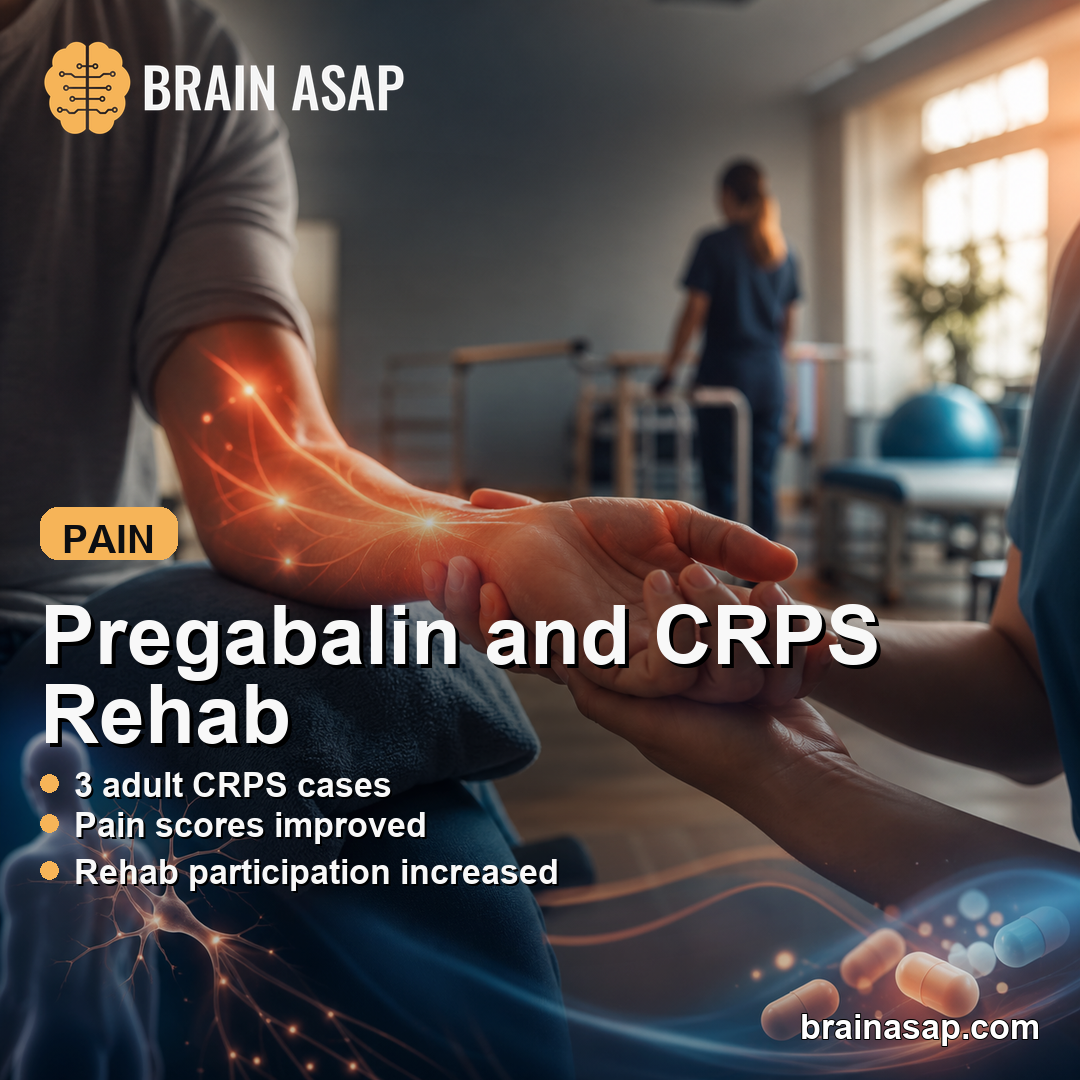
TL;DR: A 2026 study in Journal of Pain Research described 3 adults with type I complex regional pain syndrome (CRPS), a severe neuropathic pain condition with sensory, autonomic, motor, and skin changes, whose pain scores improved after pregabalin and who were then able to participate more fully in rehabilitation.
Key Findings
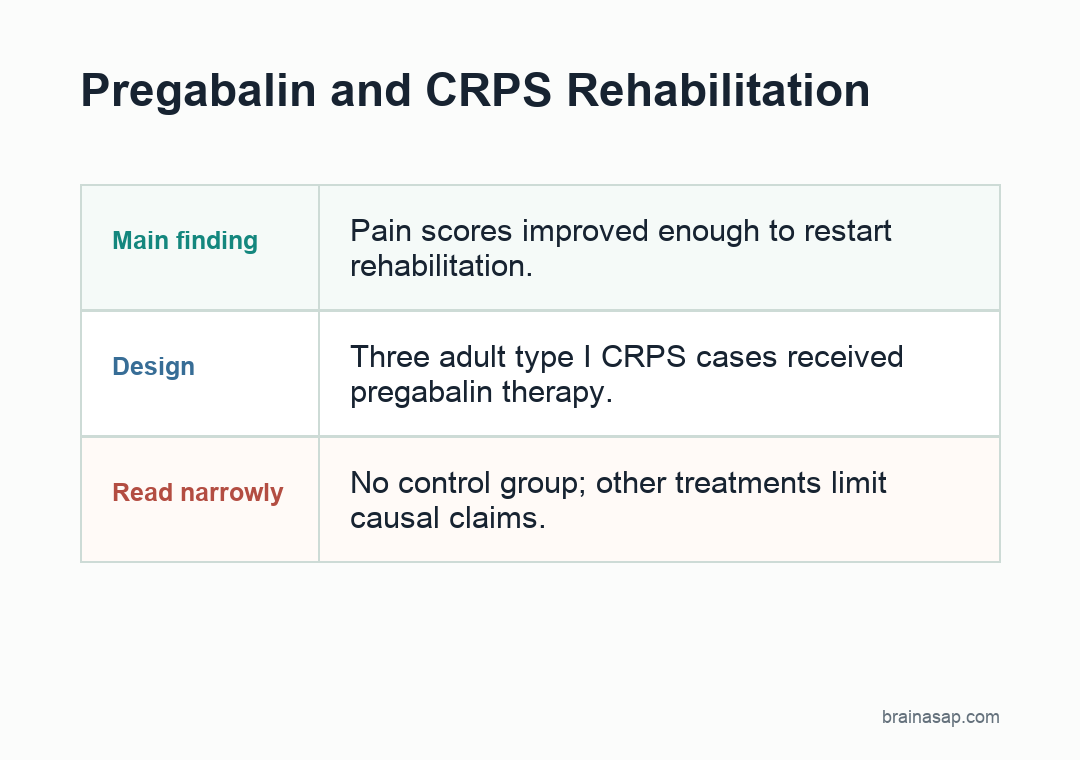
- Case-series evidence: Researchers reported 3 adult type I CRPS cases treated at a Taiwan medical center between 2022 and 2025.
- Neurologic context: The cases followed stroke, thalamic hemorrhage, and cervical myeloradiculopathy after injury and surgery.
- Pain scores: Visual Analog Scale pain scores fell from 9 to 5, 4 to 1, and 6 to 1-2 after pregabalin-based care.
- Rehabilitation link: Lower pain was followed by better tolerance of physical therapy, occupational therapy, weight-bearing work, or daily tasks.
- Main caveat: The report had no control group, only 3 cases, and other treatments were used alongside pregabalin.
Source: Journal of Pain Research, 2026.
Complex regional pain syndrome is not ordinary post-injury pain. CRPS can involve burning or sharp pain, allodynia, swelling, abnormal sweating, color or temperature changes, motor limitation, and trophic skin or nail changes.
Type I CRPS means the syndrome appears without a clearly identifiable nerve injury.
Treatment is often multidisciplinary, and evidence for specific drugs remains thin. The 2026 report focused on pregabalin, a calcium-channel-modulating medicine often used for neuropathic pain, in adults whose CRPS interfered with rehabilitation after neurologic injury.
The clinical question was practical: if pain is too severe for therapy, can pregabalin reduce symptoms enough for patients to move, load, grasp, dress, sleep, and keep working through rehabilitation?
3 Adult CRPS Cases Followed Neurologic Injury
Researchers retrospectively reviewed patients diagnosed with CRPS in the rehabilitation department of Tri-Service General Hospital.
Diagnosis used the Budapest criteria, the clinical framework for CRPS symptoms and signs, and was supported by 3-phase bone scintigraphy.
The cases were clinically different but shared a rehabilitation problem:
- Case 1: a 61-year-old man developed right arm pain and swelling after left basal ganglia and centrum semiovale infarction with right hemiplegia and Broca aphasia.
- Case 2: a 49-year-old woman developed right foot pain, edema, nail atrophy, skin changes, allodynia, and temperature intolerance after left thalamic hemorrhage with right hemiplegia.
- Case 3: an 82-year-old man developed severe right wrist pain and allodynia after cervical spinal injury, myeloradiculopathy, and anterior cervical surgery.
Each patient had pain that limited rehabilitation participation. The point of the report was not simply that pain scores changed. The stronger clinical signal was that lower pain made therapy more usable.
Pain Scores Fell After Pregabalin-Based Care
In Case 1, pregabalin was started at 150 mg/day. The patient’s Visual Analog Scale score, a 0-to-10 pain rating, fell from 9 to 5.
With symptoms reduced, he began physical and occupational therapy for forearm strengthening, stretching, upper-body ergometer work, dressing, and daily activity practice.
6 months later, researchers reported no edema, hyperesthesia, or skin color change in the right hand.
Follow-up bone scintigraphy also showed less prominent tracer uptake in the right shoulder and hand, while the patient described better quality of life and hand function.
In the second case, pregabalin at 75 mg/day was added after persistent sharp pain, temperature intolerance, hyperesthesia, and allodynia. Pain dropped to VAS 1, and she could tolerate more intensive weight-bearing and foot movement training.
The report also described ongoing spasticity management with botulinum injection, so pregabalin was a component of broader rehabilitation care.
In the third case, clinicians initially used pregabalin at 150 mg/day along with tramadol and celecoxib. Pain fell from VAS 6 to 3, then remained around VAS 1-2 after additional pain procedures and medication adjustment.
The patient could continue occupational therapy with tolerable pain and reported better sleep because breakthrough pain interrupted the night less often.
Rehabilitation Was the Clinically Important Outcome
CRPS treatment is not only about making a number on a pain scale smaller. Severe pain can block movement, and blocked movement can worsen disability.
In these cases, the visible functional outcome was rehabilitation adherence.
The report connected pain relief to several concrete therapy gains:
- Upper limb function: the first patient resumed arm and hand work after post-stroke CRPS symptoms eased.
- Weight-bearing tolerance: the second patient could do more right-sided loading and ankle movement training.
- Daily task practice: the third patient tolerated occupational therapy and completed more activities with assistance.
- Sleep quality: nighttime breakthrough pain became less disruptive in the cervical-injury case.
That is the useful way to read a small case series. It does not prove pregabalin should be the first drug for every adult with CRPS.
It shows a plausible treatment pattern where neuropathic pain control helped reopen the rehabilitation window.
The Evidence Is Encouraging but Very Small
The report’s limitations are direct. There were only 3 patients, no comparison group, and no way to separate pregabalin from every other component of care.
Steroid injections, nerve blocks, NSAIDs, baclofen, botulinum injection, tramadol, celecoxib, nerve hydrodissection, tender-point injections, physical therapy, and occupational therapy all appeared in the clinical timelines.
CRPS also varies by trigger, affected limb, time since onset, autonomic features, motor impairment, and psychological burden. A treatment that helps a patient resume therapy may not produce the same response in another patient with longer-standing disease or different medication risks.
The narrow clinical claim is specific: in these adult type I CRPS cases, pregabalin was associated with lower pain scores and better rehabilitation participation, without reported pregabalin-related complications during follow-up.
Larger prospective studies would be needed to test dosing, timing, patient selection, and whether pregabalin adds benefit beyond structured multidisciplinary CRPS care.
Citation: DOI: 10.2147/JPR.S591680. Chang et al. Clinical Outcomes of Pregabalin Therapy in Adults with Type I Complex Regional Pain Syndrome: A Case Series. Journal of Pain Research. 2026;19:591680.
Study Design: Retrospective case series from a single rehabilitation department.
Sample Size: 3 adults with type I complex regional pain syndrome.
Key Statistic: Pain scores fell from VAS 9 to 5, 4 to 1, and 6 to 1-2 after pregabalin-based care.
Caveat: No control group; other treatments were used alongside pregabalin.