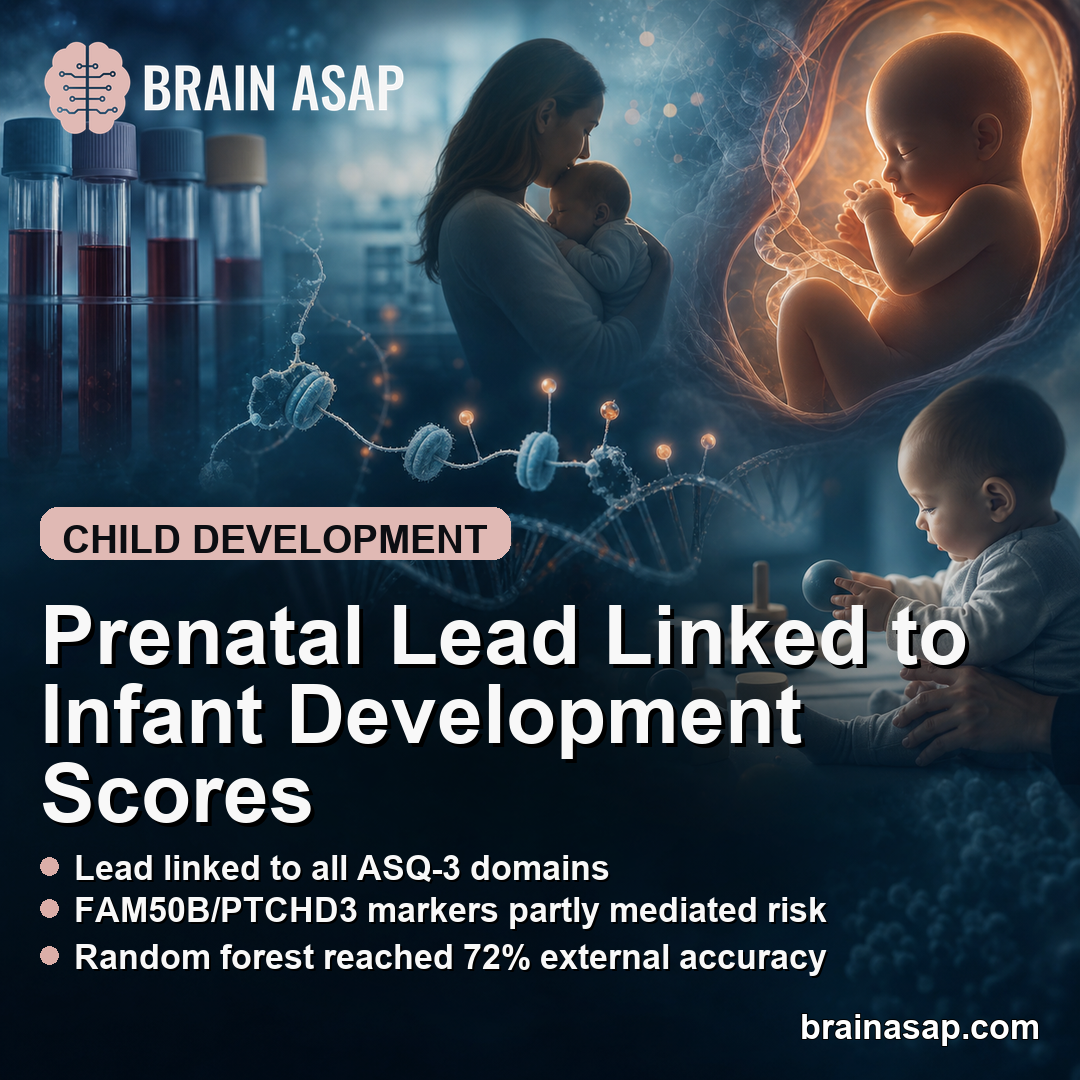
TL;DR: A 2026 birth cohort study in Environment & Health linked low-level prenatal lead exposure to lower infant Ages and Stages Questionnaire (ASQ-3) developmental scores, with FAM50B/PTCHD3 DNA methylation markers explaining part of the association.
Key Findings
- Lead was the clearest metal finding: Among 21 detectable cord-blood metals, lead showed a consistent negative association with all five ASQ-3 developmental domains.
- The cohort followed 353 mother-child pairs: Infants were assessed at 3, 6, 12, 18, 24, and 36 months, with follow-up counts declining from 332 to 249 children.
- Average lead was low: Mean cord-blood lead concentration was 15.3 μg/L, below many older reference thresholds but still tied to worse developmental scores.
- Problem-solving and motor skills stood out: Lead had the strongest mixture-model contribution for problem-solving and also contributed to gross and fine motor scores.
- FAM50B/PTCHD3 markers mattered: Four CpG methylation sites partly mediated the lead-development link, and a random forest model reached 72% external accuracy.
Source: Wan et al. (2026)
Lead exposure is usually discussed as a high-dose public health problem. This study asks a narrower question: whether cord-blood lead levels that were relatively low still tracked with infant development from birth to age 3.
The study did not claim that every child with detectable lead will have developmental delay. It reported a more specific cohort finding: in this sample, higher prenatal lead exposure was associated with lower scores on repeated early-development screens.
Researchers Followed 353 Mother-Child Pairs in Southern China
The study used the Maoming Birth Cohort, a prospective cohort based at Maoming Maternal and Child Health Care Hospital in Guangdong Province, China. Researchers analyzed 353 mother-child pairs with cord-blood metal measurements and DNA methylation data.
Infant development was measured with the Ages and Stages Questionnaire, third edition (ASQ-3), a parent- and clinician-administered screening tool for early developmental domains. The study tracked five domains:
- Communication: Early language, sound, and social communication behavior.
- Gross motor: Larger movement skills such as sitting, crawling, standing, and walking.
- Fine motor: Smaller hand and finger movements used for object handling.
- Problem-solving: Early learning, exploration, and task-response behavior.
- Personal-social: Interaction, self-care, and social-response behavior.
Follow-up was repeated at 3, 6, 12, 18, 24, and 36 months. The number of children with ASQ-3 data at those visits was 332, 324, 307, 291, 270, and 249, respectively.
Lead Was Associated With All Five Developmental Domains
Researchers measured 27 cord-blood metals, of which 21 were detectable. They then tested associations between metal levels and ASQ-3 scores using mixed-effect models adjusted for child sex, maternal education and occupation, household income, and parental smoking and alcohol use.
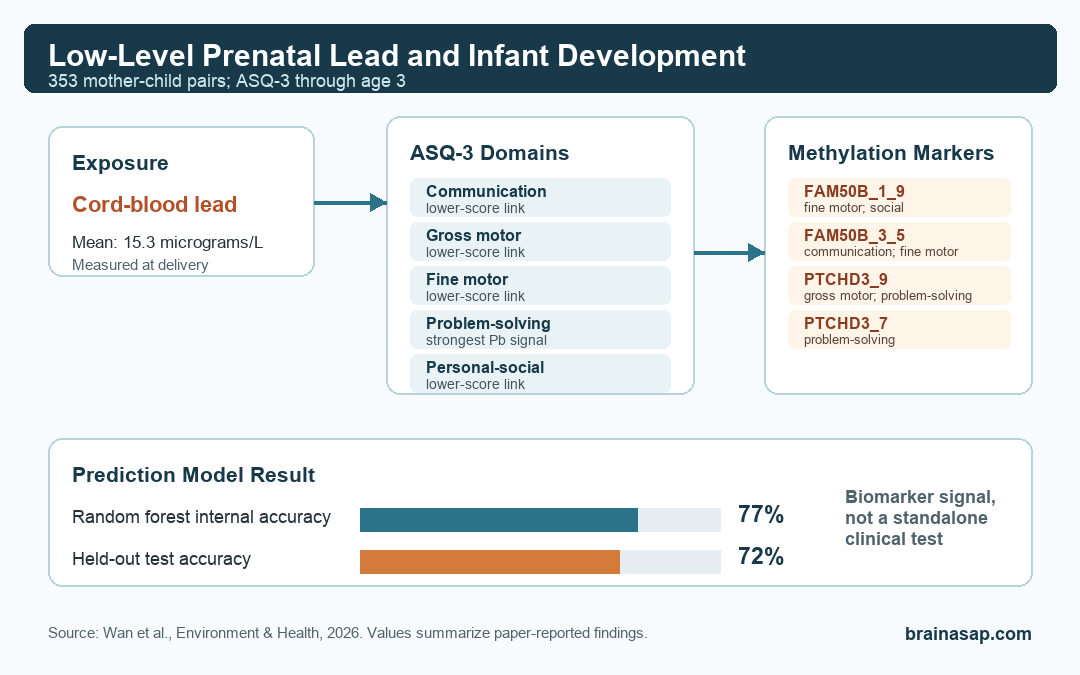
Lead was the most consistent metal finding. The average cord-blood lead concentration was 15.3 μg/L, and higher lead was negatively associated with all five ASQ-3 domains.
Other metals also appeared in parts of the analysis:
- Tin: Negatively associated with communication, gross motor, and fine motor scores in the mixed-effect models.
- Silicon: Negatively correlated with communication and problem-solving scores.
- Uranium: Associated with lower communication, gross motor, and personal-social scores.
- Lead: Carried the broadest pattern across the developmental screen.
The paper’s key point is that the lead pattern appeared even though the mean cord-blood level was below many levels that have historically drawn more attention.
That does not make 15.3 μg/L a clinical cutoff. It means the cohort did not show an obvious safe-looking floor within the measured range.
Mixture Models Pointed to Problem-Solving and Motor Scores
The study did not rely only on one-metal-at-a-time regression. Researchers also used quantile g-computation and Bayesian kernel machine regression (BKMR), two methods used to evaluate chemical mixtures rather than pretending each exposure occurs alone.
In the quantile g-computation model, lead was one of the main contributors to lower developmental scores. It had the strongest contribution for problem-solving and also contributed to gross motor, fine motor, and personal-social scores.
BKMR analysis narrowed the focus to arsenic, lead, tin, and antimony. When the model held other metals at selected quantiles, lead showed negative associations with problem-solving, fine motor, and gross motor outcomes.
The dose-response curves were important because they were described as linear or approximately linear for several outcomes.
In plain terms, the study did not find that lead mattered only after a high threshold. Within this cohort, more lead tended to align with worse developmental scores.
FAM50B/PTCHD3 Methylation Helped Explain Part of the Link
The molecular part of the paper focused on DNA methylation, a chemical marking process that can influence how genes are regulated without changing the DNA sequence itself. Researchers measured methylation at 198 candidate CpG sites in cord-blood DNA.
Two gene regions, FAM50B and PTCHD3, were central because prior work from the group had connected their methylation with lead exposure and children’s IQ. In this infant cohort, lead was significantly associated with many methylation sites, and FAM50B/PTCHD3 again emerged as a main focus.
Mediation analysis identified four CpG sites that partly explained the relationship between blood lead and infant development:
- FAM50B_1_9: Mediated lead associations with fine motor and personal-social scores.
- FAM50B_3_5: Contributed to mediation for communication and fine motor outcomes.
- PTCHD3_9: Mediated associations with gross motor and problem-solving scores.
- PTCHD3_7: Mediated the association with problem-solving scores.
The contribution weights were modest, generally around 4% to 6% for the reported pathways. Methylation was not presented as the whole mechanism.
It was one measurable biological layer that may help connect prenatal exposure with later developmental scores.
Random Forest Performed Best for Predicting Developmental Status
Researchers also tested whether FAM50B/PTCHD3 methylation data could help classify neurodevelopmental status across ages 0-3. They compared 10 machine-learning models, including random forest, support vector machine, logistic regression, neural network, XGBoost, and others.
The random forest model performed best across two checks:
- Internal cross-validation: The model reached 77% accuracy and an 87% area under the curve.
- Held-out test set: Performance was lower but still strongest among the tested models, with 72% accuracy and a 75% area under the curve.
That is not strong enough to treat the methylation panel as a clinical screening test by itself. It is better read as biomarker evidence: the same methylation regions that helped explain part of the lead association also contained some predictive information about developmental status.
Single-Hospital Design Limits the Claim
The clearest limitation is generalizability. This was a single-hospital birth cohort, and follow-up attrition reduced the number of children assessed by 36 months.
Cord blood also reflects a limited exposure window rather than a child’s full lead exposure history.
The researchers adjusted for several social and family factors, but unmeasured environmental exposures could still matter. Particulate matter, PFAS, PAHs, bisphenol A, nutrition, housing conditions, and other metal exposures may influence early neurodevelopment and could not be fully eliminated as alternative explanations.
Practical takeaway: the study supports lower-exposure prevention, not individual diagnosis. Low-level prenatal lead exposure tracked with worse developmental scores in this cohort, but the paper does not prove that a given cord-blood lead value will predict one child’s outcome.
Citation: DOI: 10.1021/envhealth.5c00459. Wan et al. DNA Methylation of FAM50B/PTCHD3 Mediates the Relationships between Low Blood Lead Exposure and Neurobehavioral Development of 0-3 Aged Infants: A Prospective Birth Cohort Study in Southern China. Environment & Health. 2026;4:742-753.
Study Design: Prospective birth cohort analysis of cord-blood metals, targeted DNA methylation, and repeated ASQ-3 developmental screening through age 3.
Sample Size: 353 mother-child pairs; ASQ-3 follow-up counts ranged from 332 children at 3 months to 249 children at 36 months.
Key Statistic: Mean cord-blood lead was 15.3 μg/L, lead was negatively associated with all five ASQ-3 domains, and the best methylation model reached 72% external accuracy.
Caveat: The study was observational, single-hospital, and based on cord-blood exposure rather than lifetime lead exposure, so it cannot prove individual-level causation.