TL;DR: A 2026 medRxiv preprint reported that closed-loop subgaleal intersectional short-pulse stimulation reduced seizure duration and rapidly lowered seizure incidence in a small first-in-human treatment-resistant epilepsy study.
Key Findings
- Subgaleal implantation reached 13 patients: Researchers enrolled 15 adults, 2 withdrew before implantation, and 13 underwent subgaleal electrode implantation and inpatient monitoring.
- 2,283 hours of video-EEG were recorded: The study collected 127 patient-days of inpatient monitoring data during the proof-of-concept protocol.
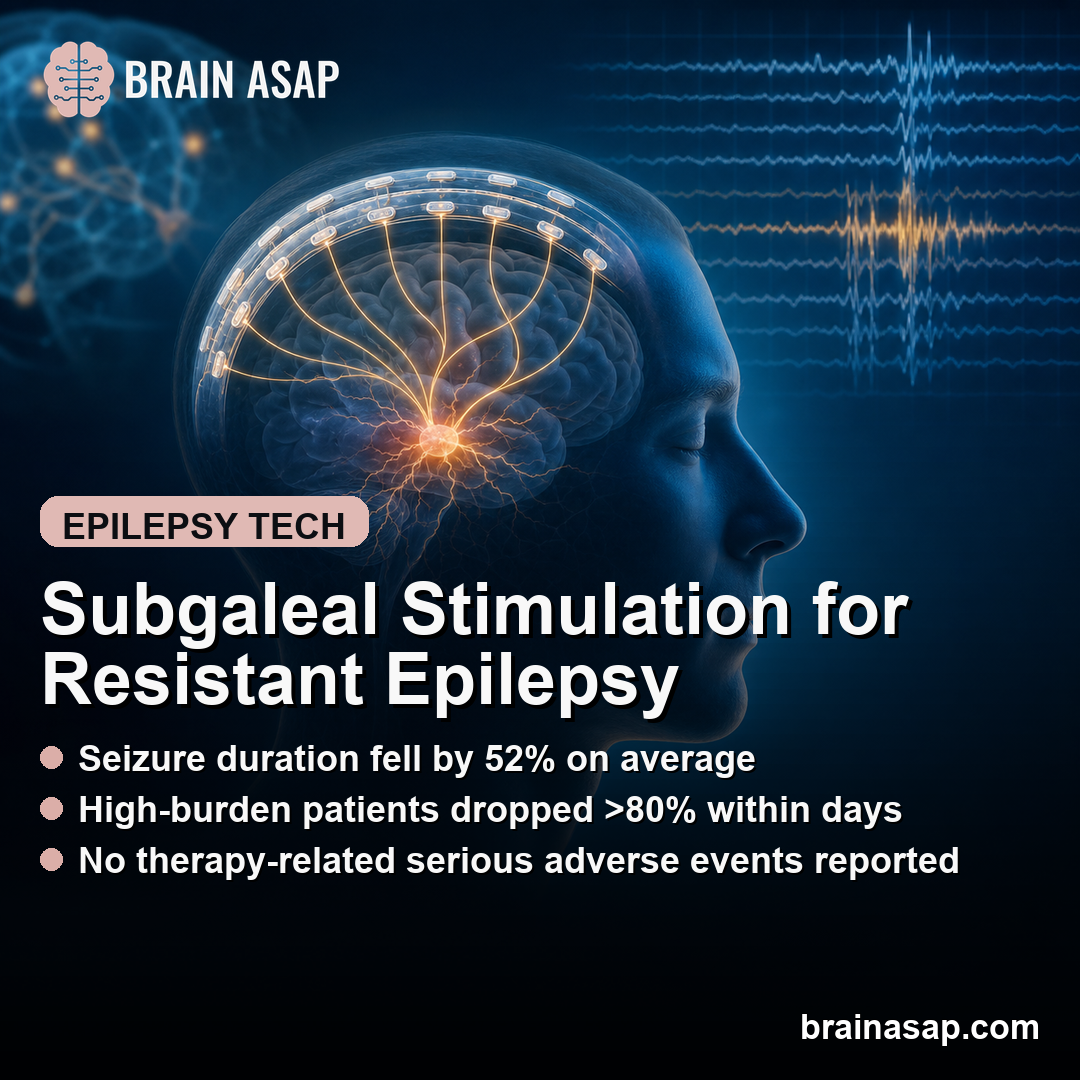
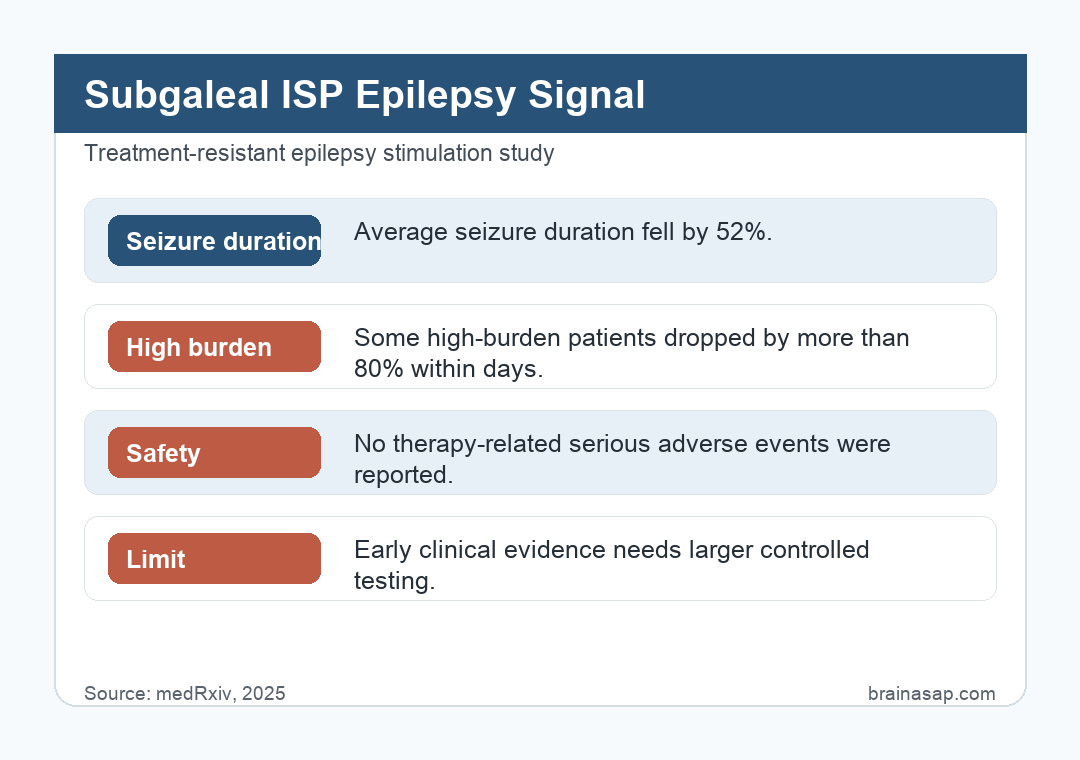
- Ictal stimulation shortened seizures: Intersectional short-pulse stimulation during seizures reduced seizure duration by an average of 52% and inhibited secondary generalization.
- Daily seizure incidence fell in 5 high-burden patients: Among patients with multiple daily seizures, closed-loop stimulation reduced seizure incidence by more than 80% within days of treatment.
- No therapy-related serious adverse events were reported: Two Grade 3 events occurred, but researchers attributed them to antiseizure-medication tapering and urinary infection, not to the implant or stimulation.
Source: Chadaide et al. medRxiv. 2026.
Treatment-resistant epilepsy leaves many patients outside the cleanest surgical options. Medications do not fully control seizures, resection may be unsafe or ineffective, and implanted neurostimulation can require hardware under the skull or deep in the brain.
This preprint tested a different route: place electrode strips under the scalp, detect seizure activity in real time, and deliver brief distributed pulses designed to interfere with the seizure before it spreads.
Subgaleal ISP Stimulation Targeted Seizures From Outside the Skull
Subgaleal electrodes sit beneath the scalp but outside the skull. That placement is less invasive than electrodes placed inside the brain or directly on the cortex, while still giving the system access to seizure-related electrical activity.
The stimulation method was called intersectional short-pulse (ISP) stimulation. In plain terms, ISP uses ultra-brief pulses distributed across electrode contacts so the electric field can be shaped toward a planned target while limiting stimulation of surrounding tissue.
The system also used closed-loop detection. Instead of stimulating continuously on a fixed schedule, the device monitored electroencephalographic activity and delivered stimulation when seizure activity was detected.
Epilepsy neurostimulation has three separate engineering problems:
- Timing: stimulation needs to engage early enough to interrupt seizure activity.
- Targeting: the electrical field needs to reach the seizure network without adding avoidable tissue injury or intolerable side effects.
- Invasiveness: many patients need options that do not require deep brain or intracranial implantation.
Thirteen Implanted Patients Produced 127 Patient-Days of Monitoring
Researchers enrolled 15 adults with therapy-resistant epilepsy between November 2021 and September 2025. Two withdrew before implantation.
The remaining 13 patients were implanted and monitored during inpatient evaluation. Across the study, researchers recorded 2,283 hours of video-EEG across 127 patient-days.
12 patients completed the experimental protocol. One measurement ended early because of cable breakage during ictal confusion, and another patient was excluded from efficacy analysis because identifiable ictal EEG waveforms were lacking.
Most participants had intractable focal epilepsy. A pair of patients had Lennox-Gastaut syndrome, a severe epilepsy syndrome involving multiple seizure types and difficult treatment decisions.
Ictal ISP Stimulation Reduced Seizure Duration by 52%
The main acute result was a shorter seizure. When ISP stimulation was delivered during ictal activity, seizure duration fell by an average of 52%.
Researchers also reported that stimulation changed spectral content and inhibited secondary generalization. In practical language, the electrical seizure activity was not only shorter; it also appeared less likely to spread into a broader generalized event.
The paper described the strongest incidence analysis in the subgroup with frequent daily seizures. In 5 high-burden patients, seizure incidence progressively decreased after closed-loop stimulation began.
The reported median incidence reductions were large:
- After 24 hours: seizure incidence was down by 55.8%.
- After 48 hours: seizure incidence was down by 80.9%.
- After 72 hours: seizure incidence was down by 96.0%.
Three of the high-burden patients had at least one full day of seizure freedom before explantation. The other two showed marked reductions and a trend toward seizure freedom.
Safety Looked Feasible During Short Inpatient Use
Safety was the first boundary for this kind of device study. Researchers reported 50 Grade 1 and 26 Grade 2 adverse events during the 127 experimental days.
Two Grade 3 adverse events occurred: psychosis related to antiseizure-medication tapering and fever from urinary infection. The study team reported both as unrelated to the subgaleal implantation procedure or ISP stimulation.
No therapy-related serious adverse events were reported, and no Grade 4 or Grade 5 adverse events occurred. All adverse events resolved either spontaneously or after treatment.
Patient comfort was also measured. Perception limits averaged 8.1 mA, while tolerability thresholds averaged 28.2 mA.
Stimulation intensity strongly correlated with visual analog discomfort scores, giving the system a measurable comfort boundary for future dosing.
The Preprint Is Promising, but Not Practice-Changing Yet
This was a first-in-human proof-of-concept study, not a definitive efficacy trial. The sample was small, the inpatient exposure was short, and antiseizure-medication tapering during presurgical evaluation could influence seizure frequency.
The stimulation workflow also had practical limits. To reduce false-positive detections, most seizures used semi-automatic stimulus delivery, which introduced timing delays that may have reduced efficacy in some cases.
The next version will need to answer several questions:
- Durability: whether seizure reductions persist during longer outpatient use.
- Automation: whether faster machine-learning detection improves early stimulation and reduces missed seizures.
- Comparative benefit: how subgaleal ISP performs against existing vagus nerve, responsive, and deep brain stimulation approaches.
- Patient selection: which seizure types, seizure-onset zones, and epilepsy syndromes benefit most.
The preprint is therefore best read as an engineering and safety signal. A minimally invasive closed-loop system appeared able to detect and disrupt seizure activity quickly in a small inpatient cohort.
For people with treatment-resistant epilepsy, this approach could widen the treatment space. Future neurostimulation may not need to choose between invasive precision and noninvasive reach; a subgaleal closed-loop approach might eventually occupy the space between them.
Citation: DOI: 10.1101/2025.09.27.25334859. Chadaide et al. Closed-Loop, Subgaleal Intersectional Short-Pulse Stimulation for the Treatment of Therapy-Resistant Epilepsy in Adults. medRxiv. 2026.
Study Design: First-in-human proof-of-concept clinical study of closed-loop ISP stimulation delivered through implanted subgaleal electrode strips during inpatient monitoring.
Sample Size: 15 enrolled adults; 13 implanted and monitored; 2,283 hours of video-EEG recorded across 127 patient-days.
Key Statistic: Ictal ISP stimulation reduced seizure duration by an average of 52%; in 5 patients with multiple daily seizures, incidence fell by more than 80% within days.
Caveat: Preprint evidence from a small short-term inpatient protocol; the study was not powered to establish long-term outpatient efficacy or rare adverse events.