TL;DR: A 2026 study in Journal of Applied Social Psychology found that women with strong feminist identification criticized idealized beauty images more sharply, but that critique did not protect their momentary body satisfaction after seeing the images.
Key Findings
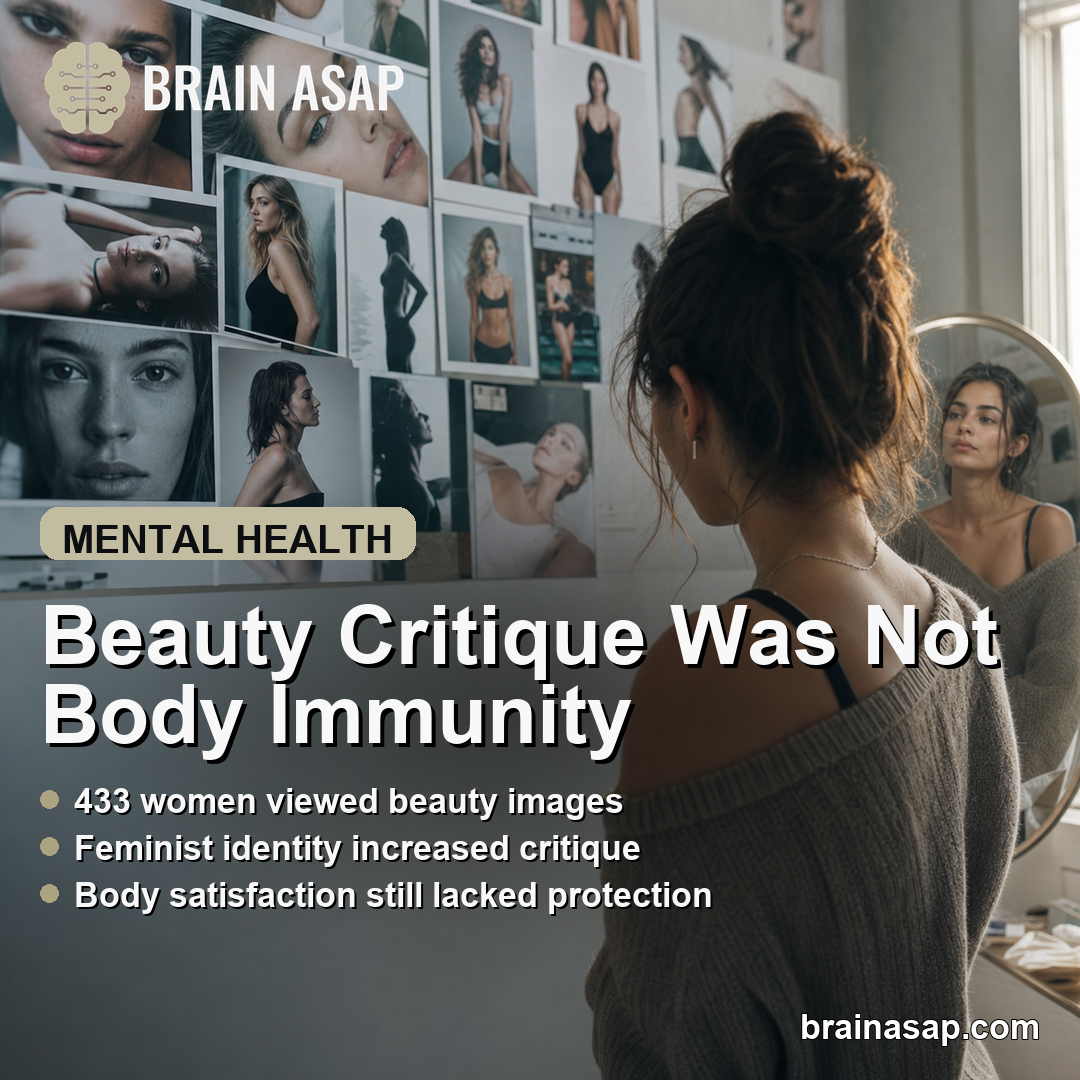
- Media exposure: 433 women viewed either 15 idealized model images or a matched set of more diverse, non-idealized images.
- Immediate reaction: idealized images lowered empowerment and increased feelings such as nervousness, unattractiveness, and appearance-change motivation.
- Feminist identification: women high in feminist identity showed stronger anger at unfair beauty standards and stronger motivation to challenge them.
- Body-image gap: feminist identity did not produce higher state body satisfaction or stronger body appreciation after image exposure.
- Main caveat: the study measured short-term reactions in an online experiment, so it cannot prove long-term protection or causality.
Source: Journal of Applied Social Psychology (2026) | Tenn et al.
Body-image research often separates two questions that feel connected in everyday life. A person can know that idealized beauty images are unrealistic and still feel worse after looking at them.
This experiment tested that split directly. Researchers asked whether feminist identification, a social identity built around resisting unequal gender norms, helped women reject narrow beauty standards without absorbing the personal sting of comparison.
Idealized Images Still Moved Mood and Self-Evaluation
The media manipulation was straightforward. Women were randomly assigned to view one of two image sets, then reported their emotions, beliefs about beauty, and feelings about their own bodies.
The idealized-image condition showed 15 models who fit a conventional beauty ideal: young, thin, and blemish-free. The comparison condition showed matched but more diverse images, including fuller bodies, visible skin conditions, and older faces.
The contrast separated abstract opinion from immediate response. Researchers measured reactions after a short exposure to a familiar media format.
After viewing idealized images, participants reported a less favorable immediate state:
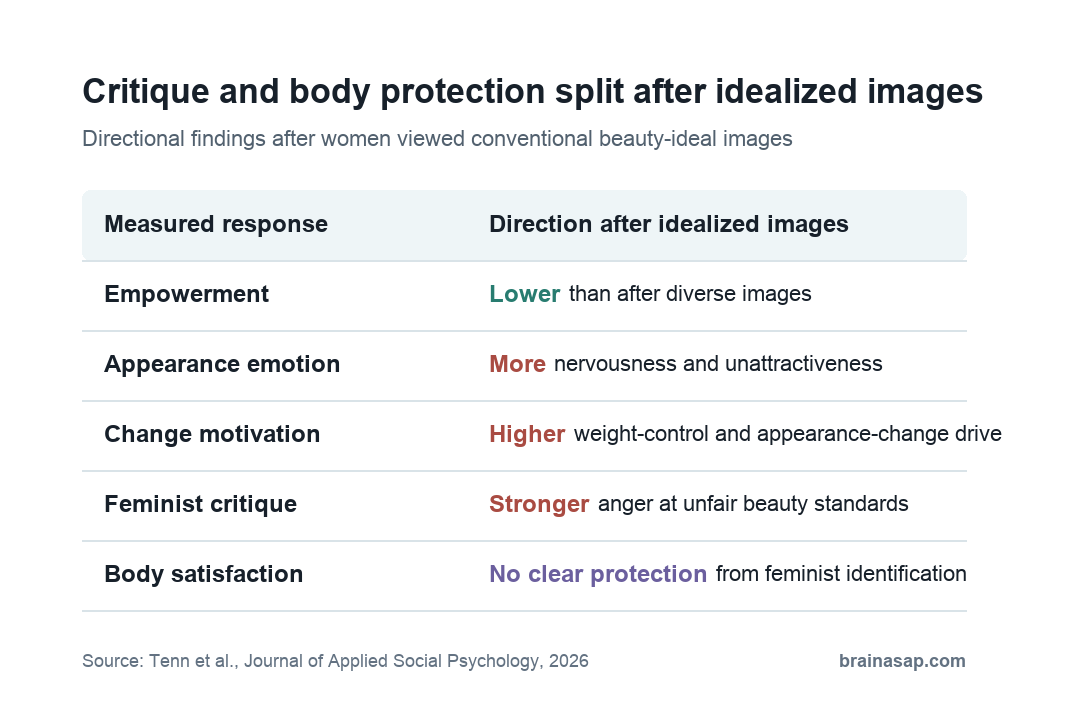
- Lower empowerment: the conventional images left women feeling less empowered than the more diverse images did.
- More negative appearance emotion: participants reported more nervousness and unattractiveness after idealized exposure.
- More change motivation: idealized images increased immediate motivation for weight-control behavior and appearance alteration.
Those outcomes fit a large body of work on social comparison. The image does not have to persuade someone intellectually before it affects mood.
A quick comparison can still change how a person feels in the moment.
Feminist Identity Increased Critique of the Images
The feminist-identity result was not a simple failure. In one domain, feminist identification worked as expected.
Women with stronger feminist identification reacted to conventional beauty images with more anger and annoyance at the unfairness of the portrayal. They were also more motivated to challenge narrow beauty standards and endorse broader definitions of physical attractiveness.
The researchers were not asking whether feminism changes cultural perception at all. The data suggest it did.
Strong feminist identification helped participants see the media message as unfair, manipulative, or socially harmful rather than natural.
Cultural resistance and personal immunity were not the same psychological outcome.
Body Satisfaction Did Not Get the Same Protection
When researchers looked at momentary body image, feminist identity did not show the same protective pattern. High feminist identification was not linked with higher state body satisfaction, meaning how satisfied participants felt with their bodies right after the exposure.
It also did not translate into stronger body appreciation in the immediate aftermath. In some analyses, women high in feminist identity made less favorable comparisons between themselves and the idealized models.
Rejecting the social standard does not automatically stop the standard from becoming a comparison target.
That distinction is important for mental-health messaging. Telling people to critique unrealistic media can be useful, but it may not be enough if the intervention stops there.
Identification With Women Added Another Vulnerability Signal
The study also measured how strongly participants identified with women as a broader social group. This was separate from feminist identification.
Participants high in identification with women appeared more vulnerable to the conventional images on one appearance-change outcome. After idealized exposure, they were more likely to endorse the idea of cosmetic surgery for themselves.
The researchers also tested a more specific identity pattern:
- Dual identifiers: women high in both feminist identity and identification with women.
- Distinctive feminists: women high in feminist identity but lower in identification with women as a broad category.
- Tentative subgroup result: distinctive feminists seemed to hold broader beauty concepts, but the difference weakened after stricter statistical correction.
That means the subgroup finding should stay tentative. It is a starting point for future research, not a firm clinical or cultural rule.
The Result Points to Two Different Intervention Targets
The study argues against a comforting but incomplete idea: if someone has the right political or cultural critique, the personal comparison should lose its force.
For body image, the target may need to be more specific. Media-literacy work can teach people to spot unrealistic standards, while body-image interventions may also need to train self-compassion, reduce comparison habits, and change the personal meaning of appearance evaluation.
This is especially relevant for adolescents and young adults, where social comparison can be intense and repeated. A one-time reminder that images are unrealistic may not undo years of exposure to thinness, youth, flawlessness, and ranking by appearance.
What the Study Can and Cannot Show
The design supports a short-term exposure claim. Researchers can compare reactions after idealized versus diverse images because participants were randomly assigned to image condition.
The identity analyses are more limited. Feminist identification was measured, not randomly assigned, so the study cannot prove that developing a feminist identity causes a particular body-image reaction.
Other limits are also important:
- Sample profile: participants tended to score relatively high on the identity measures, which can make lower-identity comparisons harder to estimate.
- Online setting: the exposure was brief and experimental, not the same as months or years of social-media use.
- Outcome timing: the study measured immediate emotional and body-image reactions, not eating-disorder risk or long-term mental health.
A person can recognize a beauty standard as unfair and still feel pulled into comparison after seeing it.
For prevention work, that means cultural critique and personal body-image protection should be treated as related but distinct goals.
Citation: DOI: 10.1111/jasp.70055. Tenn JJ, Goclowska MA, Atkinson MJ. Feminists Resist Unrealistic Beauty Standards but Are Not Invulnerable to Their Negative Consequences. Journal of Applied Social Psychology. 2026.
Study Design: Online image-exposure experiment with measured identity moderators.
Sample Size: 433 women.
Key Statistic: Participants viewed 15 idealized model images or a matched set of diverse, non-idealized images.
Caveat: The study measured immediate reactions and correlational identity patterns, not long-term body-image resilience.