TL;DR: A 2026 randomized trial in Scientific Reports found that adding esketamine to sufentanil patient-controlled analgesia lowered short-term postoperative depression and anxiety scores in elderly colorectal cancer surgery patients, without improving pain scores or increasing adverse events.
Key Findings
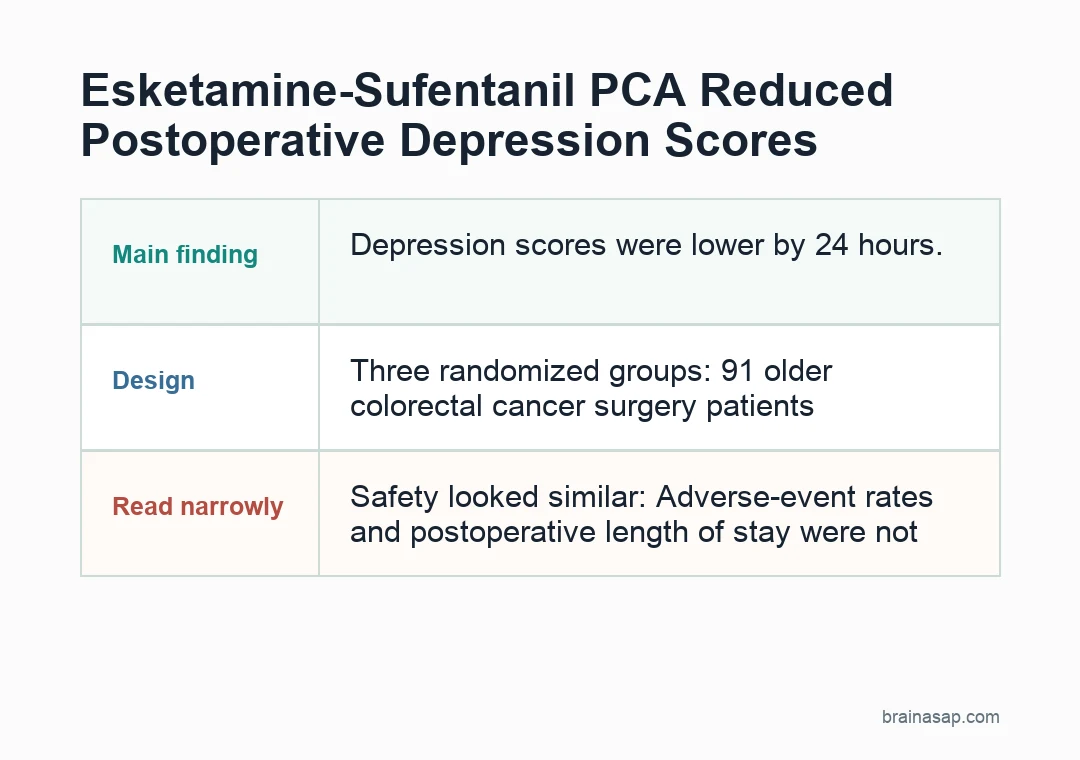
- Three randomized groups: 91 older colorectal cancer surgery patients completed follow-up after assignment to sufentanil alone, sufentanil plus esketamine 1 mg/kg, or sufentanil plus esketamine 2 mg/kg.
- Depression scores were lower: Hamilton Depression Rating Scale (HAMD-17) scores at 24 hours were 9.9 with sufentanil alone, 6.2 with 1 mg/kg esketamine, and 7.1 with 2 mg/kg esketamine.
- Anxiety scores moved similarly: Hamilton Anxiety Rating Scale (HAMA) scores at 24 hours were 7.8 in the control group, 4.3 in the 1 mg/kg group, and 5.1 in the 2 mg/kg group.
- Pain scores did not explain the mood result: Resting pain, activity pain, and PCA bolus demands did not differ significantly across groups.
- Safety looked similar: Adverse-event rates and postoperative length of stay were not significantly different, but the study was small and followed mood for only 72 hours.
Source: Ding et al. tested whether esketamine added to postoperative analgesia changed acute mood scores after colorectal cancer surgery in older adults.
Postoperative mood symptoms are not the same as a long-term diagnosis of major depression.
This trial focused on acute postoperative depressive state, meaning elevated depression symptoms measured during the first few days after surgery.
The primary outcomes were brief clinical rating scales, not a two-week psychiatric diagnosis.
Researchers measured HAMD-17, a 17-item depression-symptom scale, and HAMA, an anxiety-symptom scale, before surgery and again at 24 and 72 hours after surgery.
Esketamine Was Tested as a Mood-Active Analgesia Add-On
The trial enrolled elderly patients undergoing elective radical surgery for colorectal cancer. All three groups received sufentanil patient-controlled analgesia, a postoperative opioid infusion patients can supplement with button-activated doses.
Researchers then compared two esketamine doses against placebo:
- Control: Sufentanil 2 micrograms/kg plus saline placebo.
- ES1: Sufentanil plus esketamine 1 mg/kg.
- ES2: Sufentanil plus esketamine 2 mg/kg.
The design was double-blind, meaning patients, anesthesiologists, and outcome assessors were kept unaware of treatment assignment. The trial planned for 99 participants and reported final analyzed groups of 30 control patients, 31 ES1 patients, and 30 ES2 patients.
Esketamine is the S-enantiomer of ketamine and acts mainly through NMDA receptor antagonism. In depression research, this drug class is studied because it can influence glutamate signaling, synaptic plasticity pathways, and mood symptoms faster than conventional antidepressants.
Depression Scores Increased After Surgery With Sufentanil Alone
The clearest difference appeared in HAMD-17 depression scores. At baseline, groups were not statistically different. After surgery, the control group moved upward, while both esketamine groups moved downward.
At 24 hours, mean HAMD-17 scores were:
- Sufentanil alone: 9.9, up from 6.8 before surgery.
- Esketamine 1 mg/kg: 6.2, down from 8.0 before surgery.
- Esketamine 2 mg/kg: 7.1, down from 8.0 before surgery.
The between-group result at 24 hours was statistically significant, with the 1 mg/kg group lower than control at p < 0.001 and the 2 mg/kg group lower than control at p = 0.004.
By 72 hours, the same pattern remained. The control group averaged 9.0, while the 1 mg/kg and 2 mg/kg esketamine groups averaged 5.2 and 5.6. Both esketamine groups differed from control at p < 0.001.
Anxiety Scores Also Improved in Both Esketamine Groups
HAMA anxiety scores followed a similar pattern. Baseline means were close across groups: 5.7 in control, 5.8 in ES1, and 6.2 in ES2.
At 24 hours after surgery, HAMA scores were 7.8 with sufentanil alone, 4.3 with esketamine 1 mg/kg, and 5.1 with esketamine 2 mg/kg. Both esketamine groups were lower than control at p < 0.001.
At 72 hours, scores remained lower in the esketamine groups: 7.4 in control, 3.7 in ES1, and 4.4 in ES2. Again, both pairwise comparisons against control were significant.
The result does not show a dose-response advantage for the higher esketamine dose.
In the study’s own comparisons, 1 mg/kg and 2 mg/kg did not differ significantly. If future trials confirm similar benefit with fewer dose-related concerns, the lower dose may be the more practical perioperative option.
Pain Scores Did Not Account for the Mood Difference
A simple interpretation would be that patients felt less depressed because they had less pain. The trial did not support that explanation.
Resting pain scores fell over time in all groups, but there was no significant group effect. Activity pain scores also changed over time without a meaningful difference between treatment groups.
PCA bolus demands were similar as well:
- Control: 4.69 demands on average.
- Esketamine 1 mg/kg: 4.16 demands on average.
- Esketamine 2 mg/kg: 5.77 demands on average.
The bolus-demand comparison was not significant. Researchers also reported no significant correlation between 24-hour pain scores and 24-hour HAMD scores in the total sample.
The finding is therefore more specific: esketamine was linked to lower short-term mood scores without clear evidence that the mood shift was just better analgesia.
Safety and Satisfaction Need a Small-Trial Reading
Adverse events were not significantly different across groups. At 24 hours, adverse events occurred in 26.7% of control patients, 22.6% of ES1 patients, and 16.7% of ES2 patients. At 48 hours, the corresponding rates were 20.0%, 3.2%, and 10.0%.
Postoperative length of stay also did not differ significantly. Mean stays were 8.67 days in control, 8.80 days in ES1, and 9.85 days in ES2.
Patient satisfaction favored esketamine. The share reporting “very satisfied” was 50.0% with sufentanil alone, 77.4% with 1 mg/kg esketamine, and 90.0% with 2 mg/kg esketamine.
Three limits should stay visible:
- Acute endpoint: Mood was tracked for 72 hours, so the study cannot show durable antidepressant protection.
- Single setting: Patients came from one hospital and one surgery context.
- Scale-based outcome: HAMD-17 and HAMA scores measure symptoms, not a confirmed psychiatric diagnosis.
In this small randomized trial, esketamine-sufentanil PCA looked better than sufentanil alone for early postoperative mood symptoms in elderly colorectal cancer surgery patients, while pain control and safety measures looked broadly similar.
Citation: DOI: 10.1038/s41598-026-49287-4. Ding et al. Esketamine-sufentanil PCA reduces postoperative depression state in elderly colorectal cancer patients: a randomized controlled trial. Scientific Reports. 2026.
Study Design: Prospective double-blind randomized controlled trial.
Sample Size: 91 elderly colorectal cancer surgery patients completed analyzed follow-up across three groups.
Key Statistic: HAMD-17 depression scores at 24 hours were 9.9 with sufentanil alone, 6.2 with esketamine 1 mg/kg, and 7.1 with esketamine 2 mg/kg.
Caveat: The endpoint was an acute postoperative depressive state measured over 72 hours, not a long-term clinical diagnosis of depression.