TL;DR: A 2026 study in Journal of Macromarketing found that middle-aged women who were more satisfied with available clothing options reported better mental well-being, partly because they were less likely to avoid social situations over appearance distress.
Key Findings
- Study sample: 252 UK women ages 38 to 67 completed surveys on clothing satisfaction, well-being, aging anxiety, and appearance-related anxiety.
- Main association: higher satisfaction with fashion clothing choices predicted higher overall mental well-being.
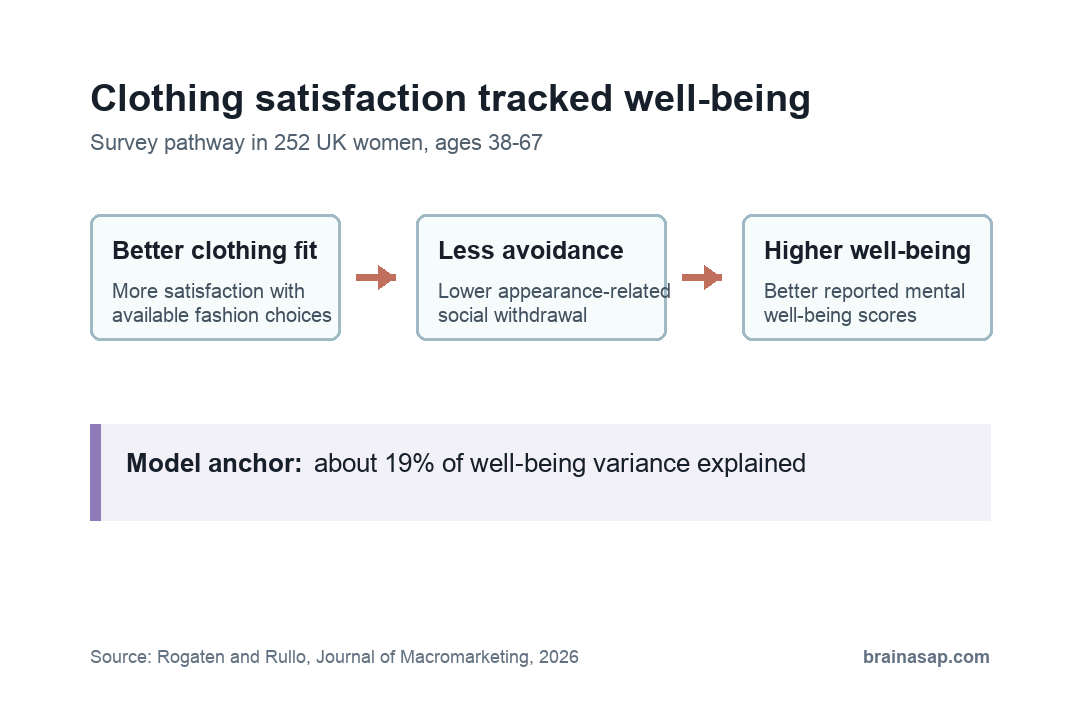
- Model fit: the researchers’ model explained about 19% of the variance in well-being scores.
- Social pathway: lower social avoidance partly explained why clothing satisfaction tracked better well-being.
- Main caveat: the cross-sectional, mostly white UK sample cannot prove causality or represent all midlife women.
Source: Journal of Macromarketing (2026) | Rogaten and Rullo
Clothing fit can look like a consumer issue from the outside. For the person wearing the clothes, it can also become a daily social-confidence issue.
This survey study focused on middle-aged women, a group the researchers argue is often under-served by youth-centered fashion markets. The question was whether satisfaction with available clothing choices related to mental well-being, appearance anxiety, and social participation.
Fashion Satisfaction Was Treated as a Well-Being Variable
The study did not frame clothing as vanity. It treated fashion access as part of self-presentation, identity, and social participation.
Midlife makes that distinction concrete. Body shape, work roles, family roles, menopause, and social expectations can all change how clothing fits and what clothing needs to do.
Researchers measured whether women could find brands and garments that matched their style preferences, bodies, and daily needs. They then compared that satisfaction with measures of well-being and appearance-related anxiety.
The survey covered several connected domains:
- Fashion satisfaction: whether available clothing options felt suitable and appealing.
- Mental well-being: broad positive functioning, optimism, and day-to-day psychological state.
- Aging anxiety: worry or distress about looking older.
- Appearance-related anxiety: threat monitoring and social avoidance tied to looks.
Threat monitoring means repeated checking for appearance flaws. Social avoidance means skipping events or interactions because appearance distress feels too high.
The Survey Included 252 Middle-Aged UK Women
Researchers collected responses from 252 women living in the United Kingdom. Participants were 38 to 67 years old, with an average age of about 53.
The sample was mostly white, and many participants were employed in managerial or skilled roles. That sample profile limits how cleanly the results transfer to women in different countries, income groups, cultural settings, or body-size contexts.
The researchers combined standardized questionnaires with an open-ended response. That allowed the study to capture both statistical associations and concrete shopping frustrations.
Clothing Satisfaction Predicted Better Well-Being
The main statistical result was that women who felt more satisfied with their fashion choices reported higher overall well-being.
The model explained about 19% of the variance in well-being scores. That percentage does not say clothing explains one-fifth of mental health.
It means the variables in the model captured a meaningful slice of differences in reported well-being within this sample.
The strongest practical explanation involved social participation. Women who could find clothing that felt suitable were less likely to avoid social situations because of appearance distress.
Lower social avoidance partly explained the link between clothing satisfaction and well-being. The daily-life mechanism is plain: poorly fitting or unsuitable clothing can make social interaction harder, while suitable clothing can remove one source of withdrawal.
That pathway is modest, but it connects a retail problem to a measurable social-behavior outcome.
Aging Anxiety Did Not Explain the Link
The researchers expected aging anxiety to be one possible bridge. Poor clothing options might increase distress about getting older, and that anxiety might reduce well-being.
The data did not support that pathway. Clothing satisfaction still predicted well-being even when aging anxiety was considered.
The result narrows the interpretation. The study is not only about fear of aging.
It is also about whether the retail environment gives midlife women usable ways to dress for their current bodies and lives.
Written Responses Pointed to Fit, Style, and Retail Barriers
The open-ended responses added practical detail. Many participants described a market split between clothing aimed at younger women and clothing that felt overly conservative for older women.
Common complaints included:
- Limited options: women felt pushed toward revealing youth styles or frumpy older styles, with fewer middle options.
- Fit and sizing: standard sizing often scaled up youthful proportions instead of accounting for midlife body changes.
- Quality and comfort: participants wanted better fabrics and construction but often found either low-quality fast fashion or expensive alternatives.
- Shopping environment: online shopping, poor fitting-room lighting, and small changing rooms made garment choice more stressful.
Those details help explain why clothing satisfaction could show up in a well-being model. The issue is not only whether someone likes fashion.
The practical question is whether available clothing options support ordinary social life, including work, family events, and everyday public settings.
The Finding Should Stay Proportional
The study is cross-sectional, so it cannot show whether better clothing access improves well-being, whether women with higher well-being feel more satisfied while shopping, or whether both are influenced by another factor.
The sample also limits generalization. Most participants were white women in the UK with relatively high fashion interest, so the result should be tested in more diverse samples.
Even with those limits, the result has a clear consumer-psychology implication. Clothing availability can shape whether people are comfortable entering social spaces.
For midlife women, better fit and representation may be more than a style preference. It may reduce one everyday source of appearance-related withdrawal.
Citation: DOI: 10.1177/02761467261429834. Rogaten J, Rullo V. Invisible Women: The Relationship Between Satisfaction with Fashion Clothing Choices and Well-Being in Middle-Aged Women. Journal of Macromarketing. 2026.
Study Design: Cross-sectional survey with standardized questionnaires and open-ended responses.
Sample Size: 252 UK women ages 38 to 67.
Key Statistic: The statistical model explained about 19% of the variance in well-being scores.
Caveat: The study cannot prove causality and used a mostly white UK sample with high fashion interest.