TL;DR: A 2024 study in Journal of Political Ideologies linked perceived grievance, a belief that society is structured around group-based oppression, with left-wing authoritarianism through psychological distress and individualizing moral concerns.
Key Findings
- Grievance link: Perceived grievance was the strongest direct predictor of left-wing authoritarianism in the tested model.
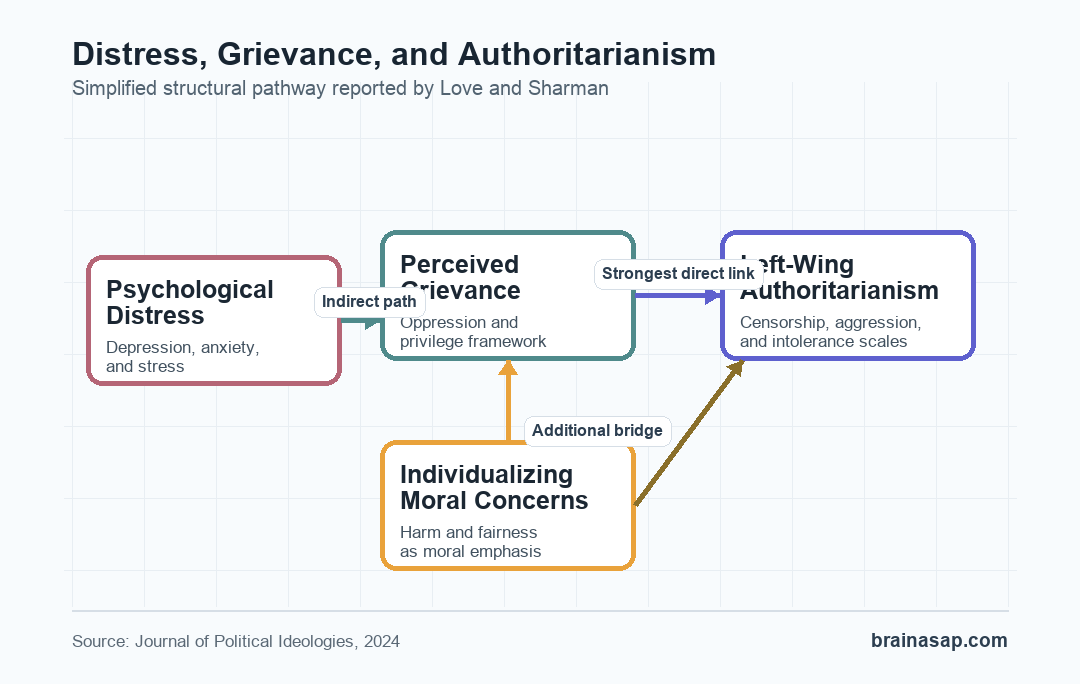
- Distress pathway: Depression, anxiety, and stress related to left-wing authoritarianism indirectly through higher perceived grievance.
- Moral focus: Individualizing moral concerns, centered on harm and fairness, also helped connect grievance beliefs with authoritarian attitudes.
- Model fit: The final structural equation model explained 53% of the variance in left-wing authoritarianism.
- Main caveat: The sample was cross-sectional, highly educated, mostly white, and politically left-leaning, so the results need broader replication.
Source: Journal of Political Ideologies (2024) | Love and Sharman
Left-wing authoritarianism is not the same as ordinary left-wing politics. In this study, it meant a cluster of rigid attitudes that included support for revolutionary aggression, top-down censorship, and intolerance toward traditional or conservative views.
Researchers tested a psychological model for why those attitudes cluster in some people. The central claim was not that distress automatically produces authoritarianism.
The model pointed to a more specific path: distress was associated with a stronger sense of social grievance, and grievance was associated with more authoritarian political thinking.
Perceived Grievance Was the Central Predictor
Perceived grievance referred to awareness or endorsement of systemic oppression and privilege, including sexism, heterosexism, Christian privilege, and white privilege. Higher scores meant a participant saw society as more deeply organized around those inequities.
In the final model, this grievance measure was the strongest direct predictor of left-wing authoritarianism. People who scored higher on perceived grievance were more likely to endorse attitudes that favored ideological enforcement, censorship, or aggressive opposition to traditional groups.
The study separated several psychological pieces that are often blurred together:
- Political identity: where a person placed themselves on the left-right spectrum.
- Perceived grievance: how strongly a person viewed society through oppression and privilege.
- Psychological distress: symptoms of depression, anxiety, and stress.
- Moral foundations: whether moral concern centered on harm/fairness or group-binding values.
This separation is useful because political extremity is easy to label but harder to explain. The strongest measurement here was not simply left-wing identity.
The grievance framework helped organize the political attitude.
Distress Worked Through Grievance, Not Directly
The study measured psychological distress with the Depression Anxiety and Stress Scale. Higher distress was related to stronger perceived grievance, and perceived grievance then related to left-wing authoritarianism.
This is a narrower claim than saying mental health symptoms cause political extremism. The tested model did not support distress as a simple direct driver of left-wing authoritarianism.
Instead, distress appeared as part of an indirect pathway:
- Higher distress: more symptoms of depression, anxiety, or stress.
- Higher grievance perception: stronger belief that society is structured around group-based oppression.
- Higher authoritarian endorsement: more support for coercive or intolerant political attitudes on the left.
This pathway is clinically and socially important because distress changes how threat, injustice, and control are interpreted. A person experiencing high stress or anxiety can read political conflict through a more urgent threat lens.
The study does not prove that sequence over time. It does identify a plausible psychological structure that future longitudinal work can test more directly.
Individualizing Moral Concerns Also Carried the Link
The researchers also measured moral foundations. Individualizing moral concerns focus on harm, care, fairness, and protection of individuals. Binding moral concerns focus more on loyalty, authority, and group cohesion.
The finding was more specific than a simple “fairness equals tolerance” story. Participants with stronger perceived grievance also placed more weight on individualizing moral concerns, and those moral concerns were associated with higher left-wing authoritarianism in the model.
The moral-foundations result can sound counterintuitive, but it is psychologically coherent. Harm and fairness motives can support open pluralism.
They can also support coercive enforcement when a person believes protection of vulnerable groups requires suppressing opposing views.
The model therefore points to two different uses of the same moral language:
- Protective use: reducing harm, expanding fairness, or defending people from discrimination.
- Authoritarian use: using harm and fairness claims to justify censorship, aggression, or ideological conformity.
- Measurement value: separating the moral concern from the enforcement style helps avoid treating all social-justice concern as authoritarian.
This distinction is essential. The study does not say that concern about inequality is itself authoritarian. It says the combination of perceived grievance, distress, and enforcement-oriented attitudes deserves separate measurement.
The Model Explained 53% of Left-Wing Authoritarianism
Researchers recruited 299 English-speaking adults through social media and political forums. Participants completed questionnaires on left-wing authoritarianism, perceived grievance, psychological distress, moral foundations, emotional reactivity, and need for cognitive closure.
The final structural equation model explained 53% of the variance in left-wing authoritarianism. In behavioral science, that is a large enough share to make the model worth testing in larger and more representative samples.
Several design details shape how the result should be read:
- Sample tilt: the participants were mostly white, highly educated, and strongly left-leaning.
- Recruitment route: social-media and political-group recruitment can attract people already interested in ideological conflict.
- Single time point: cross-sectional data cannot show whether distress came before grievance beliefs or authoritarian attitudes.
- Self-report limits: questionnaire answers measure endorsed attitudes, not observed political behavior.
Those limits do not erase the result. They define the next test.
A stronger follow-up would track people over time, include broader political and demographic samples, and compare self-reported attitudes with actual online or offline behavior.
Political Rigidity Was the Practical Signal
The most useful reading is not partisan scorekeeping. The study gives researchers a way to analyze one form of political rigidity without pretending it belongs only to one side of politics.
For left-wing authoritarianism, the model suggests that distress and grievance beliefs can combine with moral concern in a way that treats coercive enforcement as justified.
The key issue is not the existence of moral concern. It is whether that concern turns into intolerance, censorship, or aggression.
This distinction also applies beyond politics. In clinical and social settings, distress can narrow attention toward threat and make simple certainty seem safer than ambiguity.
When political narratives provide a clear oppressor-victim frame, that certainty can become emotionally reinforcing.
The study keeps the claim bounded: it identifies an association structure in one survey sample. Still, it helps sharpen the question.
Modern polarization is not only about beliefs. It is also about distress, moral emotion, perceived injustice, and the social demand to enforce a worldview.
Citation: DOI: 10.1080/13569317.2024.2344755. Love S, Sharman R. Perceived grievance and individualising moralities: exploring the psychological structure of left-wing authoritarianism. Journal of Political Ideologies. 2024.
Study Design: Cross-sectional online survey analyzed with structural equation modeling.
Sample Size: 299 English-speaking adults recruited through social media and political forums.
Key Statistic: The final model explained 53% of the variance in left-wing authoritarianism, with perceived grievance as the strongest direct predictor.
Caveat: The sample was politically skewed and cross-sectional, so the model cannot establish cause and effect.