TL;DR: A 2026 study in PLOS One found that people with Parkinson’s disease made more silent pauses while reading aloud, especially when sentences were longer or syntactically more complex.
Key Findings
- Reading task compared 71 adults: Researchers compared 32 people with Parkinson’s disease and 39 older control participants.
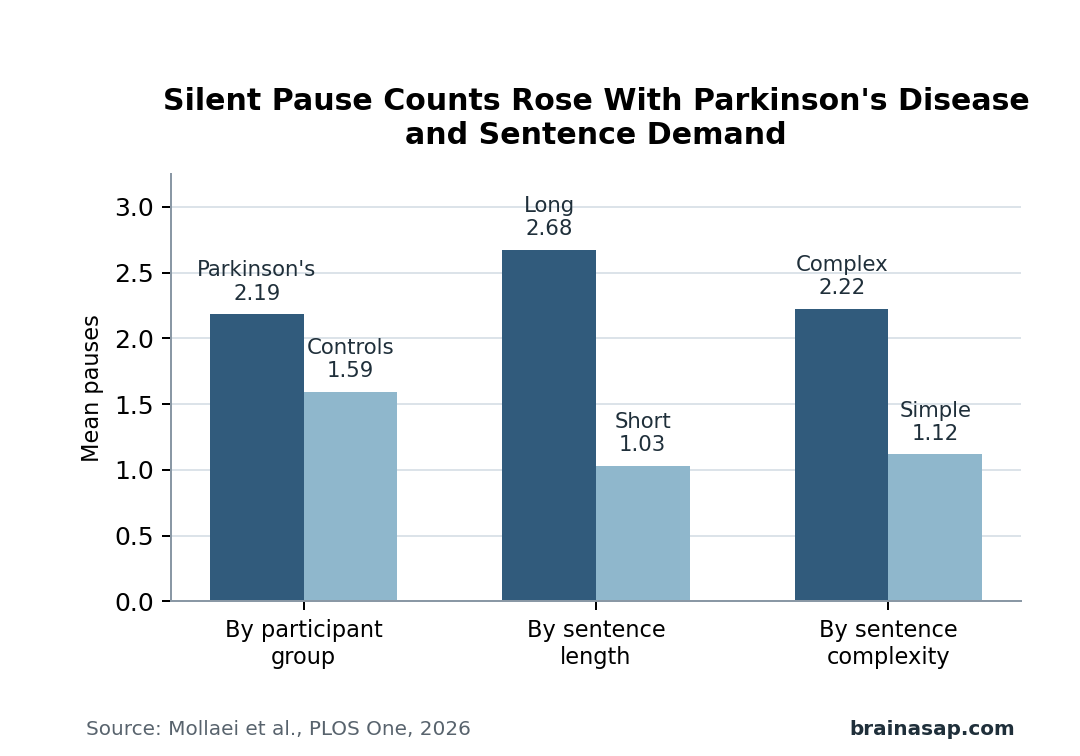
- Parkinson’s readers paused more often: The Parkinson’s group averaged 2.185 pauses across sentence-length categories, compared with 1.595 in controls.
- Long sentences increased pausing: Across groups, long sentences produced more pauses than short sentences, with means of 2.676 versus 1.033 pauses.
- Complex sentences also raised pause counts: Complex sentences produced more pauses than simple sentences, and the complexity effect was stronger in Parkinson’s disease.
- Pause pattern tracked cognition and speech severity: Lower Montreal Cognitive Assessment (MoCA) scores were linked with more pauses, while higher dysarthria severity was linked with longer pauses.
Source: PLOS One (2026) | Mollaei et al.
Silent pauses are the brief intervals that interrupt speech flow. In Parkinson’s disease, those pauses can come from motor speech changes, respiratory timing, sentence planning, cognition, or some mixture of all four.
The new study focused on a practical question: when people with Parkinson’s disease read a standard passage aloud, do pauses change because the person has Parkinson’s disease, because the sentence is harder, or both?
Researchers Measured Pauses During a Standard Reading Task
Researchers studied 71 adults: 32 people with idiopathic Parkinson’s disease and 39 older control participants. The Parkinson’s group had a mean age of about 68 years.
On average, participants in the Parkinson’s group had been diagnosed for roughly 73 months.
Each participant read the Rainbow Passage, a controlled speech sample often used in speech-language research. Researchers marked silent pauses in the audio recordings using Praat software and a 200-millisecond cutoff.
That cutoff means very brief articulatory intervals were not counted as meaningful pauses.
The study separated pauses by where and when they occurred:
- Between-sentence pauses: Gaps between one sentence and the next.
- Within-sentence pauses: Gaps that happened inside a sentence.
- Short versus long sentences: Short sentences had 7-17 words; long sentences had 21-28 words.
- Simple versus complex sentences: Sentence complexity was classified using previously published Rainbow Passage criteria.
Researchers also measured Montreal Cognitive Assessment (MoCA) scores, a brief cognitive screening test, and a clinician-rated measure of dysarthria severity, meaning motor speech impairment severity.
Parkinson’s Disease Was Linked With More Pauses Overall
People with Parkinson’s disease produced more pauses than controls. Across sentence-length categories, the Parkinson’s group averaged 2.185 pauses, compared with 1.595 pauses in the older control group.
The same pattern appeared in the sentence-complexity analysis. Parkinson’s participants averaged 1.938 pauses, while controls averaged 1.404 pauses.
Pause duration showed a smaller but still important group difference. In the sentence-length analysis, pauses averaged 0.396 seconds in the Parkinson’s group and 0.345 seconds in controls.
In the sentence-complexity analysis, the corresponding averages were 0.408 seconds and 0.353 seconds.
Longer Sentences Produced More and Longer Pauses
Sentence length mattered strongly in both groups. Long sentences produced an average of 2.676 pauses, while short sentences produced an average of 1.033 pauses.
Pause duration also increased in longer sentences. Across groups, long-sentence pauses averaged 0.411 seconds, compared with 0.331 seconds in short sentences.
Parkinson’s speech changes are sometimes described mainly as a motor problem. The length finding suggests that the speech system is also sensitive to how much material has to be planned and coordinated at once.
- Planning load: Longer sentences require the reader to hold and organize more words before and during speech.
- Respiratory timing: Longer spoken units can require more breath and phrase planning.
- Motor sequencing: Parkinson’s disease can affect timing and initiation, which can make longer utterances harder to maintain smoothly.
The interaction between Parkinson’s status and sentence length was significant for pause duration. In plain terms, longer sentences increased pause length, and that length effect differed by group.
Complex Sentences Increased Pause Counts More in Parkinson’s Disease
Sentence complexity produced a similar pattern. Complex sentences had more pauses than simple sentences, with averages of 2.224 versus 1.118 pauses.
The complexity effect on pause number was stronger in people with Parkinson’s disease. Pausing did not simply rise uniformly across every sentence type.
The increase was more visible when the sentence required more linguistic planning.
Pause duration was also longer in complex sentences overall, with 0.395 seconds for complex sentences versus 0.365 seconds for simple sentences. The Parkinson’s group showed longer pauses than controls.
The interaction between disease status and complexity was not statistically significant for duration.
- Pause count result: Complexity increased the number of pauses, and the group-by-complexity interaction was significant.
- Pause duration result: Complexity increased duration overall, but the group-by-complexity interaction was not significant.
- Interpretation: Sentence complexity affected how often readers paused more clearly than how long each pause lasted.
The study therefore points toward a combined speech-motor and cognitive-linguistic explanation. Parkinson’s disease affected the pause pattern, but the size and form of that effect depended on the sentence being read.
MoCA and Dysarthria Tracked Different Pause Features
Within the Parkinson’s group, lower MoCA scores were associated with more pauses. The strongest reported correlation was with the total number of pauses in the passage: rs = -0.502, with a p value of 0.005.
Negative correlations also appeared for short, long, simple, and complex sentence categories. In ordinary terms, participants with lower cognitive-screening scores tended to pause more often while reading.
MoCA scores were not significantly associated with pause duration. That split is useful because it suggests that pause frequency and pause length reflect partly different processes:
- More pauses: May reflect cognitive-linguistic planning demands, working memory load, or sentence-level formulation difficulty.
- Longer pauses: May reflect motor speech severity, respiratory-speech coordination, initiation delay, or broader timing constraints.
- Clinical implication: Counting pauses and measuring pause length do not tell the same story.
Dysarthria severity showed a different relationship. Higher severity ratings were associated with longer pauses in short sentences, long sentences, and complex sentences.
The strongest reported dysarthria correlation was for complex-sentence pause duration, where rs = 0.509 and p = 0.004. Dysarthria severity was not significantly associated with the number of pauses.
That distinction supports the researchers’ broader interpretation. Parkinson’s pause behavior is not one single symptom.
Pause counts were more tied to cognitive-linguistic load, while pause duration was more tied to motor speech impairment.
Reading Task Design Limited Interpretation
The study used a controlled reading task, which is helpful for comparing people on the same words and sentences. It also limits what the findings can say about spontaneous conversation.
In conversation, people have to choose words, plan ideas, and manage discourse in real time.
Several other limits matter for interpretation:
- Sentence overlap: Length and complexity were not fully independent because the Rainbow Passage was not designed to separate those variables cleanly.
- Recording format: Some data came from in-person sessions and some from online recordings during COVID-era adaptations.
- Motor staging: Researchers did not collect standardized global Parkinson’s motor severity scores such as MDS-UPDRS or Hoehn and Yahr stage.
- Cognitive detail: MoCA is a screening test, not a full neuropsychological battery for executive function, working memory, and language processing.
Even with those constraints, the evidence is concrete. Silent pauses during a short reading task reflected Parkinson’s speech fluency, sentence demand, cognitive screening scores, and dysarthria severity.
For speech-language therapy research, the practical takeaway is that pause metrics deserve closer attention. They can help identify which patients struggle most when sentence planning, speech timing, and motor control have to work together.
Citation: DOI: 10.1371/journal.pone.0330808. Mollaei et al. Pause characteristics of sentence production in Parkinson’s disease: Insights from sentence complexity and length. PLOS One. 2026;21(4):e0330808.
Study Design: Cross-sectional speech analysis comparing connected-reading pauses in Parkinson’s disease and older control participants.
Sample Size: 71 adults: 32 with idiopathic Parkinson’s disease and 39 older control participants.
Key Statistic: Parkinson’s participants produced more pauses than controls, and total pause count correlated with MoCA score in the Parkinson’s group (rs = -0.502, p = 0.005).
Caveat: The reading passage did not independently manipulate sentence length and complexity, and the study lacked standardized global Parkinson’s motor severity scores.