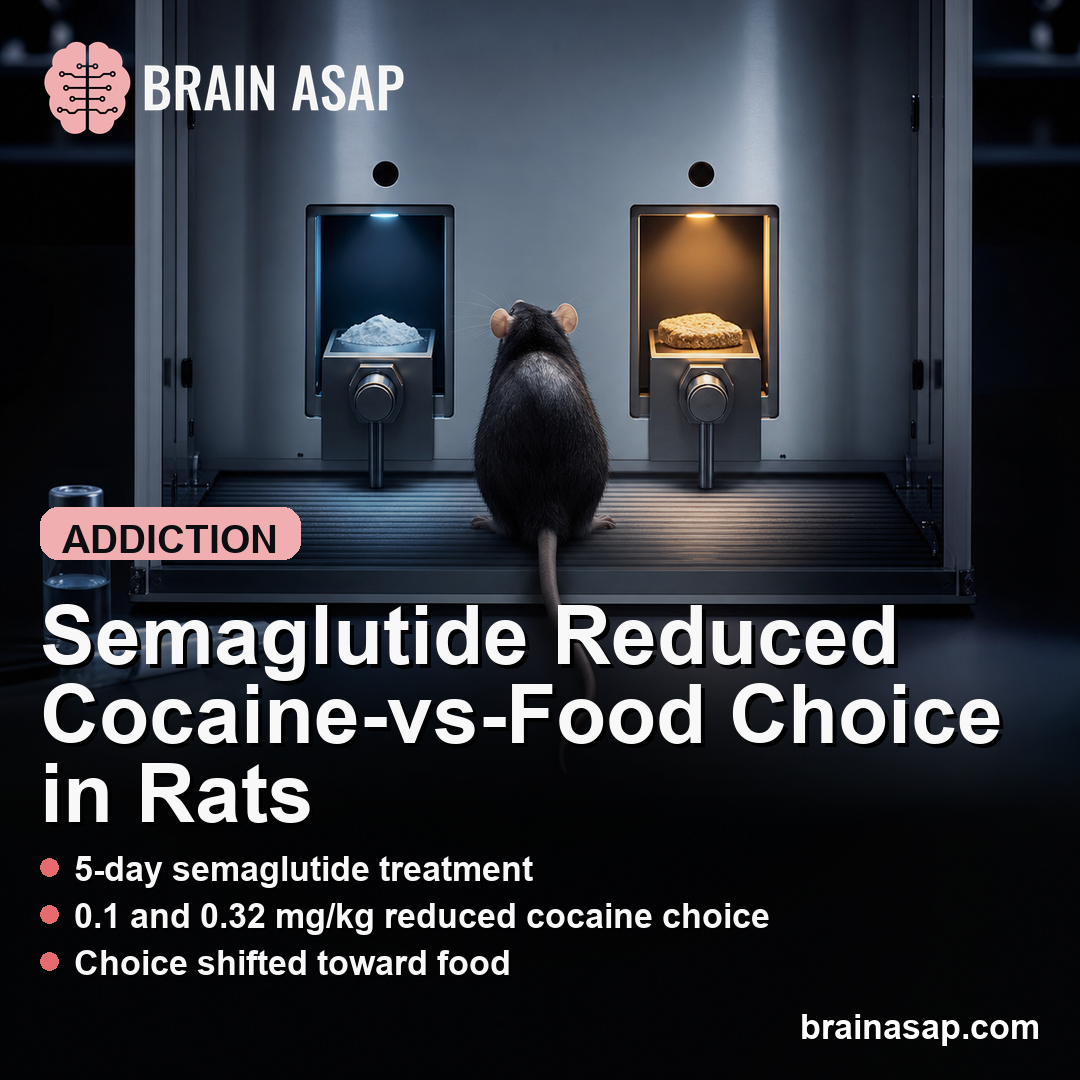
TL;DR: A 2026 rat study in Neuropsychopharmacology reported that repeated semaglutide treatment reduced cocaine-vs-food choice in male and female rats, supporting further clinical testing for cocaine use disorder rather than proving human benefit.
Key Findings
- 5-day treatment: Rats received repeated semaglutide treatment across 5 days rather than a single acute dose.
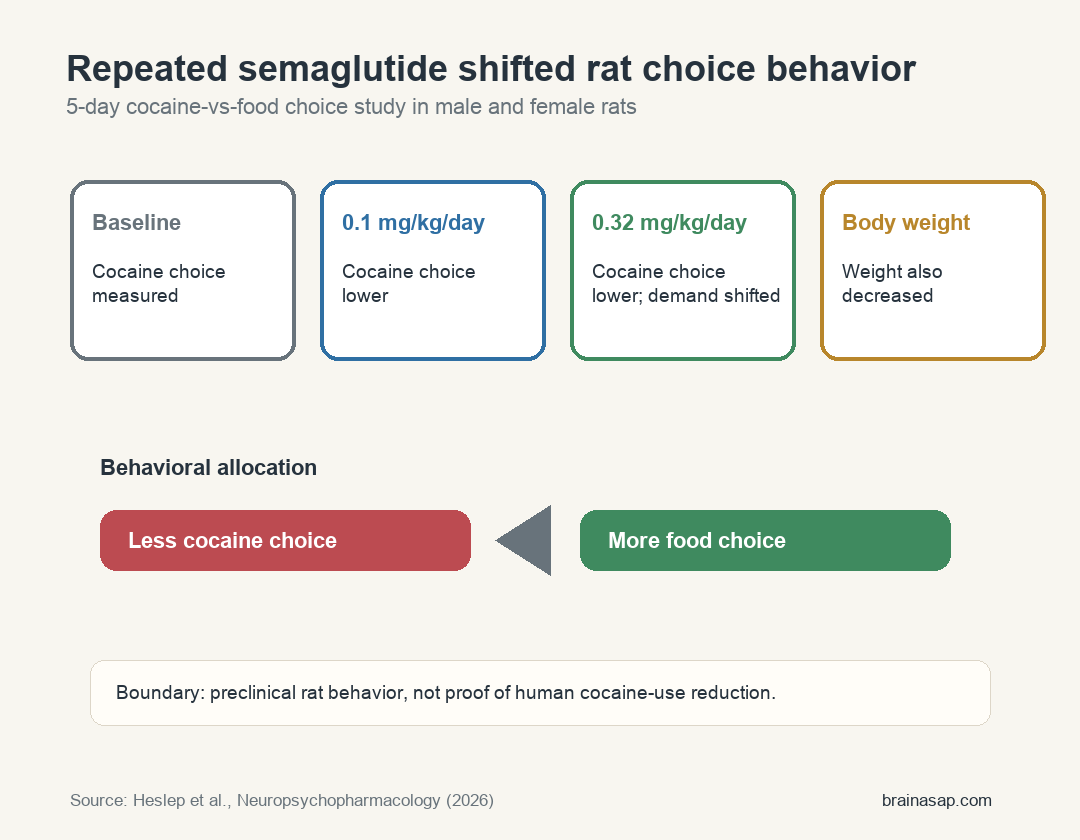
- Two active doses: Both 0.1 and 0.32 mg/kg/day semaglutide significantly reduced cocaine choice.
- 12-rat main procedure: The main cocaine-vs-food choice analysis included 12 rats, split evenly between males and females.
- Behavior shifted toward food: Semaglutide decreased cocaine choice and reciprocally increased food choice.
- Body weight also fell: Semaglutide reduced body weight, but the authors interpreted cocaine-choice reduction as larger than a simple food-reinforcement effect.
Source: Neuropsychopharmacology (2026) | Heslep et al.
Semaglutide is best known as a GLP-1 receptor agonist used in diabetes and weight-management care. This preclinical study tested whether repeated semaglutide could reduce cocaine reinforcement when rats chose between cocaine and food.
Cocaine use disorder has no FDA-approved medication. That gap has made GLP-1 drugs a research target because GLP-1 biology intersects with reward circuits, feeding, and dopamine-related behavior.
Semaglutide Was Tested in a Cocaine-vs-Food Choice Procedure
The main experiment used a choice procedure designed to ask whether a treatment selectively reduces drug reinforcement rather than broadly suppressing behavior. Rats could allocate responding between cocaine and food under controlled conditions.
The primary readout was percent cocaine choice. That measure is useful because it shows whether behavior shifts away from drug reinforcement and toward a non-drug alternative.
- Drug option: Cocaine self-administration under experimentally controlled unit-dose conditions.
- Food option: A competing non-drug reinforcer available in the same behavioral framework.
- Main outcome: The share of choices allocated to cocaine rather than food.
The main procedure included 12 rats, with 6 males and 6 females. A separate behavioral-economic demand procedure included 7 rats, with 4 males and 3 females.
Repeated 0.1 and 0.32 mg/kg/day Semaglutide Reduced Cocaine Choice
The treatment was repeated for 5 days. Both 0.1 mg/kg/day and 0.32 mg/kg/day semaglutide significantly attenuated cocaine choice in the main procedure.
The direction of behavior changed in a clinically relevant way for a preclinical addiction model. Rats chose cocaine less and food more, rather than simply stopping all operant responding.
- Lower cocaine allocation: Semaglutide reduced percent cocaine choice.
- Higher food allocation: Food choice increased reciprocally.
- Both sexes included: The main experiment included male and female rats, though the sample was still small.
The study did not report a human abstinence outcome. It tested a translational behavioral model meant to screen medications before clinical trials.
Behavioral-Economic Testing Supported a Cocaine-Specific Effect
The second procedure tested how hard rats would work for cocaine as the response requirement changed. This behavioral-economic setup can show whether a treatment lowers cocaine demand across increasing work costs.
At 0.32 mg/kg/day, semaglutide decreased the cocaine fixed-ratio value where rats shifted behavior away from cocaine and toward food. That finding supported the main choice result.
- Main choice procedure: Tested cocaine-versus-food allocation across semaglutide treatments.
- Demand procedure: Tested cocaine choice when the work requirement changed.
- Converging result: The higher semaglutide dose pushed behavior away from cocaine under the demand procedure.
The two procedures together reduce the chance that the result reflects a single task artifact. They still do not replace clinical testing in people with cocaine use disorder.
Body-Weight Loss Did Not Fully Explain the Cocaine Result
Semaglutide also reduced body weight during the 5-day treatment. That is expected for a GLP-1 receptor agonist and creates an obvious interpretive problem in a cocaine-versus-food study.
If semaglutide simply made food less reinforcing, rats might stop choosing food. The reported pattern went the other way: cocaine choice fell while food choice increased.
- Weight effect: Body weight decreased during semaglutide treatment.
- Food-choice effect: Food choice increased rather than falling.
- Interpretation: The cocaine-reinforcement effect appeared larger than a generalized appetite or motor suppression effect.
That distinction is central. A medication candidate for addiction needs to reduce drug taking without broadly impairing behavior or making normal rewards unusable.
GLP-1 Reward-Circuit Biology Remains Mechanistically Unclear
The source notes that semaglutide does not readily cross the blood-brain barrier, so the mechanism behind reduced cocaine choice remains unresolved. GLP-1 receptors are still relevant to reward circuitry through indirect and circuit-specific routes.
Prior work cited in the study links GLP-1 receptor signaling to ventral tegmental area GABA neurons and reduced dopamine activity. Cocaine reinforcement depends heavily on mesolimbic dopamine signaling, so that circuit route is plausible.
- Known challenge: Semaglutide’s limited blood-brain-barrier crossing complicates a simple central-drug explanation.
- Candidate pathway: GLP-1 receptor effects on VTA GABA neurons may reduce dopamine activity.
- Needed experiment: GLP-1 antagonists could test whether receptor blockade prevents the cocaine-choice effect.
Mechanism matters for drug development because GLP-1 agents differ in pharmacology, dosing, side effects, and brain access.
Human Cocaine Use Disorder Trials Are Still the Real Test
The study supports clinical evaluation of semaglutide as a candidate cocaine use disorder medication. It does not show that semaglutide reduces cocaine use in people.
One cited human laboratory study with acute exenatide did not reduce cocaine self-administration or subjective effects, but that design tested a single acute dose. The rat study intentionally used repeated dosing to improve translational relevance.
- Preclinical strength: Repeated dosing and choice procedures are closer to medication-development logic than a single acute screen.
- Preclinical limit: Small rat samples cannot estimate human treatment effects or adverse-event tradeoffs.
- Clinical next step: Randomized trials would need cocaine-use outcomes, retention, craving, body-weight effects, and safety monitoring.
The narrow conclusion is that repeated semaglutide reduced cocaine choice in rats while increasing food choice. Semaglutide deserves clinical testing, but this study does not make it a cocaine use disorder treatment.
Citation: DOI: 10.1038/s41386-026-02386-2. Heslep et al. Repeated semaglutide treatment attenuates cocaine-vs-food choice in male and female rats. Neuropsychopharmacology. 2026.
Study Design: Preclinical cocaine-vs-food choice and behavioral-economic demand study in rats.
Sample/Model: Main choice procedure used 12 rats, 6 male and 6 female; behavioral-economic demand procedure used 7 rats.
Key Statistic: Repeated 0.1 and 0.32 mg/kg/day semaglutide significantly reduced cocaine choice across 5 treatment days, while 0.32 mg/kg/day shifted behavior away from cocaine in the demand procedure.
Caveat: Rat choice behavior is not human cocaine-use disorder treatment evidence; clinical trials are needed to test efficacy and safety.