TL;DR: A 2026 study in Psychological Medicine found that people with schizophrenia spectrum disorders and higher avolition or moderate-to-high delusion severity appeared to improve more after virtual reality cognitive behavioral therapy for psychosis (VR-CBTp), while lower delusion severity favored standard CBTp.
Key Findings
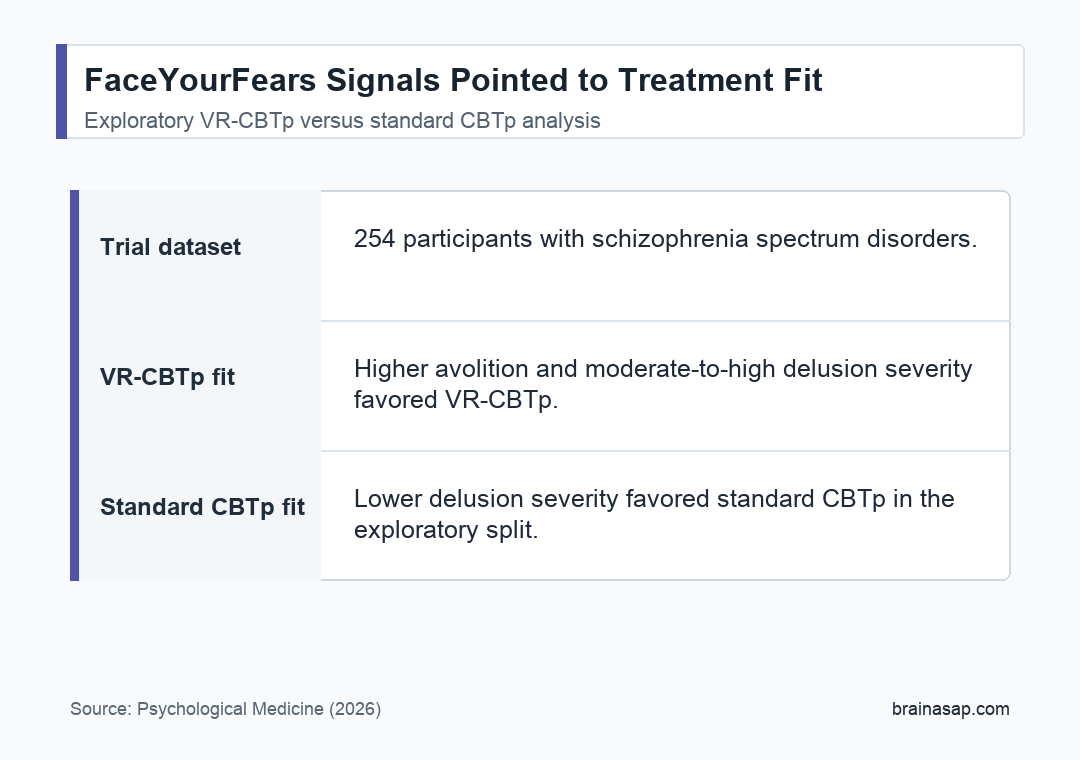
- FaceYourFears dataset: The exploratory moderator study used trial data from 254 participants, including 128 standard CBTp participants and 126 VR-CBTp participants.
- 10 therapy sessions: Both treatments targeted paranoia, but VR-CBTp added in-session virtual social exposure and behavioral experiments.
- Avolition signal: Higher baseline avolition predicted poorer outcomes overall, yet the high-avolition subgroup showed better end-of-treatment paranoia outcomes with VR-CBTp than with standard CBTp.
- Delusion-severity split: Lower baseline delusion severity favored standard CBTp, while moderate-to-high delusion severity favored VR-CBTp in the exploratory interaction analysis.
- Broad non-signals: Age, gender, education, diagnosis, depression, social anxiety, anhedonia, functioning, core beliefs, and interpersonal trauma did not significantly modify treatment outcome.
Source: Psychological Medicine (2026) | Christensen et al.
Virtual reality cognitive behavioral therapy for psychosis is not just ordinary therapy delivered through a headset. In the FaceYourFears trial, therapists used customizable virtual social scenes so participants could test paranoid expectations while the feared situation was happening.
The new analysis asked a practical matching question: which baseline features made one therapy look better than the other for paranoia after treatment?
VR-CBTp Was Tested Against Standard CBTp for Paranoia
Researchers analyzed all participants from the FaceYourFears randomized trial who had schizophrenia spectrum disorders and paranoia. The sample included 254 people in the main analysis, split almost evenly between standard CBTp and VR-CBTp.
Both groups received 10 individual sessions focused on paranoia. Standard CBTp used cognitive worksheets, psychoeducation, cognitive restructuring, core-belief work, self-worth work, homework, and real-world behavioral experiments where feasible.
VR-CBTp used the same cognitive-behavioral logic but moved behavioral experiments into immersive virtual environments. Participants could enter social situations, experience suspicious thoughts in real time, and practice new responses with therapist support.
- Outcome measure: End-of-treatment paranoia was assessed with the Green Paranoid Thoughts Scale total score at 3 months.
- Core clinical variables: The analysis tested paranoia, safety behavior, delusion severity, negative symptoms, avolition, anhedonia, social anxiety, depression, and cognitive biases.
- Demographic variables: Researchers also tested age, gender, education, occupation, and diagnosis as possible treatment-effect modifiers.
Avolition and Delusion Severity Helped Separate the Groups
Avolition means reduced motivation or difficulty initiating goal-directed behavior. Across both therapies, higher avolition was linked to worse paranoia outcomes, which fits the broader clinical problem: people with more negative symptoms often have a harder time engaging with treatment.
The treatment-matching result was different. At higher baseline avolition, participants had better end-of-treatment paranoia outcomes after VR-CBTp than after standard CBTp.
Researchers interpreted that interaction as a hypothesis-generating pattern: virtual exposure may help some people who struggle to initiate real-world practice.
Delusion severity, measured with the Scale for the Assessment of Positive Symptoms (SAPS), also split the pattern. Lower delusion severity was associated with better response to standard CBTp, while moderate-to-high delusion severity was associated with better response to VR-CBTp.
Safety Behavior and Cognitive Bias Predicted Poorer Paranoia Outcomes
Several baseline characteristics predicted worse end-of-treatment paranoia regardless of therapy type. Higher safety behavior, higher cognitive bias, higher avolition, and higher delusion severity were all associated with poorer outcomes across treatments.
Safety behaviors are actions people use to feel protected, such as avoiding eye contact, leaving social situations early, or monitoring others for threat. In paranoia treatment, those behaviors can reduce short-term distress while preventing the person from learning that the feared outcome may not occur.
- Safety behavior: Higher baseline Safety Behaviour Questionnaire scores were associated with higher end-of-treatment paranoia.
- Cognitive bias: Higher Davos Assessment of Cognitive Biases Scale scores were also linked to poorer outcomes.
- Delusion severity: Higher SAPS delusion severity predicted poorer outcomes overall, even though the treatment-matching pattern favored VR-CBTp at moderate-to-high severity.
The distinction is clinically important. A baseline feature can predict poorer outcomes overall and still help identify which treatment format may work better within that harder-to-treat group.
Most Demographic and Clinical Variables Did Not Modify Response
The study did not find significant treatment-matching effects for many variables that clinicians might expect to matter. Age, gender, education, occupation, diagnosis, social anxiety, depression, anhedonia, total negative symptoms, functioning, core beliefs, and interpersonal trauma did not significantly modify end-of-treatment paranoia.
Those factors can still be clinically relevant. In this exploratory analysis, they did not clearly separate who did better with VR-CBTp versus standard CBTp.
- Patient preference still matters: The researchers concluded that both treatments appear suitable for a broad range of people with paranoia.
- Treatment fit stayed specific: The advantage was limited to baseline avolition and delusion-severity patterns, not every participant.
- Standard CBTp remains important: Lower delusion severity favored standard CBTp in the moderation analysis.
The Findings Are Useful but Exploratory
The FaceYourFears trial was not powered mainly for moderator testing. The current analysis examined many possible baseline variables, and the researchers did not apply multiplicity adjustment, so the signals should be treated as leads for future trials rather than final rules for clinical selection.
Still, the pattern is clinically sensible. VR-CBTp can place people directly inside controlled social situations, which may be especially useful when motivation is low or persecutory delusions make real-world experiments difficult to start.
For clinicians, the cautious takeaway is not that every psychosis service needs to replace CBTp with VR. The practical takeaway is that high avolition and moderate-to-high delusion severity are worth tracking in future VR-CBTp trials because they may identify patients who benefit from structured, therapist-guided virtual exposure.
Citation: DOI: 10.1017/S0033291726103870. Christensen et al. Treatment effect modifiers of virtual reality-based versus standard cognitive behavioral therapy for paranoia in schizophrenia spectrum disorders: an exploratory moderator analysis of clinical and demographic characteristics in the FaceYourFears trial. Psychological Medicine. 2026;56:e117.
Study Design: Exploratory moderator analysis of randomized trial data comparing VR-CBTp with standard CBTp for paranoia.
Sample Size: 254 participants with schizophrenia spectrum disorders and paranoia.
Key Statistic: High avolition and moderate-to-high delusion severity favored VR-CBTp in interaction analyses, while lower delusion severity favored standard CBTp.
Caveat: The trial was not powered mainly for moderator testing, and the many exploratory comparisons need confirmation.