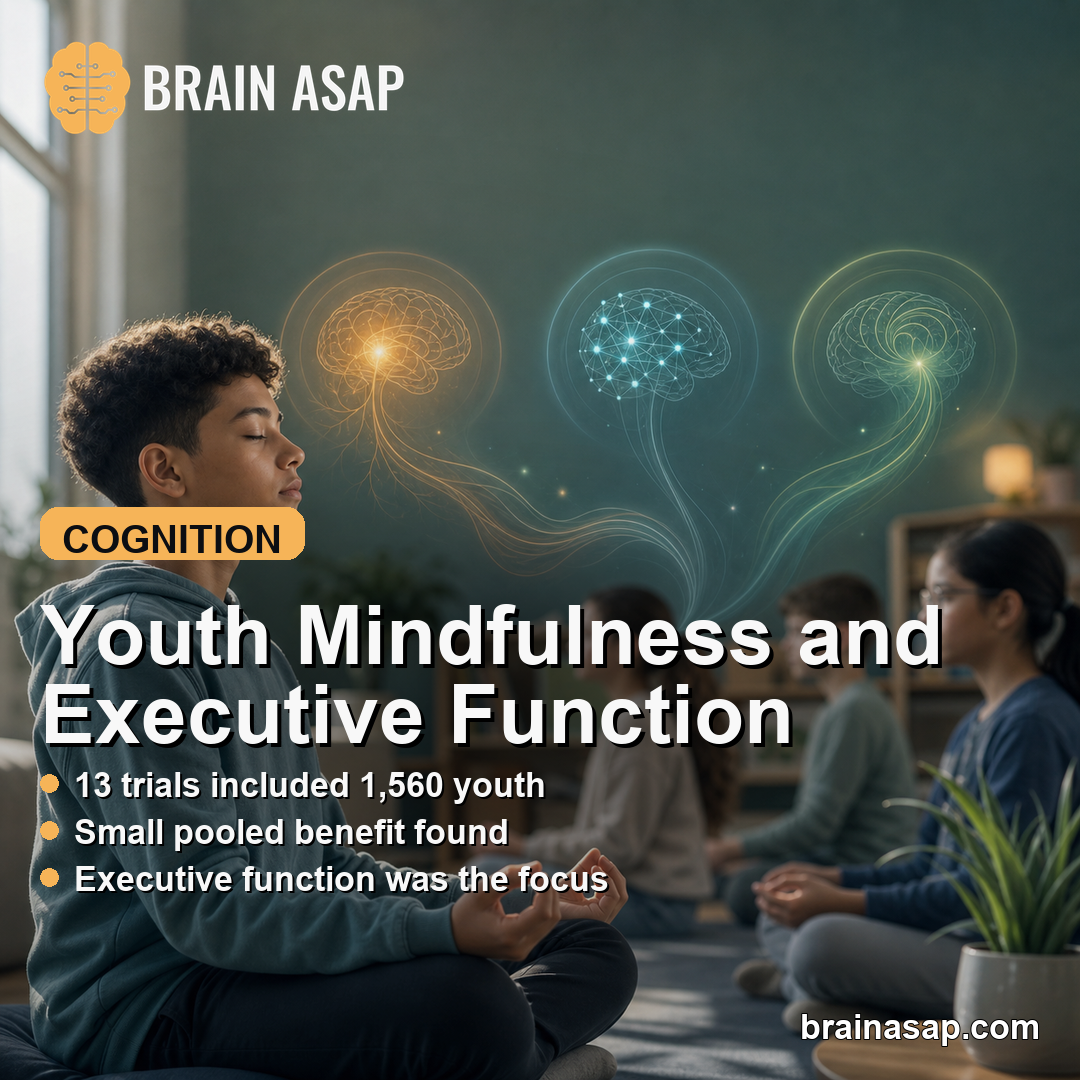
TL;DR: A 2026 systematic review and meta-analysis posted as a medRxiv preprint found that mindfulness-based programs were linked to a small improvement in executive function, meaning inhibition, working memory, and flexible thinking, across 13 youth trials.
Key Findings
- 13 trials were included: The meta-analysis pooled randomized and quasi-randomized trials in 1,560 children and adolescents aged 3-18 years.
- Executive function improved: Mindfulness-based interventions were linked to a small positive effect on direct executive-function tasks, with pooled Hedges’ g = 0.365.
- Heterogeneity was negligible: The pooled estimate had I2 = 0.0%, meaning the included trial estimates were unusually consistent for this literature.
- Age and domain results were similar: Effects were similar in preschool and school-age samples and across inhibitory control, working memory, and cognitive flexibility.
- Evidence certainty was moderate: GRADE certainty was downgraded once for risk of bias, and the preprint has not yet been peer reviewed.
Source: medRxiv preprint (2026) | Li.
Mindfulness Had a Small Youth Executive-Function Effect
The review focused on executive function, the set of control skills children use to hold information in mind, stop an automatic response, and shift between rules.
Those skills sit close to classroom behavior, learning, and emotional regulation, so mindfulness programs are often promoted as a way to strengthen attention from the inside out.
Li narrowed the evidence base to trials that used direct behavioral or computerized executive-function tasks. Teacher ratings, grades, and broad attention scales can mix executive control with motivation, classroom context, or adult expectations.
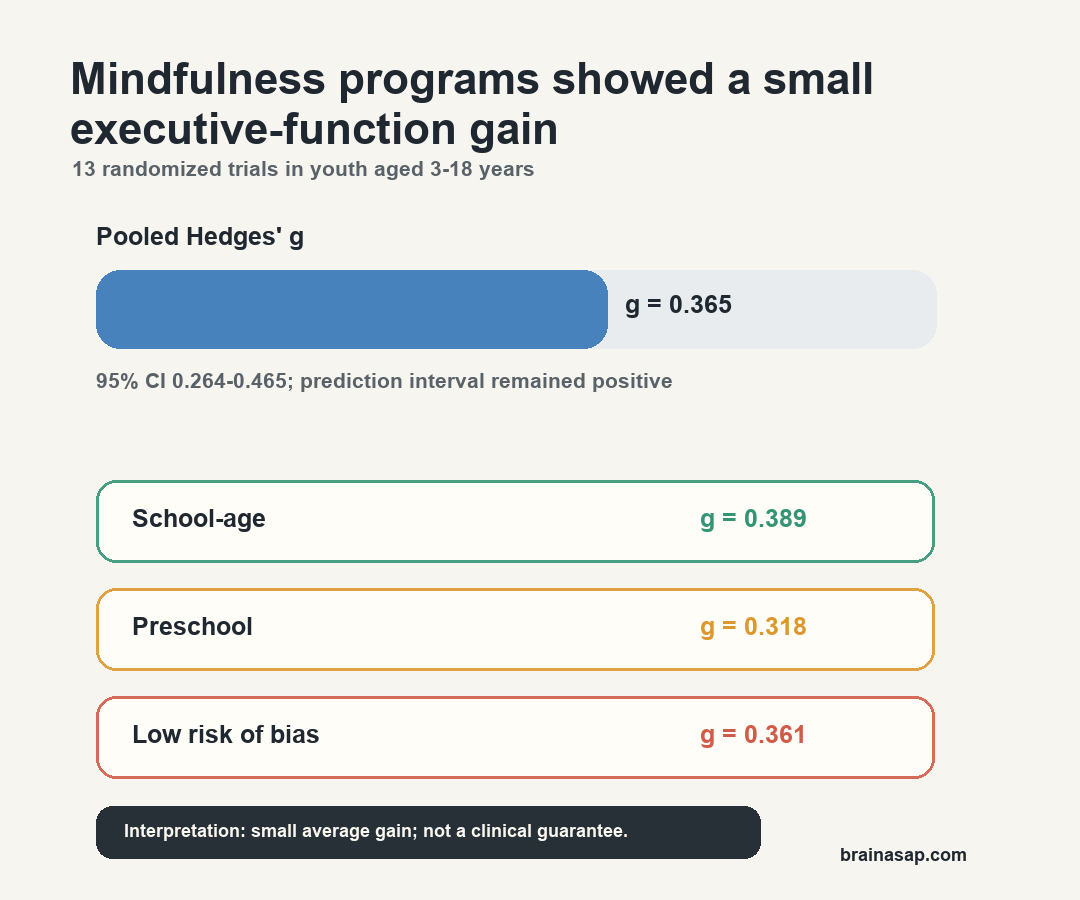
The primary analysis included 13 randomized or quasi-randomized trials with 1,560 participants aged 3 to 18 years. The pooled result was Hedges’ g = 0.365, with a 95% confidence interval from 0.264 to 0.465.
The Meta-Analysis Kept the Outcome Definition Tight
Mindfulness-based interventions were defined as structured programs that included mindfulness meditation practices, such as breath awareness, body scans, or mindful movement with explicit present-moment attention instruction. Yoga-only programs without a mindfulness meditation component were excluded.
The outcome rules were also specific. Eligible trials needed at least one direct measure of executive function, not just a questionnaire about behavior. The review grouped those outcomes into three practical domains:
- Inhibitory control: stopping a prepotent or distracting response.
- Working memory: holding and updating information during a task.
- Cognitive flexibility: shifting between rules, categories, or task demands.
That narrower definition makes the estimate easier to interpret. The review is not claiming that mindfulness reliably raises grades, treats ADHD, or fixes school performance.
The question is whether programs with mindfulness practice improve task-measured executive control.
The review also excluded clinical and high-adversity samples, including ADHD, incarcerated youth, and orphaned children. That keeps the estimate cleaner for generally developing school and preschool populations.
The tradeoff is narrower reach: the pooled result should not be automatically extended to groups with different baseline needs.
The Estimate Stayed Positive Across Sensitivity Checks
The pooled estimate was not driven by obvious statistical instability. Reported heterogeneity was I2 = 0.0%, and the Q test was not significant.
The 95% prediction interval, 0.252 to 0.477, stayed fully positive.
Several checks pointed in the same direction:
- School-age trials: the pooled effect was g = 0.389.
- Preschool trials: the pooled effect was g = 0.318.
- Low risk-of-bias trials: the estimate was g = 0.361 across eight studies.
- Trim-and-fill adjustment: the adjusted estimate was g = 0.354.
Those numbers do not make the effect large. They do make the average signal less fragile than a single trial result.
More Weeks of Mindfulness Did Not Predict a Larger Effect
The review also tested whether longer programs produced stronger executive-function effects. Across interventions lasting 4 to 20 weeks, the meta-regression for duration was not significant, with p = .79.
That null result should be read carefully. The review included only 13 studies, so moderator tests had limited power.
A non-significant dose-response result does not prove program length is irrelevant. It means the available trials did not show a clear linear pattern across the studied range.
The same caution applies to subgroup comparisons by executive-function domain. The review did not find a significant difference between inhibitory control, working memory, and cognitive flexibility, but each domain subgroup contained only a small number of studies.
The Result Supports a Modest Classroom-Relevant Claim
The classroom-relevant claim is straightforward: mindfulness-based programs may slightly improve measured executive function in generally developing children and adolescents. That is narrower than saying mindfulness is a broad academic or mental-health intervention.
For schools, the estimate is most useful as a planning constraint. If a program is easy to implement, age-appropriate, and acceptable to families and teachers, a small executive-function gain may be meaningful.
If a program is expensive, displaces core instruction, or is marketed as a cure-all, the evidence does not justify that leap.
A small effect can still be worth studying because executive function is cumulative. Better inhibition and working memory during daily classroom tasks may add up over time, especially if the program is low risk and fits into normal routines.
The available trials leave that downstream chain unresolved, but they give future studies a clearer target.
Three boundaries are especially important:
- Preprint status: the preprint was posted to medRxiv and had not been certified by peer review.
- Risk of bias: GRADE certainty was moderate, downgraded once because some trials had bias concerns.
- Population scope: clinical samples such as ADHD, incarcerated youth, and orphaned children were excluded to keep the sample more homogeneous.
Practical conclusion: the evidence supports a small, consistent, task-based executive-function advantage in a tightly defined set of youth mindfulness trials, with replication and implementation testing still needed.
Citation: DOI: 10.64898/2026.04.18.26351184. Li NM. Effects of Mindfulness-Based Interventions on Executive Function in Children and Adolescents: A Systematic Review and Meta-Analysis. medRxiv. 2026.
Study Design: Systematic review and random-effects meta-analysis of randomized and quasi-randomized youth mindfulness trials.
Sample Size: 13 trials with 1,560 children and adolescents aged 3-18 years.
Key Statistic: Pooled executive-function effect Hedges’ g = 0.365, with 95% CI 0.264 to 0.465 and I2 = 0.0%.
Caveat: The evidence was rated moderate and the review is a medRxiv preprint, so the result should not be treated as settled clinical guidance.