TL;DR: A 2026 qualitative study in iScience found that a 10-week Arts on Prescription program helped unemployed young adults with anxiety, depression, or stress report better mood, stronger routines, and less isolation, but some activities also caused stress, fatigue, or boundary concerns.
Key Findings
- Young adult mental-health sample: The study focused on 22 Danish participants aged 18 to 30 who had mental-health challenges and were outside education, employment, or training.
- Ten-week arts program: Culture Vitamins for Young Adults offered about 28 sessions, including ceramics, visual art, singing, theater, guided reading, architecture, film, street art, and jazz.
- Interview-based evidence: Researchers analyzed 4 focus group interviews with 18 participants, while 4 participants completed a survey.
- Benefits were practical, not only emotional: Participants reported better confidence, improved mood, less isolation, stronger daily routines, and more readiness to think about school or work.
- Program design mattered: Some participants described fatigue, guilt about missing sessions, inadequate content warnings, uncomfortable performance demands, referral barriers, and limited follow-up.
Source: iScience (2026) | Hejlesen and Jensen
Arts on Prescription is not art therapy in the clinical sense. It is a form of social prescribing, where people are referred into structured community activities that may support mental health, routine, and social connection.
This study asked what that model felt like for young adults who were stuck between school, work, health problems, and service systems.
The finding was not simply that art improved mental health. Structured creative participation gave some participants a safer way to rebuild confidence.
The same interviews also showed where poorly calibrated activities can create stress.
Arts on Prescription Offered Structure During a Stalled Life Transition
The program was called Culture Vitamins for Young Adults. It ran for 10 weeks in Denmark and targeted people aged 18 to 30 who had left education or were unemployed because mental-health difficulties interfered with daily functioning.
Most participants reported anxiety, depression, or stress. Some also described ADHD, autism, or chronic pain, a mix that shaped the program risk: a creative group can support one participant and overtax another.
The program included sessions across several cultural settings:
- Ceramics: 5 sessions used clay techniques such as coil building, hand-building, and glazing.
- Visual art: 6 sessions included drawing, painting, spray art, and individual or collaborative projects.
- Group singing: 5 sessions used shared song choice and guided vocal instruction.
- Other activities: Theater, guided reading, architecture, street art, film, and jazz sessions filled out the schedule.
That variety is central to the finding. The program did not try to treat symptoms with one technique.
It gave participants repeated, low-stakes reasons to leave home, meet others, try something structured, and notice what kinds of activity were manageable.
Participants Reported Better Mood, Confidence, and Daily Routines
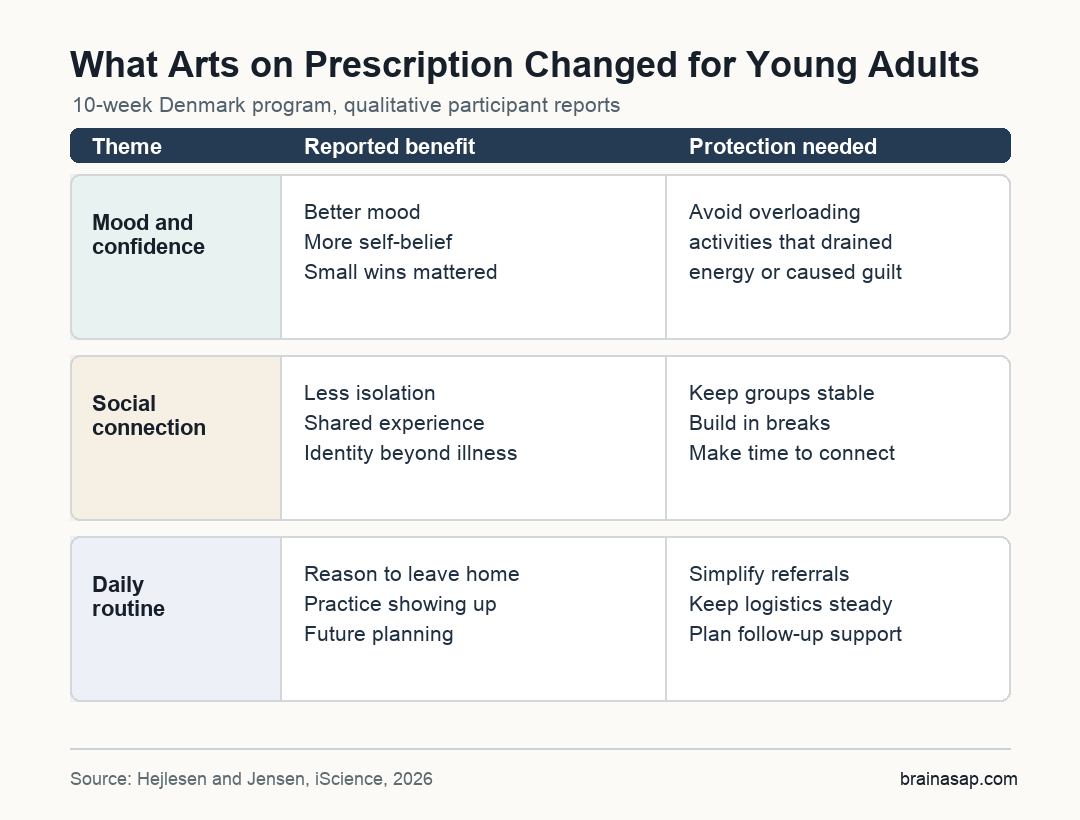
The first theme was catalyst for change. Participants described better mood, less depression, more self-confidence, and a stronger sense that small actions were possible.
The sample was not just distressed. These were young adults whose mental-health challenges were tangled with education, employment, and identity.
A weekly or near-weekly appointment could become practice for showing up again.
The practical gains were as important as the emotional ones:
- Routine: Regular sessions gave participants a reason to get up, leave home, and structure the week.
- Self-efficacy: Completing creative tasks helped some participants see that they could still learn or make something.
- Future planning: Several participants began thinking about education, internships, or work in more concrete terms.
- Self-knowledge: The program helped some participants identify which settings gave energy and which settings drained it.
Art did not replace mental-health care. In this sample, creative participation acted as a bridge when a person was not ready for work or school but needed more than passive waiting.
Peer Connection Reduced Isolation but Group Stability Still Mattered
The second theme was social aspects. Participants valued being around other people who understood mental-health difficulties without requiring long explanations.
That shared context helped reduce isolation. It also helped some participants stop seeing themselves only as sick, unemployed, or behind.
The group created room for a different identity: someone who could make, participate, sing, talk, or simply attend.
Group belonging is not automatically helpful, though. The interviews also described a fragile side of peer dynamics.
If people dropped out or attendance became irregular, some participants found it easier to withdraw as well.
For a vulnerable group, group continuity becomes part of the intervention. The activity may be ceramics or singing, but the mechanism often depends on repeated contact with familiar people.
- Shared experience reduced explanation burden: Participants did not have to defend why ordinary tasks were hard.
- Safe group norms supported attendance: Respectful, caring interactions made it easier to show up.
- Dropout affected motivation: When attendance weakened, some participants felt less anchored to the program.
Some Sessions Needed Better Safeguards and Follow-Up
The third theme was program content and structure. Participants liked many creative activities and praised coordinators, but they also named specific design problems.
Some activities were tiring. Others created pressure, especially when performance or emotional material was involved.
A young adult dealing with anxiety, stress, autism, ADHD, or chronic pain may need opt-out routes, content warnings, and explicit permission to pause without guilt.
The study also identified system-level barriers:
- Referral friction: Some participants had to push case workers or jobcentre staff to approve the program.
- Inconsistent logistics: Changing times or places created confusion for people already managing stress.
- Limited transition support: Several participants wanted more help after the program ended.
- Mismatch risk: A helpful challenge can become distressing if the activity is too exposing or poorly explained.
Those details keep the finding grounded. Arts on Prescription is not automatically gentle because it uses arts and culture.
For this population, trauma-informed pacing, clear session previews, and coordinated follow-up are part of the active design.
The Evidence Is Qualitative and Needs Careful Reading
This was a qualitative study, not a trial showing symptom-score improvement. The evidence came mainly from focus group interviews with participants who completed the program and agreed to discuss their experiences.
That creates a real limitation. The findings may underrepresent people who did not attend regularly, disliked the program, or left because it was not a good fit.
The study was also rooted in a Danish welfare and jobcentre context, so the access barriers and transition needs may look different in other countries.
Even with those limits, the study gives a practical mental-health lesson. Well-being support for young adults often needs structure, belonging, and agency at the same time.
Creative activities can provide that mix, but only when the program protects boundaries, keeps the group stable, and helps participants move into the next step.
Citation: DOI: 10.1016/j.isci.2026.115463. Hejlesen IF, Jensen A. The role of arts on prescription in supporting young adults’ mental health and life transitions. iScience. 2026;29:115463.
Study Design: Qualitative study using semi-structured focus group interviews and a small survey component after a 10-week Arts on Prescription program.
Sample Size: 22 participants aged 18 to 30 were included; 18 took part in focus groups and 4 completed a survey.
Key Statistic: Thematic analysis identified catalyst for change, social aspects, and program content and structure as the main themes shaping mental-health and transition experiences.
Caveat: The study was single-site, qualitative, and based on participants who completed the program, so it cannot estimate average symptom improvement or generalize to all young adults.