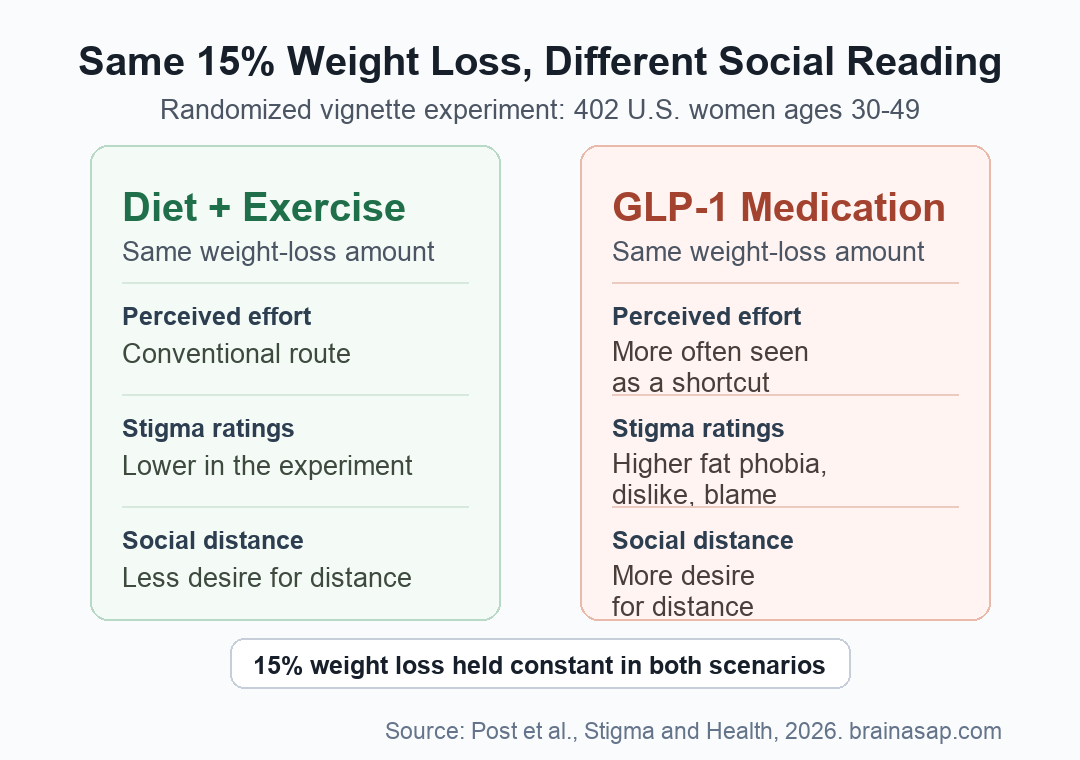
TL;DR: A 2026 study in Stigma and Health found that women who lost 15% of body weight with GLP-1 receptor agonists, medications such as semaglutide that mimic a metabolic hormone involved in appetite and glucose signaling, were judged more harshly than women who lost the same amount through diet and exercise.
Key Findings
- Medication-assisted loss drew more stigma: Participants rated a woman more negatively when her 15% weight loss came from a GLP-1 medication rather than diet and exercise.
- Shortcut beliefs explained much of the reaction: Seeing GLP-1 use as an easy way out predicted greater fat phobia, dislike, blame, and desire for social distance.
- The experiment used matched vignettes: Researchers randomly assigned 402 U.S. women ages 30 to 49 to read about the same weight-loss result with different method and race cues.
- White-target vignettes drew stronger shortcut judgments: Stigma was higher when the woman in the scenario was portrayed as white rather than Black, especially in the medication condition.
- The design cannot prove real-world behavior: The study measured reactions to brief scenarios, not how friends, clinicians, employers, or family members behave toward actual GLP-1 users.
Source: Post et al. Stigma and Health. 2026.
GLP-1 receptor agonists have changed obesity care by making large medication-assisted weight loss more common. Drugs in this class include familiar names such as Ozempic, Wegovy, Mounjaro, and Zepbound, although the paper focused on social perception rather than one brand.
The clinical question is not the same as the social one. A medication can be evidence-based and still carry stigma if observers believe the person did not lose weight the right way.
Researchers tested that social judgment directly. They asked whether the same body-weight change is read differently when it is described as the result of diet and exercise versus a GLP-1 medication.
402 Women Rated the Same 15% Weight Loss With Different Causes
The study recruited 402 U.S. women between ages 30 and 49. Participants identified as Black or white and reported being overweight or having obesity.
Each participant read a short vignette about a woman named Evette who lost 15% of her body weight. The weight-loss result stayed constant, but researchers changed two features of the scenario.
- Weight-loss method: Evette lost weight either through diet and exercise or with a GLP-1 medication.
- Target race cue: Evette was portrayed as either a Black woman or a white woman through a pretested photo paired with the same vignette.
- Measured reactions: Participants rated fat phobia, dislike, blame, desire for social distance, and whether Evette had taken a shortcut.
The design keeps the outcome fixed. Everyone in the experiment considered the same amount of weight loss; what changed was the explanation for how it happened.
GLP-1 Weight Loss Was Treated as Less Legitimate
The core result was simple: GLP-1-assisted weight loss drew more stigma than weight loss attributed to diet and exercise.
That stigma was not just a vague negative feeling. It appeared across several measures, including more blame and more desire for social distance.
The strongest explanatory signal was the shortcut belief. Participants who saw medication-assisted weight loss as an easy way out were more likely to judge Evette harshly.
- Fat phobia: Shortcut beliefs predicted stronger anti-fat attitudes toward the target.
- Dislike: The medication route increased negative personal evaluation when it was seen as less effortful.
- Blame: Participants were more likely to assign moral responsibility when the method seemed too easy.
- Social distance: Stigma also showed up as wanting more distance from the person in the vignette.
In plain terms, observers were not only judging the body. They were judging the process, effort, and perceived deservingness behind the body change.
White-Target Scenarios Produced Higher Shortcut Beliefs
The race finding was more specific. Stigma was higher when Evette was portrayed as a white woman rather than a Black woman.
Researchers interpreted this cautiously. The result suggests that shortcut assumptions may not attach to every target in the same way.
In the white-target medication condition, participants were more likely to endorse the idea that Evette had taken the easy way out. Those shortcut beliefs then predicted stronger dislike and blame.
- The target’s race cue changed interpretation: The same medication description produced different social readings depending on how Evette was portrayed.
- Participant race did not drive the GLP-1 pattern: The medication-related stigma signal appeared similarly across participant groups in this sample.
- The mechanism was still perception: The key measured pathway was what observers believed about effort and legitimacy, not any actual difference in health behavior.
This result should not be read as evidence that Black women are protected from weight stigma or medication stigma. In this specific experiment, shortcut-mediated stigma was stronger for the white-target vignette.
Why Shortcut Beliefs Matter for Obesity Treatment
Weight stigma has clinical consequences. Prior research links weight stigma to stress, depression and anxiety symptoms, health-care avoidance, and harmful health behaviors.
GLP-1 stigma is therefore more than online commentary. If people expect shame for using medication, they may delay care, hide treatment, or feel worse while managing a chronic health condition.
Obesity treatment is already loaded with moral judgment. The medication shortcut frame adds another layer: it treats biologically assisted weight loss as less legitimate than willpower-coded weight loss.
- Clinical care: Patients may need direct reassurance that evidence-based medication use is not a moral failure.
- Public communication: Explaining how GLP-1 pathways affect appetite and metabolic signaling may reduce the idea that treatment is just cheating.
- Social support: Family and peer reactions can affect whether someone feels shame, privacy pressure, or confidence around treatment.
Brief Vignettes Cannot Capture Real Social Life
The study was experimental, but the outcome was a rating after a short scenario. Scenario ratings help isolate stigma mechanisms, but they do not show how people behave in real relationships or clinical settings.
The sample was also specific: women ages 30 to 49 who identified as Black or white and reported overweight or obesity. Results may differ among men, other age groups, other racial or ethnic groups, clinicians, or people with direct GLP-1 experience.
The stronger claim is still important. When observers believed medication-assisted weight loss was a shortcut, they showed more stigma toward a woman who had lost the same amount of weight.
For a treatment class now used by millions of adults, the social message is practical: reducing stigma will require challenging the idea that there is only one acceptable way to lose weight.
Citation: DOI: 10.1037/sah0000689. Post et al. Social perceptions of weight loss with glucagon-like peptide-1 (GLP-1) receptor agonists in Black and White women with obesity. Stigma and Health. 2026.
Study Design: Randomized vignette experiment testing weight-loss method and target race cues.
Sample Size: 402 U.S. women ages 30 to 49 who identified as Black or white and reported overweight or obesity.
Key Statistic: The vignette held weight loss at 15% of body weight; GLP-1 medication use increased stigma ratings relative to diet and exercise, with shortcut beliefs mediating the effect.
Caveat: Reactions to brief scenarios may not match real-world behavior toward actual GLP-1 users.