TL;DR: A 2026 mouse study in Nature Neuroscience found that glucose signaling through ATP-citrate lyase (ACLY), an enzyme that links sugar metabolism to gene regulation, helped oligodendrocyte progenitor cells multiply before they matured into myelin-forming cells.
Key Findings
- Glucose mapped onto cell state: Developing mouse-brain regions with higher glucose had more proliferating oligodendrocyte progenitor cells, while lower-glucose regions had more maturing oligodendrocytes.
- ACLY was required for progenitor expansion: Removing ATP-citrate lyase from oligodendrocyte progenitor cells reduced their ability to multiply effectively.
- Myelin reduction was temporary: Mice lacking ACLY in these progenitor cells showed a temporary reduction in myelin because the starting cell pool was smaller.
- Maturing cells used alternate fuels: Oligodendrocytes still matured by relying on acetyl-CoA made from other sources, including ketone-related metabolism.
- Ketogenic diet improved deficits in mice: In transgenic mice lacking ACLY in oligodendrocyte progenitor cells, a ketogenic diet improved the myelin deficits reported in the study.
Source: Nature Neuroscience (2026) | Sauma et al.
Glucose Acted Like a Developmental Timing Signal
The brain does not build myelin everywhere at once. Myelin is the fatty insulation wrapped around nerve fibers, and it helps electrical signals travel quickly and reliably.
The cells that make myelin, oligodendrocytes, arise from dividing precursor cells called oligodendrocyte progenitor cells or OPCs.
Researchers focused on a basic timing problem: why some developing brain regions keep expanding their OPC pool while others start pushing those cells toward myelin production. Their answer was metabolic.
Local glucose levels did not simply reflect energy supply; they tracked whether the cell lineage was still multiplying or beginning to mature.
Using spatial metabolic mapping in developing mouse brains, researchers found a clear regional pattern:
- Higher-glucose regions: more OPCs were actively dividing.
- Lower-glucose regions: more cells were beginning to mature into myelin-producing oligodendrocytes.
- Changing glucose over time: the same lineage appeared to shift from expansion toward maturation as the local metabolic environment changed.
Myelination is not just a late finishing step. It supports developmental milestones such as movement, language, and fast circuit communication, and disruption during vulnerable windows can leave white-matter injury.
ACLY Linked Glucose Metabolism to OPC Proliferation
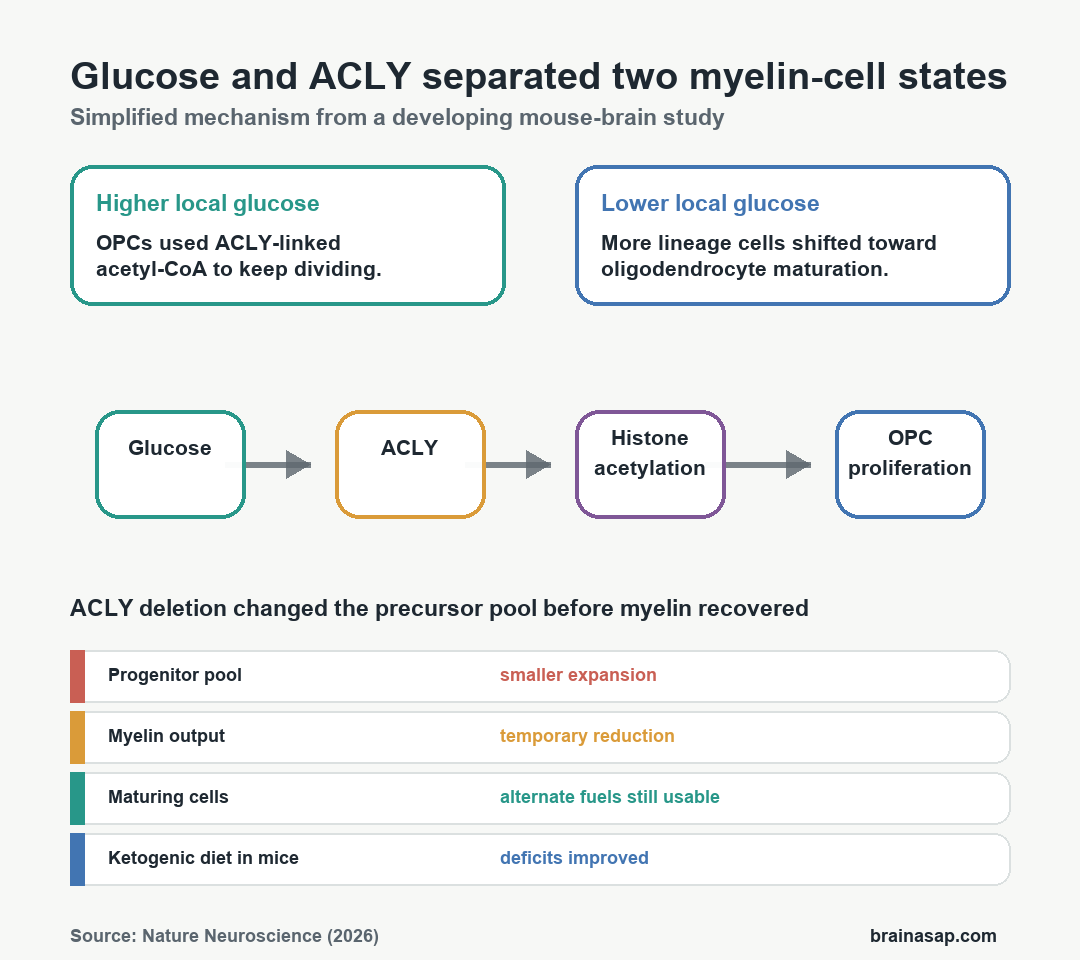
The central enzyme was ATP-citrate lyase, usually shortened to ACLY. ACLY converts glucose-derived carbon into acetyl-CoA, a small metabolic molecule that can support histone acetylation, a chemical change on DNA-associated proteins that helps regulate which genes are active.
In this study, that pathway mattered most for the dividing precursor stage. When researchers genetically deleted ACLY in OPCs, the cells could no longer expand normally.
Those mice had a smaller progenitor pool and showed a temporary reduction in myelin.
The finding separates two jobs that can blur together in myelin biology:
- Cell-pool building: OPCs needed glucose-derived ACLY activity to support proliferation.
- Cell maturation: later oligodendrocyte differentiation continued even when the ACLY-dependent progenitor expansion step was impaired.
- Myelin output: the downstream deficit came partly from having fewer precursor cells available at the right developmental time.
A treatment or nutrition question about myelin repair often has different answers for different cell stages. The metabolic need of a dividing progenitor differs from the metabolic need of a maturing myelin-producing cell.
Maturing Oligodendrocytes Could Switch Fuel Sources
The study did not show that glucose is always the preferred or only useful fuel for the oligodendrocyte lineage. Instead, it suggested a stage-specific split.
OPCs depended on glucose-derived acetyl-CoA for proliferation, while more mature oligodendrocytes relied on acetyl-CoA generated outside the nucleus from other fuels.
Ketone-related metabolism was the clearest example in the study report. When transgenic mice lacking ACLY in OPCs were placed on a ketogenic diet, which raises circulating ketone bodies, their myelin deficits improved.
The ketogenic-diet finding needs a narrow reading. It is not evidence that low dietary sugar builds myelin, and it does not translate directly into advice for pregnancy, premature infants, multiple sclerosis, or brain repair.
The experiment was a mouse model with a specific genetic deletion in a specific cell lineage.
The cleaner interpretation is narrower and stronger: oligodendrocyte-lineage cells use different metabolic routes at different developmental stages. The timing of available fuels helps shape whether the lineage expands, matures, or supports myelin production.
Premature White-Matter Injury Is the Clinical Context
The developmental window discussed in the source corresponds roughly to the late human gestational period, about 32 to 40 weeks. That is clinically important because premature birth can interrupt the environment in which myelin-building progenitor cells normally expand and mature.
The study points to a practical research direction, not a bedside protocol. Researchers can now ask cell-stage-specific questions:
- Timing: which developmental windows require glucose-supported OPC proliferation?
- Cell state: when do oligodendrocytes become less dependent on ACLY and more able to use alternate fuels?
- Injury repair: does metabolic support protect or restore the progenitor pool after developmental white-matter injury?
- Disease relevance: do similar fuel-switching rules apply in demyelinating diseases such as multiple sclerosis?
Those questions are more actionable than a generic claim that metabolism affects the brain. The study gives a specific link: glucose availability, ACLY-regulated histone acetylation, progenitor proliferation, and myelin timing.
Cellular Sugar Sensing Is Not Dietary Advice
The most important boundary is simple. Low glucose in this study refers to local metabolic shifts inside developing brain regions, not a recommendation to lower blood sugar or change dietary intake.
The brain needs a stable glucose supply, and development is not a self-experimentation target.
The mechanistic takeaway is direct. Myelin development depends partly on whether the right cell type receives the right metabolic signal at the right time.
In OPCs, glucose-derived ACLY activity helped maintain the dividing precursor pool. In maturing oligodendrocytes, alternate acetyl-CoA sources still supported myelin formation.
The result reframes myelin as a timing problem, a cell-state problem, and a metabolic-routing problem at once. Future repair strategies need to ask not only how to make more myelin, but which metabolic state a myelin-forming cell is in before trying to push it.
Citation: DOI: 10.1038/s41593-026-02263-7. Sauma et al. Glucose-dependent spatial and temporal modulation of oligodendrocyte progenitor cell proliferation via ACLY-regulated histone acetylation. Nature Neuroscience. 2026.
Study Design: Developmental mouse-brain study using spatial metabolic mapping and oligodendrocyte-lineage ACLY deletion.
Sample/Model: Developing mouse brains and transgenic mice with ACLY removed from oligodendrocyte progenitor cells.
Key Statistic: OPC-specific ACLY deletion produced a temporary myelin reduction, and ketogenic-diet exposure improved myelin deficits in the mouse model.
Caveat: Mouse developmental findings do not provide direct dietary guidance for humans or clinical treatment recommendations.