TL;DR: A 2026 Nature Communications study found that extra MeCP2, the dosage-sensitive protein linked to Rett syndrome and MECP2 duplication syndrome, disrupted neural progenitor cells far more than mature neurons by activating developmental genes too early.
Key Findings
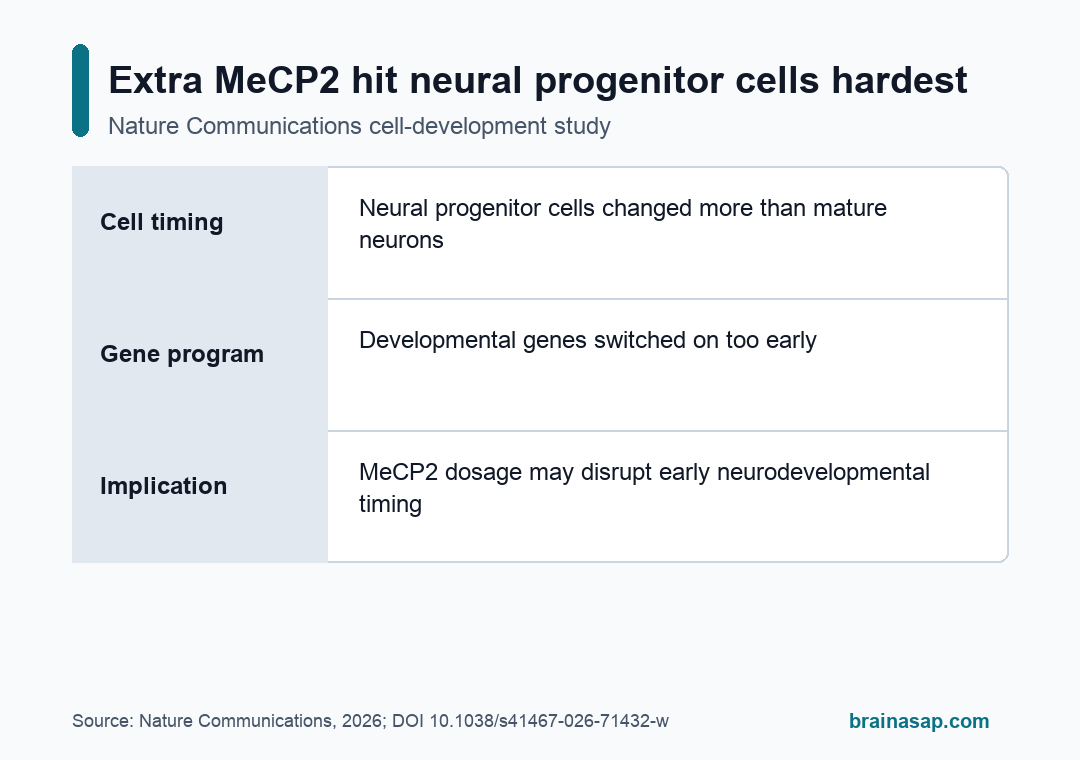
- Cell timing mattered: MeCP2 overexpression caused broad transcriptional changes in neural progenitor cells, but only modest changes in mature neurons.
- Developmental genes switched on early: Extra MeCP2 accumulated at CpG islands, DNA regions often found near gene starts, and activated bivalent genes that help steer cell fate.
- SWI/SNF was part of the mechanism: The study linked the abnormal gene activation to interaction with the SWI/SNF chromatin remodeling complex, a protein machine that changes how DNA is packaged.
- Mouse and human cells converged: Researchers saw the same broad pattern in mouse neural cells and human neural cells, strengthening the cell-type interpretation.
- Gene therapy context changed the safety frame: The result suggests mature neurons may tolerate added MeCP2 better than embryonic or progenitor-stage cells, which shapes Rett syndrome replacement strategies.
Source: Nature Communications (2026) | Luoni et al.
Why MeCP2 Dosage Is a Timing Problem, Not Just a Level Problem
MeCP2 is a DNA-binding protein that helps regulate gene expression in brain cells. Too little functional MECP2 causes Rett syndrome, while too much MECP2 causes MECP2 duplication syndrome.
The protein is unusually tricky for treatment: the brain appears to need a narrow dosage range, and the wrong amount can damage development.
This study asks whether the same increase has different consequences depending on the cell’s developmental state. Researchers tested extra MeCP2 in immature neural cells and mature neurons.
The distinction is therapy-relevant because MECP2 duplication syndrome begins during development, while many Rett syndrome gene-replacement ideas would add MECP2 to a more mature nervous system.
The main answer was clear: neural progenitor cells, the immature cells that produce neurons, were much more vulnerable than mature neurons.
In progenitors, extra MeCP2 reshaped gene expression and pushed developmental programs. In mature neurons, the same overexpression produced far smaller transcriptional and functional effects.
What Happened in Neural Progenitor Cells
Neural progenitor cells sit near the start of brain-cell development, before a cell has fully committed to a mature neuronal identity. The data suggest that this early state gives extra MeCP2 more room to disrupt the gene-control system.
The key progenitor-cell effects were specific enough to explain why timing matters:
- Low baseline MeCP2: Progenitor cells normally carry less endogenous MeCP2 than mature neurons, so added MeCP2 can occupy regulatory DNA more strongly.
- CpG island binding: Extra MeCP2 deposited onto CpG islands, DNA regions near many gene promoters, instead of creating a totally new binding map.
- Bivalent gene activation: Developmental genes that are usually held in a poised state became activated, which can shift the timing of neural differentiation.
- Functional downstream change: Progenitor-stage overexpression altered neurogenesis and later neuronal activity, connecting the molecular result to cell behavior.
Bivalent genes are genes carrying chromatin marks that keep them ready but restrained. That setup is useful during development because cells need to turn fate-determining genes on at the right time.
The problem in this study was that extra MeCP2 appeared to push some of those genes out of waiting mode too early.
Why Mature Neurons Were More Resistant
Mature neurons already express high levels of MeCP2. In that context, adding more protein did not have the same broad effect.
Researchers found reduced CpG island binding by the ectopic protein and faster degradation. Mature neurons seemed to limit the extra dosage before it could broadly rewrite transcription.
Mature neurons still showed some dosage sensitivity, so Rett syndrome treatment would need careful control.
The contrast was important: developmental context changed both the amount of MeCP2 that stayed bound to regulatory DNA and the size of the transcriptional response.
This difference helps explain why a lifelong duplication syndrome can look severe even if adult-gene-delivery experiments sometimes appear more tolerable. The same molecule can be more disruptive when it arrives during a developmental window in which cell identity is still being built.
How SWI/SNF Connected MeCP2 to Developmental Gene Activation
The study also identified a mechanism involving the SWI/SNF chromatin remodeling complex. Chromatin remodeling complexes change how tightly DNA is packaged around proteins, making genes easier or harder to access.
In progenitor cells, MeCP2 overexpression interacted with SWI/SNF in a way that helped activate developmental bivalent genes.
That mechanism is useful because it turns the result into more than a broad dosage warning. It suggests a sequence:
- Extra MeCP2 enters a low-MeCP2 progenitor state.
- The protein binds CpG islands near developmental genes.
- SWI/SNF-linked remodeling makes those genes more active.
- Neurogenesis and later neuronal function shift away from the normal developmental program.
That sequence fits the clinical logic of MECP2 duplication syndrome, where the dosage problem is present from early life.
It also points toward a more nuanced safety test for gene therapy: the risk is not only how much MECP2 is delivered, but which cells receive it and at what developmental stage.
MeCP2 Dose Timing Matters for Gene Therapy Safety
Rett syndrome therapies aim to restore MeCP2 function, but the narrow dosage window has always raised concern. This study does not prove that adding MECP2 to the mature brain is automatically safe.
It does argue that mature neurons may be more buffered against overexpression than neural progenitor cells because they already contain high MeCP2 and can reduce ectopic protein accumulation.
For safety testing, a therapy that reaches mature neurons at controlled levels may carry a different risk profile than a developmental duplication affecting progenitors and early neural lineages.
Future safety testing should therefore separate:
- Cell type: progenitor cells, immature neurons, mature neurons, and non-neuronal brain cells may not respond the same way.
- Developmental timing: embryonic, postnatal, and adult delivery could produce different molecular consequences.
- Dose control: even buffered mature neurons may still be vulnerable if expression is too high or too widespread.
The result does not remove dosage risk in mature neurons. It shows that MeCP2 dosage risk is conditional.
Cell state, endogenous protein level, chromatin context, and protein turnover all shape whether added MeCP2 becomes a manageable correction or a developmental disruption.
Citation: DOI: 10.1038/s41467-026-71432-w. Luoni et al. MeCP2 gene dosage-dependent neurodevelopmentally restricted defects arise by aberrant activation of cell fate-determining bivalent genes. Nature Communications. 2026;17:3225.
Study Design: Mouse and human neural-cell experiments using RNA sequencing, CUT&Tag, chromatin assays, and functional validation of MeCP2 overexpression across developmental cell states.
Sample/Model: Mouse neural progenitor cells and neurons, human neural-cell contexts, and in vivo validation focused on MeCP2 overexpression timing.
Key Statistic: Progenitor cells showed broad transcriptional and functional disruption, while mature neurons showed comparatively modest effects.
Caveat: The study clarifies cellular mechanisms and therapy-relevant safety logic, but it is not a clinical gene-therapy trial in Rett syndrome patients.