TL;DR: A 2026 preprint posted to medRxiv found that adults with migraine had worse brain fog, more task forgetting, and slower smartphone cognitive-test performance on headache days, suggesting that migraine-related cognitive symptoms can be measured in daily life rather than only in clinic visits.
Key Findings
- Brain fog affected 60% of headache days: participants contributed 3,014 person-days for headache-day versus non-headache-day comparisons.
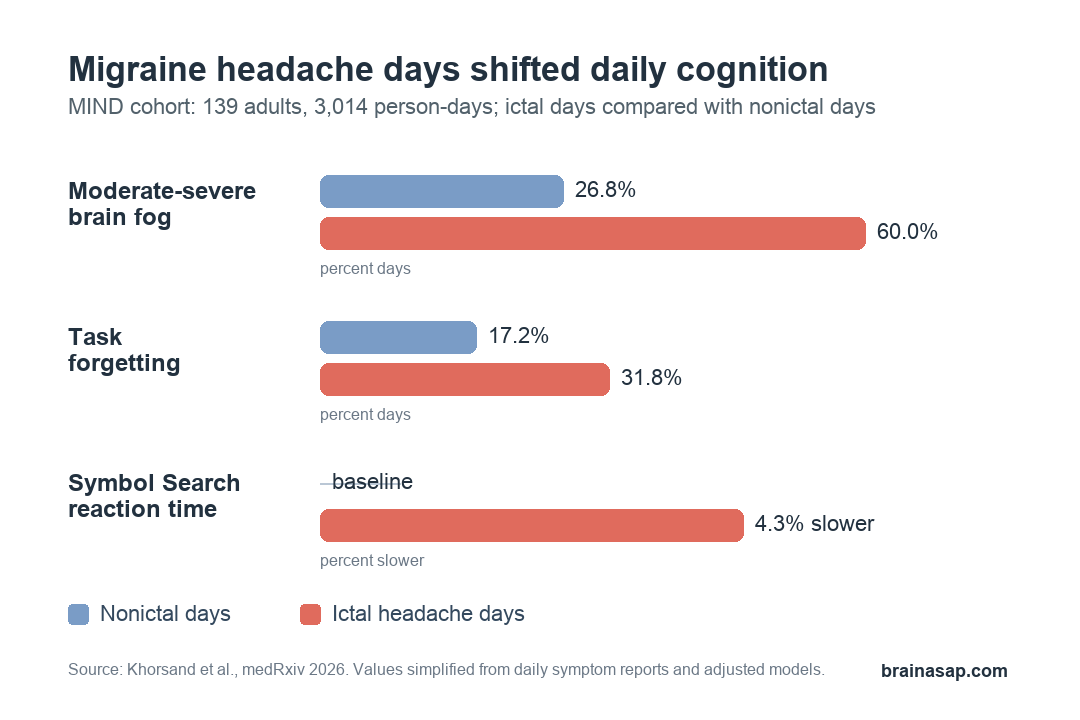
- Brain fog was more common during attacks: moderate-to-severe brain fog appeared on 60.0% of ictal days, compared with 26.8% of nonictal days.
- Forgetting also increased: same-day task forgetting was reported on 31.8% of ictal days, compared with 17.2% of nonictal days.
- Processing speed slowed: Symbol Search reaction time was 4.3% slower on ictal days, and Color Dots reaction time was 1.5% slower.
- Working-memory accuracy dropped: Grid Memory accuracy was lower on headache days, with an odds ratio of 0.867.
Source: Khorsand et al. used 30 days of daily smartphone diaries and cognitive tasks to compare migraine headache days with headache-free days.
Migraine Brain Fog Was Tracked Day by Day
Migraine brain fog is often described as slowed thinking, poor concentration, or difficulty remembering ordinary tasks. Those symptoms matter clinically, but they are hard to capture if testing happens only at a scheduled clinic visit.
This study used the MIND cohort, short for Migraine Impact on Neurocognitive Dynamics, to measure cognition closer to daily life. Adults with migraine completed smartphone reports and brief cognitive tasks for 30 consecutive days.
The design focused on within-person change. Instead of asking whether people with migraine differ from unrelated controls, researchers asked whether the same person’s cognition changed on a headache day.
- Ictal day: a day when the participant reported having a headache at the time of the daily assessment.
- Nonictal day: a day when the participant did not report a current headache.
- Phase-classified day: a subset of days labeled as preictal, ictal, postictal, or interictal using adjacent diary entries.
This within-person design fits migraine because symptoms are state-dependent. A person can feel cognitively different during an attack even if ordinary between-person testing misses the change.
The MIND Cohort Captured 3,014 Person-Days
The final analytic sample included 139 adults after minimum-data and quality-control exclusions. The cohort was 84.9% female, with a mean age of 38.2 years and a mean baseline headache frequency of 13.8 days per month.
Participants contributed 2,097 nonictal days and 917 ictal days to the main headache-day comparison. A smaller subset, 1,828 person-days, could be assigned to more specific migraine phases.
Each daily session paired symptom reporting with three objective cognitive tasks:
- Symbol Search: a processing-speed and visual-search task.
- Color Dots: a visual working-memory and attention task using color-location recall.
- Grid Memory: a visuospatial working-memory task requiring people to reproduce dot locations on a grid.
The main objective outcomes were reaction time, accuracy, and a speed-accuracy composite. Models adjusted for age, sex, and practice effects, because people often improve slightly as they repeat smartphone tasks.
Headache Days Carried More Brain Fog and Forgetfulness
The subjective symptom signal was large. On ictal days, moderate-to-severe brain fog was reported on 60.0% of days. On nonictal days, that figure was 26.8%.
Adjusted models told the same story. Ictal days were associated with higher odds of more severe brain fog, with an odds ratio of 3.39 and a 95% confidence interval of 2.70 to 4.27.
Task forgetting also increased during attacks. Participants reported forgetting tasks on 31.8% of ictal days, compared with 17.2% of nonictal days.
In adjusted models, the odds of task forgetting were about 2.8 times higher on ictal days. The finding fits the patient description of migraine as more than pain: during attacks, daily planning and follow-through can become harder.
Objective Smartphone Tasks Also Shifted During Attacks
The objective changes were smaller than the symptom-report changes, but they moved in a clinically coherent direction. On headache days, Symbol Search reaction time was slower, with a reaction-time ratio of 1.043.
Converted from the ratio, Symbol Search performance was about 4.3% slower during attacks.
Color Dots reaction time also slowed on ictal days, with a ratio of 1.015, or about 1.5% slower. Grid Memory reaction time did not differ significantly in the primary headache-day comparison.
Accuracy showed a different pattern. Grid Memory accuracy was lower on ictal days, with an odds ratio of 0.867 and a 95% confidence interval of 0.823 to 0.914.
- Processing speed: headache days were linked to slower visual search and attention performance.
- Working memory: reaction-time effects were less consistent, but Grid Memory accuracy declined during attacks.
- Subjective burden: brain fog and forgetting changed more sharply than brief task accuracy.
The subjective reports and objective tasks measured different layers of cognition. Patient-reported cognitive burden may include mental effort, fatigue, reduced efficiency, task avoidance, and disrupted daily functioning that a short accuracy score captures only partly.
Preictal and Postictal Labels Were Harder to Separate
The study also tried to classify days as preictal, postictal, or interictal. Those labels use surrounding diary entries to estimate whether a headache-free day occurred just before or just after an attack.
The clearest separation remained ictal versus nonictal. Reaction times were generally faster outside headache days, but the differences among preictal, postictal, and interictal periods were limited.
The timing limit matters for interpretation. Migraine phases do not always fit cleanly into once-daily diary boxes.
Premonitory symptoms can begin before headache onset, and postdrome symptoms can last beyond the headache itself.
- Once-daily sampling: one assessment per day can miss the onset, peak, and recovery curve of an attack.
- Adjacent-day rules: phase labels depend on complete surrounding diary entries.
- Clinical timing: a person tested during an attack may look slower than their usual headache-free baseline.
Digital Cognition Could Complement Migraine Diaries
Most migraine trials and routine tracking still depend heavily on patient-reported outcomes, such as headache days, pain freedom, or symptom severity. Those measures are necessary, but they do not fully capture functional cognition.
Brief smartphone tasks could add a low-burden objective layer. They may help measure whether a treatment improves cognitive efficiency, not only whether it reduces pain.
Main limitation: this was a preprint in a remote, mostly female, self-selected cohort recruited largely through social media. Testing context, sleep, stress, medication timing, screen conditions, and time of day could all affect performance.
The repeated-measures result is useful because it measured the same people over time. For migraine care, the practical question is not whether a person is globally impaired, but whether an attack temporarily changes how well they can think, remember, and function.
Citation: DOI: 10.64898/2026.04.14.26350892. Khorsand et al. Digital Assessment of Objective and Patient-Reported Cognition Across Migraine Phases: Results from the MIND Cohort. medRxiv. 2026.
Study Design: Prospective decentralized observational study using 30 days of smartphone diaries and cognitive tasks.
Sample Size: 139 adults with migraine contributed 3,014 person-days for the main headache-day comparison.
Key Statistic: Ictal days had higher odds of severe brain fog (OR 3.39) and slower Symbol Search reaction time (ratio 1.043).
Caveat: The source is a preprint and the once-daily remote design may not fully resolve preictal, ictal, postictal, and interictal timing.