TL;DR: A 2026 nationwide study in Journal of Korean Medical Science found that among South Korean children and adolescents with intellectual disability, diagnosed ADHD increased from 30.23% in 2012 to 41.77% in 2021, while diagnosed depression increased from 10.46% to 19.37%.
Key Findings
- Population: Researchers analyzed South Korean national health-insurance records for children and adolescents ages 2 to 18 with intellectual disability (ID), with yearly cohorts ranging from 10,638 to 14,587.
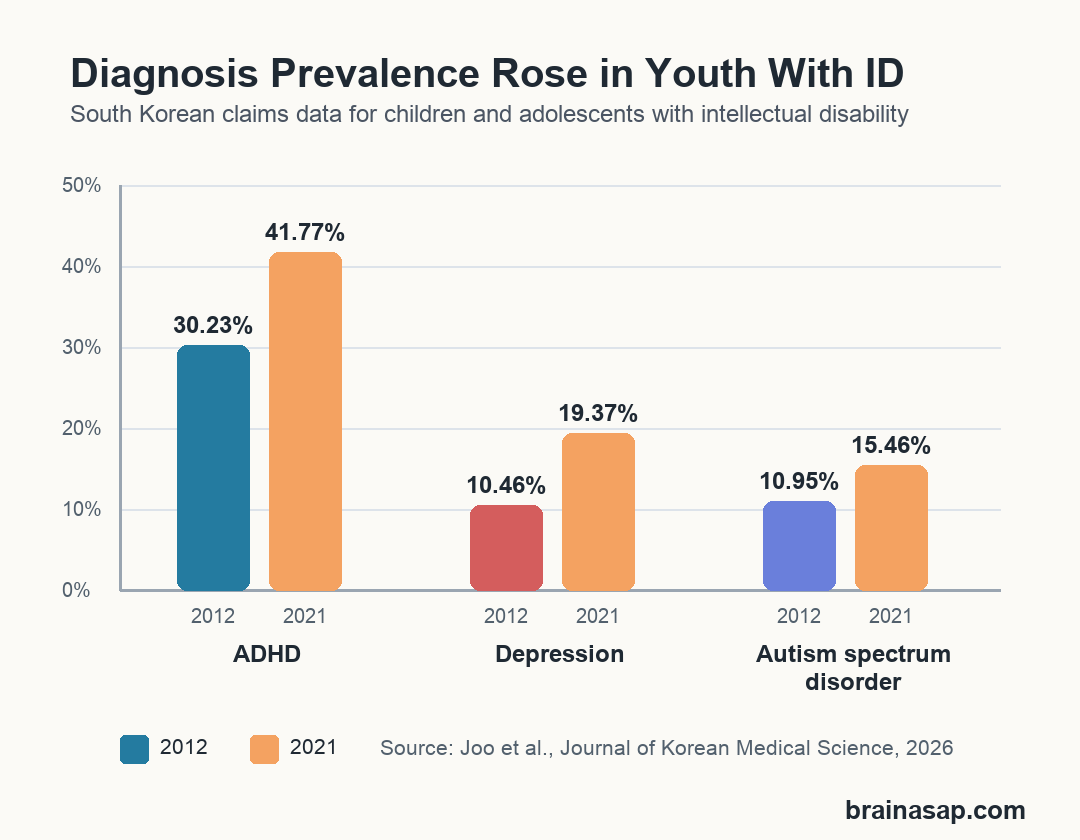
- ADHD trend: Diagnosed attention-deficit/hyperactivity disorder (ADHD) was the most common psychiatric comorbidity and increased from 30.23% in 2012 to 41.77% in 2021.
- Depression trend: Diagnosed depressive disorder nearly doubled, rising from 10.46% to 19.37% across the same period.
- ASD trend: Autism spectrum disorder (ASD) diagnoses also increased, from 10.95% in 2012 to 15.46% in 2021.
- Main caveat: The study used claims diagnoses, so children with ID who did not reach hospital-based care could have been missed.
Source: Joo et al. 2026.
Children with intellectual disability often need care for more than developmental support. Psychiatric diagnoses can shape school planning, family stress, medication decisions, and access to therapy.
This study looked at whether those diagnoses changed over time in South Korea. The researchers used the National Health Insurance Service-National Health Information Database, or NHIS-NHID, a nationwide claims database.
The study included children and adolescents who had an ID diagnosis recorded at least twice from 2012 through 2021. That repeated-diagnosis rule made the cohort more specific than a single billing-code screen.
ADHD Was the Most Common Psychiatric Diagnosis
The clearest result was the size and persistence of ADHD. Across every year, ADHD was the most common psychiatric diagnosis tracked in children and adolescents with ID.
Its prevalence increased from 30.23% in 2012 to 41.77% in 2021. In practical terms, the 2021 cohort had more than 4 in 10 children or adolescents with ID carrying an ADHD diagnosis in the claims data.
The paper tracked several psychiatric and neurodevelopmental conditions:
- Neurodevelopmental diagnoses: ADHD, autism spectrum disorder, language disorder, and tic disorders.
- Internalizing diagnoses: anxiety disorders and depressive disorder.
- Behavior diagnoses: conduct disorder and oppositional defiant disorder.
ADHD matters here because attention, impulsivity, and activity regulation can affect educational support and behavior planning. When ADHD is common in an ID cohort, clinicians may need to screen for it rather than treating all attention problems as part of ID itself.
Depression Rose Nearly Twofold From 2012 to 2021
Depressive disorder had one of the largest changes. Diagnosed depression increased from 10.46% in 2012 to 19.37% in 2021.
That does not prove that depression symptoms almost doubled in the population. Claims data can reflect changing awareness, access, diagnostic coding, and service use.
The recorded increase is still clinically important because depression can be harder to detect in children with communication or cognitive limitations.
The study also found a sex difference. Depression showed female predominance, while several neurodevelopmental and behavior diagnoses showed male predominance.
For families and care teams, the sex-stratified results support a simple point: psychiatric screening in ID should not stop after developmental or behavior labels are assigned. Mood symptoms need their own attention.
Autism and Tic Disorder Diagnoses Also Increased
Autism spectrum disorder, or ASD, increased from 10.95% to 15.46%. Tic disorders increased from 4.04% to 8.61%.
Those changes may partly reflect better recognition. ID and ASD often overlap, and improved access to assessment can change the number of children who receive both labels.
The study’s sex-stratified results also fit common clinical patterns:
- Male-predominant diagnoses: ADHD, ASD, tic disorders, language disorder, conduct disorder, and oppositional defiant disorder.
- Female-predominant diagnosis: depressive disorder.
- No clear sex difference: anxiety disorders did not show a significant sex difference in this analysis.
The diagnosis trend should not be read as proof that every condition became biologically more common. The data show more recorded psychiatric diagnoses in a high-support population, which can mean more detection, more burden, or both.
Claims Data Can Show Trends, Not Untreated Need
The strongest feature of the paper is scale. Yearly cohorts ranged from 10,638 to 14,587 children and adolescents with ID, and the dataset covered a national health-insurance system rather than one clinic.
That scale gives the trend more weight than a small hospital series. It also lets researchers compare diagnosis categories across the same health-system structure.
The limitation is just as important. A claims database only sees children who reach care and receive diagnostic coding.
- Missed cases: children with ID outside hospital-based care may not appear in the dataset.
- Diagnostic coding: billing codes may not capture symptom severity or the full clinical interview.
- Unmeasured drivers: the study did not test how income, region, school access, or family factors explained the diagnosis trends.
Those caveats mean the study should be read as a diagnosis-prevalence trend, not a direct measure of every psychiatric symptom in South Korean children with ID.
Screening Needs to Follow the Child, Not the Label
Care teams should keep screening over time. Children and adolescents with ID may also have treatable psychiatric conditions, and those conditions can change over childhood.
A developmental diagnosis should not make ADHD, depression, anxiety, or ASD screening optional. In this national dataset, ADHD affected 41.77% of the 2021 cohort, and depression affected 19.37%.
That is a high enough burden to justify routine psychiatric review, especially when behavior changes, sleep changes, irritability, loss of interest, school refusal, or family strain appear.
The study does not say that medication is always needed. It says psychiatric comorbidity is common enough in ID that care systems should look for it directly.
Citation: DOI: 10.3346/jkms.2026.41.e126. Study authors et al. Joo et al. Time trends in the comorbid psychiatric disorders of children and adolescents with intellectual disability in Korea: a nationwide population-based study from 2012-2021. Journal of Korean Medical Science . 2026;41(15):e126.
Study Design: Nationwide retrospective claims-database study using South Korea’s NHIS-NHID records from 2012 through 2021.
Sample Size: Annual cohorts of children and adolescents ages 2 to 18 with intellectual disability ranged from 10,638 to 14,587 participants.
Key Statistic: ADHD diagnosis prevalence increased from 30.23% to 41.77%; depressive disorder increased from 10.46% to 19.37%.
Caveat: Claims diagnoses can miss children who did not reach hospital-based care and cannot measure all untreated psychiatric symptoms.