TL;DR: A 2026 study in Comprehensive Psychoneuroendocrinology found that adulthood stressor severity was linked to higher hair cortisol in a longitudinal sample, while early-life stress, recent stress, daily phone-based stress reports, and the cortisol/DHEA ratio did not show consistent associations.
Key Findings
- 2 aligned samples were tested: Study I included 79 adults, and Study II included 86 adults measured at 2 time points 3 months apart.
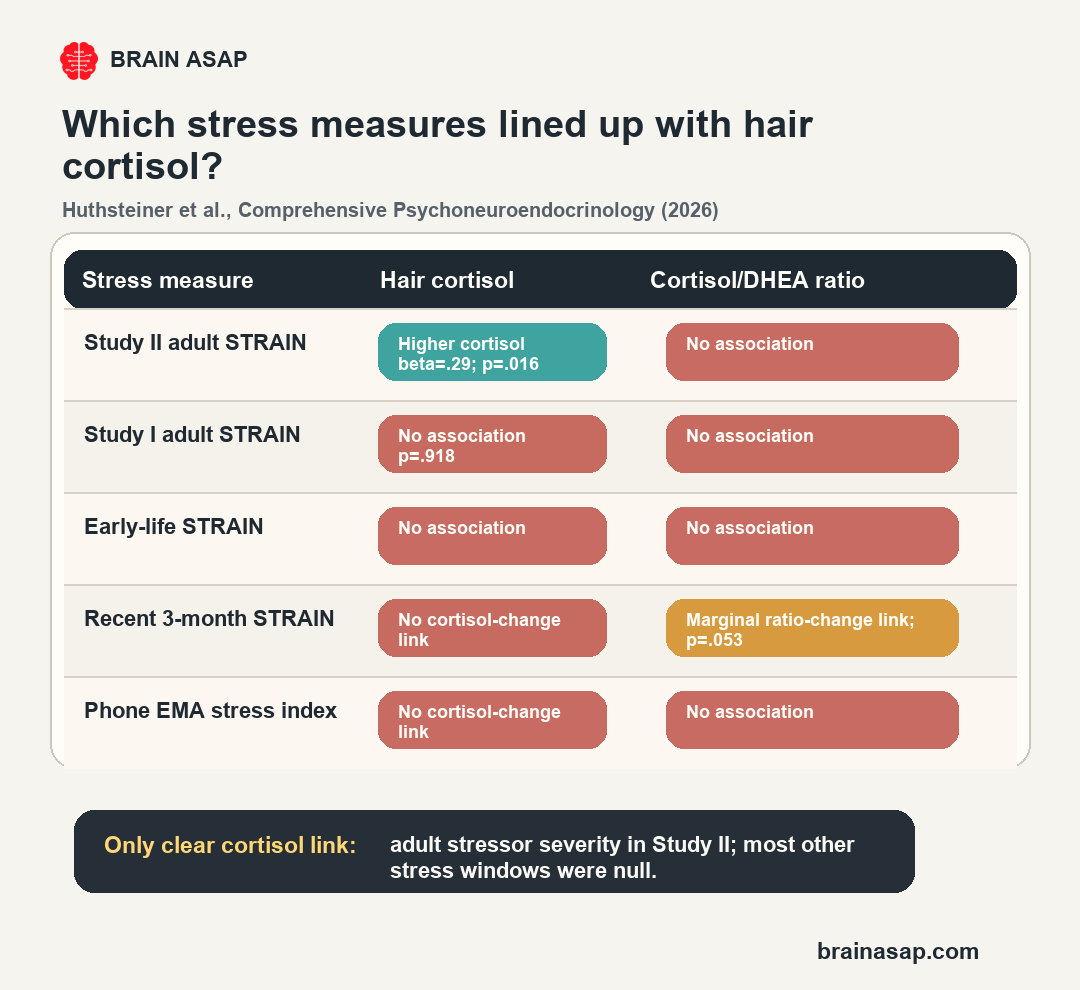
- Adult stressor severity tracked cortisol in Study II: greater STRAIN adulthood stress exposure predicted higher hair cortisol in the adjusted model (beta = 0.29; p = .016).
- Study I did not replicate the cortisol link: adulthood stressor exposure was not associated with hair cortisol in the cross-sectional sample (p = .918 unadjusted).
- Recent stress did not predict cortisol change: neither the 3-month Recent STRAIN nor the phone-based EMA stress index was significantly related to changes in hair cortisol.
- Cortisol/DHEA ratio was mostly uninformative: the ratio showed no consistent stress associations, with only a marginal adjusted link between recent STRAIN and ratio change (p = .053).
Source: Comprehensive Psychoneuroendocrinology (2026) | Huthsteiner et al.
Hair cortisol is often used as a biological readout of longer-term cortisol output, because the proximal 3 centimeters of hair can roughly reflect hormone exposure across recent months. Chronic stress research needs that longer window because a single blood or saliva sample may miss the broader pattern.
The problem is that stress is not a single clean exposure. A person can report severe lifetime adversity, daily hassles, recent stressful events, or momentary stress in a phone survey, and those measures may not line up with the same biological window.
Hair Cortisol Was Tested Against Several Stress Windows
Researchers ran 2 methodologically aligned studies to test whether more detailed stress measurement would make the hair cortisol pattern clearer. Both studies used the Stress and Adversity Inventory (STRAIN), an online tool that captures stressor count, severity, timing, duration, and life domain.
Study I was cross-sectional. It included 79 participants who provided hair samples and lifetime STRAIN data split into early-life and adulthood stressor exposure.
Study II followed 86 participants across 2 laboratory sessions separated by 3 months. It added a 3-month Recent STRAIN measure and ecological momentary assessment, or EMA, meaning repeated phone-based stress reports collected during daily life.
- Lifetime adult stress: cumulative adulthood stressor exposure from the STRAIN.
- Early-life stress: cumulative stressor exposure from earlier developmental periods.
- Recent stress: a 3-month STRAIN measure designed to match the hair sampling window.
- Daily stress experience: repeated phone prompts using perceived-stress and daily-stressor items.
Adulthood Stressor Severity Predicted Higher Hair Cortisol Only in Study II
The clearest positive result came from Study II. Greater adulthood stressor exposure was associated with higher hair cortisol across both time points, and the association remained significant after adjustment for age, sex, waist-to-hip ratio, anxiety/depressive symptoms, and hair treatment.
The adjusted standardized coefficient was beta = 0.29, with p = .016. In plain terms, participants who reported more severe adulthood stressors tended to have higher hair cortisol in this sample.
That result did not mean every stress measure worked. The same study found no significant hair cortisol association for early-life stressor exposure, recent STRAIN stress, or the EMA stress index.
The Cross-Sectional Study Found No Cortisol Association
Study I is the main caution. Despite using a similar lifetime STRAIN approach, neither adulthood nor early-life stressor exposure was significantly associated with hair cortisol.
For adulthood stressor exposure, the unadjusted result was essentially null: p = .918. The adjusted model also showed no significant predictors, with an adjusted R-squared below zero, meaning the model did not explain meaningful variance beyond noise in that sample.
The split result prevents a simple headline that chronic stress always raises hair cortisol. The stronger interpretation is narrower: adulthood stress severity may track hair cortisol under some sample and measurement conditions.
The relationship was not stable enough to treat as a universal biomarker rule.
Recent Stress and Daily Phone Reports Did Not Match Cortisol Change
The recent-stress finding may sound counterintuitive. Hair cortisol is often described as a recent-months marker, so a 3-month stress inventory and 3 months of phone-based reports should, in theory, be well aligned.
That did not happen here. In Study II, changes in hair cortisol were not significantly related to the 3-month Recent STRAIN or to the EMA stress index.
The paper’s interpretation is that severity and persistence may matter more than the mere amount of recent stress. Everyday fluctuations in a healthy young sample may not be intense enough to shift long-term cortisol output detectably.
- Recent STRAIN: captured stressor exposure during the preceding 3 months.
- EMA stress index: summarized repeated phone reports of momentary perceived stress and daily stressors.
- Hair cortisol change: did not significantly track either recent-stress measure.
The Cortisol/DHEA Ratio Added Little Clear Signal
Researchers also tested the cortisol/DHEA ratio. DHEA, or dehydroepiandrosterone, is another adrenal steroid that can counterbalance some cortisol-related processes, so the ratio has been proposed as a broader marker of hypothalamic-pituitary-adrenal axis activity.
In this paper, the ratio was not consistently related to stress exposure. Early-life and adulthood STRAIN measures did not predict it, and recent stress did not clearly predict ratio change.
A borderline result did appear: greater recent STRAIN stress was marginally associated with a larger decrease in the cortisol/DHEA ratio after adjustment, with p = .053. The association is not strong enough to carry the main claim, but it may be worth testing in larger samples.
The Useful Message Is Measurement Specificity, Not Biomarker Certainty
The study separates several stress windows instead of treating stress as a single variable. It also shows why hair cortisol should not be oversold as a straightforward chronic-stress detector.
The strongest result points toward adulthood stressor severity, not early adversity, not recent daily stress, and not a general stress score. Even that result appeared in Study II and not Study I.
Several limits shape the interpretation:
- Healthy young samples: both studies used selective eligibility criteria and relatively young participants.
- Self-reported stress: STRAIN is detailed, but retrospective reports can still miss or reshape exposure history.
- Complex cortisol biology: hair growth, sampling region, storage duration, lab batch, and covariates can affect hair hormone estimates.
- Nonlinear effects: sample sizes may have been too small to detect subgroup-specific or nonlinear stress biology.
Practical takeaway: hair cortisol may be most informative when stress exposure is severe, persistent, and carefully characterized. Here, it was not a broad readout of every stress measure, and the null findings are part of the result.
Citation: DOI: 10.1016/j.cpnec.2026.100348. Study authors et al. From lifetime stressor exposure to daily stress experience: Associations with hair cortisol. Comprehensive Psychoneuroendocrinology. 2026.
Study Design: Two aligned observational studies testing lifetime stress, recent stress, daily EMA stress reports, hair cortisol, and the cortisol/DHEA ratio.
Sample Size: Study I included 79 adults; Study II included 86 adults measured twice across 3 months, with EMA data available for 60 participants.
Key Statistic: In Study II, adjusted adulthood STRAIN exposure predicted higher hair cortisol (beta = 0.29; p = .016), while Study I did not show the same association.
Caveat: The positive cortisol result was sample-specific, and most stress windows plus the cortisol/DHEA ratio showed no consistent association.