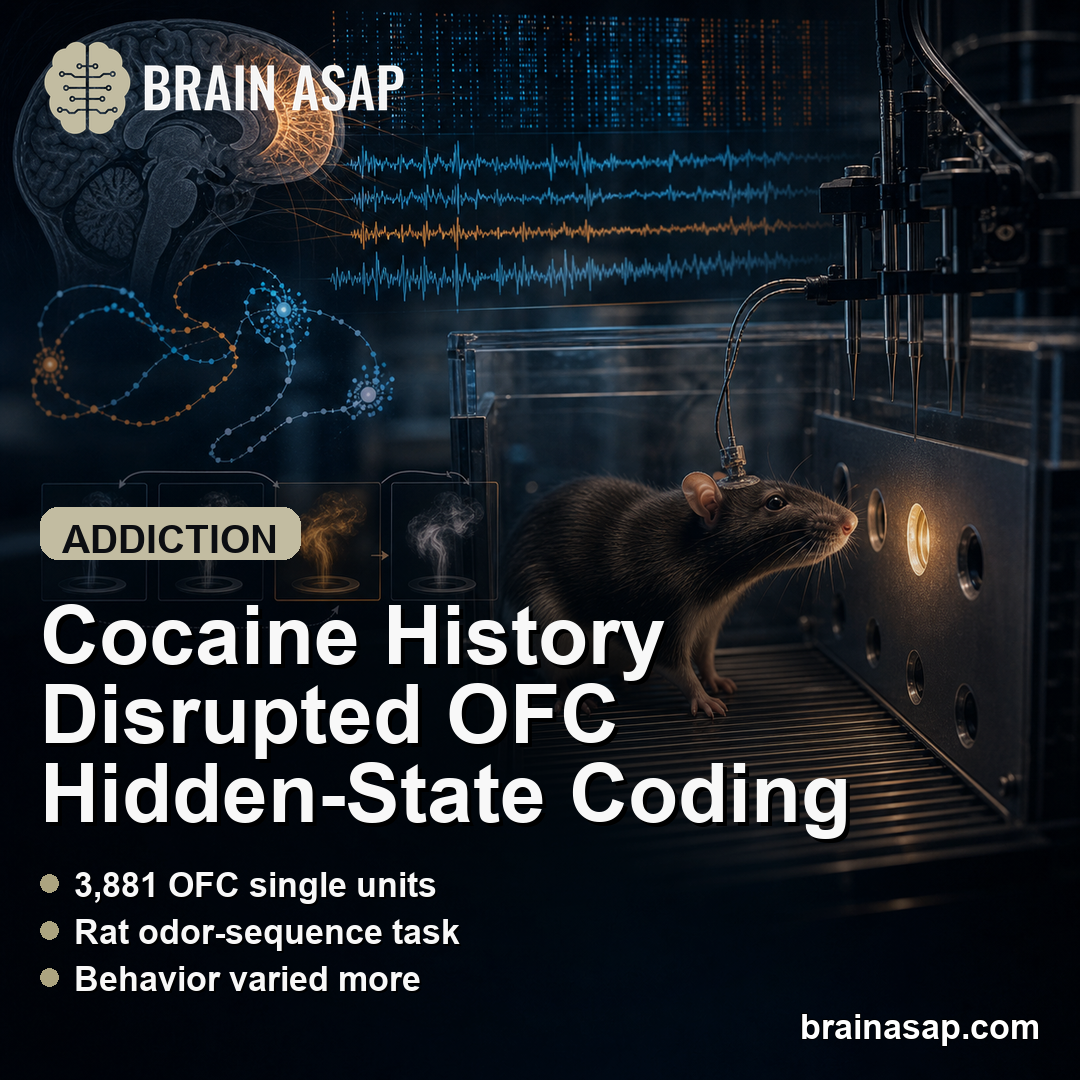
TL;DR: A 2026 study in eLife found that prior cocaine self-administration disrupted how rat orbitofrontal cortex (OFC), a frontal brain region involved in task structure and flexible behavior, encoded hidden states in an odor-sequence task.
Key Findings
- 3,881 single units: The study recorded 3,881 lateral OFC single units while rats performed a sequential odor task.
- Cocaine history: Rats first self-administered cocaine, then were tested on whether OFC activity generalized across task states with shared hidden meaning.
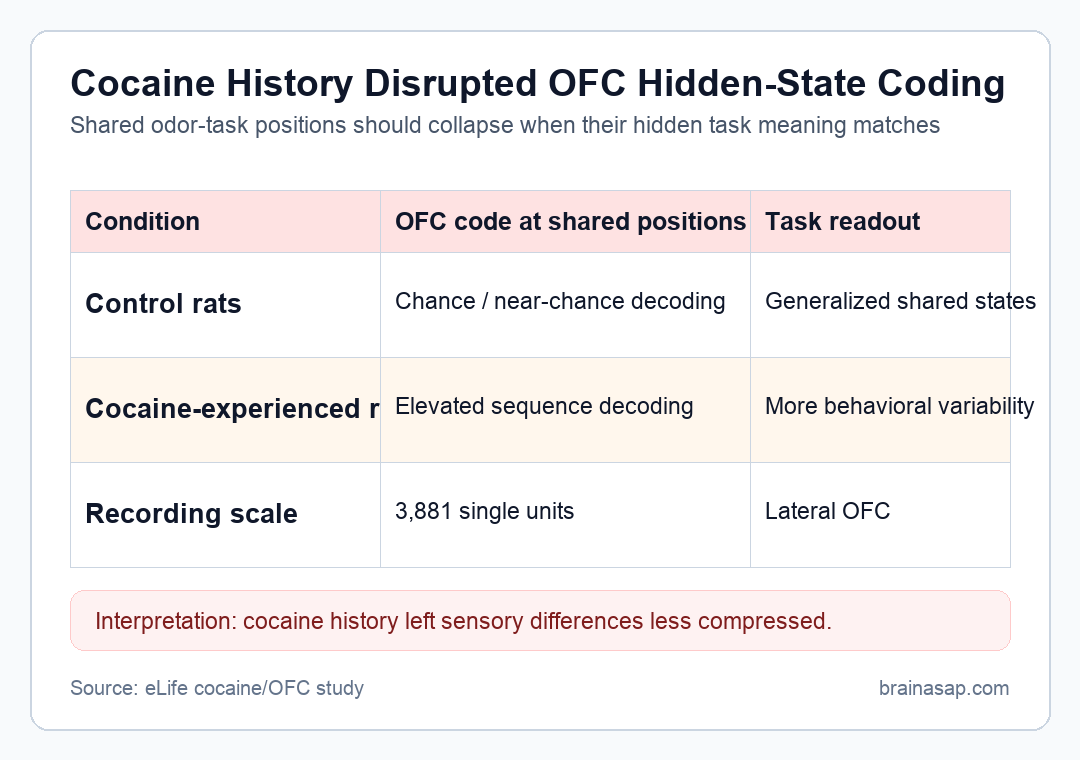
- Control coding collapsed shared states: In well-trained controls, sequence decoding was near chance at shared positions where sensory cues differed but task information matched.
- Cocaine kept decoding elevated: In cocaine-experienced rats, sequence decoding remained significantly elevated at positions that controls treated as equivalent.
- Behavior varied more: The cocaine-related neural difference was accompanied by increased behavioral variability at those shared task positions.
Source: eLife (2026) | Zong et al.
Orbitofrontal cortex (OFC) helps the brain recognize task structure: which cues matter, which cues can be ignored, and when different situations share the same underlying meaning. That ability is often called hidden-state inference.
In addiction research, hidden-state coding is relevant because substance use disorder can involve inflexible behavior. A person or animal may keep responding to surface cues even when the consequences have changed.
Cocaine Self-Administration Tested OFC Task-State Coding in Rats
The researchers trained rats to self-administer cocaine, then recorded lateral OFC activity during a figure-eight-style sequential odor task. The task contained unique positions and shared positions.
Shared positions had different sensory details but the same task meaning. A flexible OFC code should treat those positions as equivalent once the animal has learned the structure.
- Hidden state: The underlying task meaning that stays the same even when surface cues differ.
- Shared position: A task location where distinct odor sequences should be treated similarly because they carry the same information.
- Sequence decoding: A neural analysis asking whether OFC firing still reveals which odor sequence the rat is in.
The study was not testing whether cocaine made rats generally unable to perform. It tested whether cocaine history changed how OFC neurons represented equivalence across task states.
Control OFC Activity Generalized Across Shared Odor Positions
In well-trained control rats, sequence decoding dropped to chance at shared positions. That is exactly what the task structure predicts: if the two positions mean the same thing, OFC activity no longer needs to preserve the superficial sequence difference.
Decoding was also near chance even at unique positions in controls, reflecting that distinguishing those positions was not useful for the task at that stage. The neural code had become organized around what mattered behaviorally.
- Learning effect: Control OFC activity stopped over-representing sensory differences that no longer mattered.
- Generalization effect: Shared positions were represented as similar because they had the same hidden task meaning.
- Cognitive-map interpretation: OFC helped encode the task structure rather than every surface cue separately.
This is the core benchmark for the cocaine comparison. Normal OFC learning compressed different-looking task states when they should be treated alike.
Cocaine-Experienced OFC Neurons Kept Surface Differences Separate
In cocaine-experienced rats, sequence decoding remained significantly elevated, especially at positions where controls had collapsed superficial sensory differences across learning. OFC activity still identified which sequence the rat was in.
That means cocaine history disrupted the normal identification of hidden states. Instead of treating two sensory-distinct positions as equivalent, OFC ensembles retained a stronger separation between them.
- Neural finding: Single-unit and ensemble activity preserved sequence information that controls had reduced.
- Task finding: The disrupted coding appeared at shared positions where generalization was expected.
- Behavior finding: Rats with cocaine history showed increased behavioral variability at those positions.
The behavioral variability is important because it links the neural code to task performance. The decoding difference was not only an analysis artifact; the cocaine-experienced rats behaved less consistently where hidden-state generalization should help.
3,881 OFC Units Supported a Circuit-Level Addiction Mechanism
The study recorded 3,881 single units, giving the analysis enough neural data to examine both individual-cell activity and ensemble structure. Tensor component analysis also suggested that reduced generalization after cocaine extended across positions in the sequences.
OFC has long been linked to outcome-guided learning, reversal behavior, and updating choices when consequences change. This experiment gives that idea a more specific circuit readout: cocaine history impaired OFC coding of shared hidden task causes.
- Brain region: Lateral OFC was the recording target.
- Drug history: Cocaine self-administration occurred before the odor-sequence recordings.
- Computational idea: Hidden-state inference lets the brain generalize across different cues that have the same meaning.
For addiction neuroscience, the result connects cocaine history to a concrete OFC computation. The drug exposure was associated with poorer neural generalization, not just higher or lower firing overall.
Rat OFC Coding Does Not Directly Measure Human Cocaine Addiction
The study supports a mechanism, not a direct clinical diagnostic test. Rat self-administration and odor-sequence behavior are controlled models for neural computation, while human substance use disorder involves social context, craving, withdrawal, psychiatric comorbidity, and treatment history.
Still, the mechanism is relevant. If cocaine history makes OFC representations too tied to superficial cue differences, that could help explain why behavior becomes less flexible when consequences change.
- Model strength: Neural recordings during a structured task can isolate hidden-state coding with precision.
- Model limit: The task is not a human relapse or treatment study.
- Next step: Future work could test whether restoring OFC generalization improves flexible behavior after cocaine exposure.
The main contribution is a sharper circuit explanation for addiction-related inflexibility. Cocaine history changed how OFC represented task structure, leaving sensory differences more separated when controls treated them as equivalent.
Citation: DOI: 10.7554/elife.109883. Study authors et al. Zong et al. Prior cocaine use disrupts identification of hidden states by single units and neural ensembles in orbitofrontal cortex. eLife . 2026;15:RP109883.
Study Design: Rat cocaine self-administration study with lateral orbitofrontal cortex single-unit recordings during an odor-sequence task.
Sample/Model: Cocaine-experienced and control rats with 3,881 recorded OFC single units.
Key Statistic: Cocaine-experienced rats retained elevated sequence decoding at shared task positions where controls showed chance or near-chance decoding.
Caveat: The study identifies a rat OFC mechanism and does not directly test human addiction treatment or relapse outcomes.