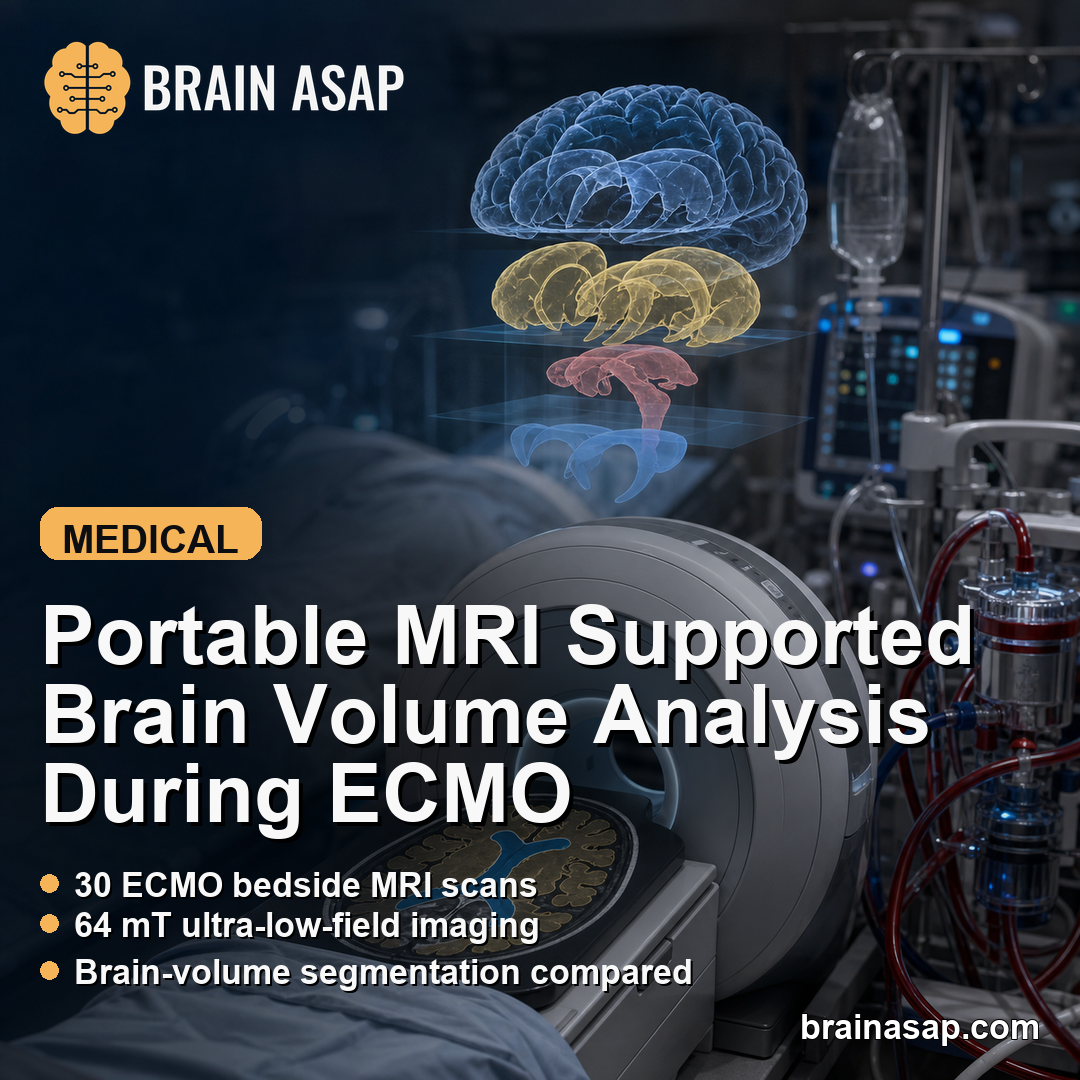
TL;DR: A 2026 medRxiv preprint reported that bedside 64 mT portable MRI scans from ECMO patients could support brain-volume analysis, with segmented volumes broadly comparable to conventional MRI and low-field MRI scans without ECMO equipment.
Key Findings
- 30 ECMO scans: The volumetric pipeline analyzed T2-weighted portable MRI scans from 30 patients receiving extracorporeal membrane oxygenation.
- 64 mT bedside MRI: Imaging used an ultra-low-field 64 mT system designed for bedside scanning in intensive care.
- Multiple brain regions: Segmentation estimated whole brain, gray matter, white matter, ventricles, hemispheres, intracranial volume, and cerebellum.
- Comparable volumes: Brain-volume estimates were broadly comparable to conventional field-strength MRI and ultra-low-field MRI without ECMO circuitry.
- Exploratory ECMO differences: VV ECMO showed larger ventricle and cerebellar volumes than VA ECMO in an unadjusted subgroup comparison.
Source: medRxiv (2026) | Stockbridge et al.
Extracorporeal membrane oxygenation (ECMO) can keep critically ill patients alive when the heart or lungs cannot provide enough support. It also makes neuroimaging difficult, because moving an unstable patient and ECMO circuit to a conventional MRI suite can be risky.
This preprint asked a narrower technical question: can ultra-low-field portable MRI produce images that support quantitative brain-volume measurement while ECMO equipment is present?
Portable 64 mT MRI Was Tested During ECMO Support
The analysis used data from the SAFE MRI ECMO study at Johns Hopkins Hospital. Adults receiving venoarterial ECMO or venovenous ECMO underwent bedside portable MRI between August 2022 and November 2023.
Portable MRI here means a 64 mT ultra-low-field scanner, far below conventional 1.5 T or 3 T hospital MRI. The advantage is bedside access; the challenge is lower signal and harder segmentation.
- VA ECMO: Venoarterial support is commonly used for severe cardiac or cardiopulmonary failure.
- VV ECMO: Venovenous support is commonly used for severe respiratory failure.
- Neuroimaging problem: ECMO patients are at risk for acquired brain injury, but transport and scanner compatibility can limit monitoring.
The source frames this as a feasibility study, not a diagnostic outcome trial. It tested whether the imaging and segmentation pipeline could produce plausible brain volumes under difficult ICU conditions.
SynthSeg Estimated Whole Brain and Regional Volumes
Researchers analyzed T2-weighted scans from 30 patients. The volumetric pipeline estimated total gray matter, total white matter, subcortical gray matter, ventricles, hemispheres, telencephalon, lateral ventricles, intracranial volume, and cerebellum.
The study drew on the SynthSeg segmentation approach, which has been adapted for low-field MRI. Earlier portable MRI work had raised concerns about whether segmentation was reliable enough for quantitative analysis.
- Image acquisition: Scans were acquired at the bedside while ECMO support continued.
- Segmentation: Software estimated brain-region volumes from low-field T2-weighted images.
- Comparison: ECMO patient volumes were compared with conventional MRI and low-field MRI values from people without ECMO instrumentation.
Brain volumes from ECMO patients fell within expected age- and sex-related ranges. The paper also reported comparable dispersion across scanner conditions, suggesting the ECMO circuit did not create prohibitive signal problems after processing.
Brain Volumes Were Comparable Despite ECMO Equipment
The core result is technical but clinically important. Segmented volumes from ECMO patients were described as comparable to measurements from conventional field MRI and ultra-low-field MRI without ECMO instrumentation.
For whole brain volume, the study noted that ECMO patients had slightly lower median volume than neurologically typical comparison groups, but overall values remained in the normal range for age and sex.
- Feasibility finding: ECMO equipment did not appear to prevent useful volumetric processing.
- Clinical direction: Quantitative volume tracking could someday help identify atypical brain-volume loss in critical illness.
- Current boundary: The study did not show that portable volumetry changes treatment decisions or outcomes.
The distinction matters. A feasible measurement is a first step; clinical utility requires proving that the measurement detects meaningful injury and improves decisions.
VA and VV ECMO Differences Were Exploratory
The subgroup comparison separated venoarterial and venovenous ECMO. The paper reported larger ventricle and cerebellar volumes in VV ECMO than VA ECMO, but these statistics were explicitly exploratory and not adjusted for multiple comparisons.
Example regional values included 28.2 cc ventricular volume in VV ECMO and 21.9 cc in VA ECMO. Cerebellar volume was 148.1 cc in VV ECMO and 120.9 cc in VA ECMO.
- Not a causal result: ECMO type was not randomized, and the underlying illnesses differ between groups.
- Small subgroups: The cohort size limits stable estimates of VA-versus-VV differences.
- Follow-up need: Larger studies would need to connect volume patterns with delirium, stroke, cognition, or survival.
Those subgroup numbers are best treated as hypothesis-generating. The stronger result is the feasibility of obtaining segmentable bedside brain scans in the ECMO setting.
Portable MRI Could Expand ICU Brain Monitoring
ECMO patients face neurological risks from hypoxia, embolic events, hemorrhage, inflammation, and prolonged critical illness. Conventional MRI can be clinically valuable, but transport and safety barriers often reduce access.
If validated, bedside MRI volumetry could add a quantitative monitoring layer. It might help researchers track brain changes during prolonged ICU care, especially when conventional scanning is impractical.
- Near-term use: Feasibility evidence supports additional portable MRI research in critically ill patients.
- Validation need: Measurements should be compared against conventional MRI, neurological exams, and long-term outcomes.
- Patient relevance: The eventual goal is earlier recognition of brain injury or volume loss without unsafe transport.
The preprint does not make portable MRI a replacement for standard imaging. It suggests that 64 mT bedside MRI may be good enough for some quantitative neuroimaging questions that were previously hard to study during ECMO.
Citation: DOI: 10.64898/2026.04.09.26350481. Stockbridge et al. Feasibility of Volumetric Analysis using Bedside Ultra-Low-Field Portable Magnetic Resonance Imaging in Patients receiving Extracorporeal Membrane Oxygenation. medRxiv. 2026.
Study Design: Retrospective analysis of prospectively collected observational portable MRI data.
Sample Size: T2-weighted scans from 30 ECMO patients at Johns Hopkins Hospital.
Key Statistic: Portable MRI estimated multiple brain-region volumes, including ventricular volume of 28.2 cc in VV ECMO and 21.9 cc in VA ECMO.
Caveat: This was a small feasibility preprint, and subgroup volume differences were exploratory.