TL;DR: A 2026 study in Psychological Medicine found that transcranial direct current stimulation (tDCS), a weak electrical brain-stimulation method, affected empathy differently depending on whether researchers targeted the right temporoparietal junction or the left dorsolateral prefrontal cortex.
Key Findings
- Two brain targets diverged: right temporoparietal junction (rTPJ) stimulation strengthened cognitive empathy, while left dorsolateral prefrontal cortex (lDLPFC) stimulation mainly changed autonomic regulation.
- Study 1 included 76 people: participants completed pain-empathy picture tasks after real or sham tDCS while electroencephalography (EEG) measured late positive potential (LPP) brain responses.
- rTPJ stimulation improved other-focused ratings: the other-unpleasantness discrimination measure was higher after real rTPJ-tDCS than after sham stimulation (p = 0.020).
- LPP responses increased after rTPJ-tDCS: early and late LPP differences between painful and nonpainful pictures were larger after rTPJ stimulation, with post hoc p values of 0.001 and 0.002.
- Study 2 included 120 people: rTPJ stimulation improved content and emotion understanding during autobiographical videos, while lDLPFC stimulation increased heart-rate-variability markers SDNN, RMSSD, and SD1.
Source: Li et al. (2026)
Empathy is not one mental operation. The study separated two parts that often travel together: understanding another person’s state and regulating one’s own emotional response while doing so.
Researchers tested whether those parts could be shifted by stimulating different brain regions.
The data did not show a general empathy boost. They showed a target-specific split between rTPJ-linked perspective understanding and lDLPFC-linked emotion regulation.
Researchers Tested Two tDCS Targets Across Two Empathy Tasks
Transcranial direct current stimulation (tDCS) sends a low electrical current through scalp electrodes. In this study, researchers used anodal tDCS, a common stimulation approach intended to increase excitability in the targeted cortical area.
The two targets were chosen because they map onto different empathy processes:
- Right temporoparietal junction: the rTPJ is often linked to perspective-taking and representing another person’s mental or emotional state.
- Left dorsolateral prefrontal cortex: the lDLPFC is often linked to cognitive control and emotion regulation.
This distinction is clinically relevant because empathy can fail in different ways. Some people may have trouble reading another person’s state. Others may read it but become overwhelmed by personal distress.
Study 1 used a pain-empathy task. Participants saw painful and nonpainful pictures, rated the pictured person’s unpleasantness and their own unpleasantness, and completed the task while EEG recorded brain responses.
Study 2 used longer autobiographical videos. Participants watched positive, negative, and neutral personal narratives, rated what they understood and felt, and completed the task while electrocardiography tracked heart rate variability (HRV), a marker related to autonomic flexibility.
rTPJ Stimulation Increased Other-Focused Pain Empathy
Study 1 enrolled 80 healthy adults, with 76 people in the final analysis after missing data and equipment exclusions. Participants were assigned to rTPJ or lDLPFC stimulation groups, and each person completed real and sham sessions separated by a washout period.
The clearest behavioral result involved other-unpleasantness ratings. This measure asked how much unpleasantness the person in the picture seemed to be experiencing, so it captured cognitive empathy more than personal distress.
Researchers reported a significant interaction between stimulation target and stimulation type for this other-focused measure (F1,74 = 4.23, p = 0.043). Follow-up tests showed that real rTPJ-tDCS produced higher discrimination values than sham stimulation (p = 0.020), while lDLPFC-tDCS did not differ from sham (p = 0.604).
The self-unpleasantness measure behaved differently. It showed that somatic pain pictures produced stronger emotional empathy than affective-pain pictures, but it did not show the same target-specific tDCS effect.
EEG Markers Also Pointed to Stronger rTPJ Effects
The EEG analysis focused on the late positive potential (LPP), a sustained brain response to emotionally meaningful stimuli. Researchers measured early LPP responses from 500-1000 ms and late LPP responses from 1000-3000 ms after each picture appeared.
The rTPJ result showed up again. Painful-minus-nonpainful LPP differences increased after real rTPJ stimulation compared with sham, both in the early window (p = 0.001) and late window (p = 0.002).
The lDLPFC group did not show those LPP changes. This supports a specific interpretation: stimulating rTPJ made other people’s pain states more neurally distinguishable, rather than simply making participants more emotionally reactive across the board.
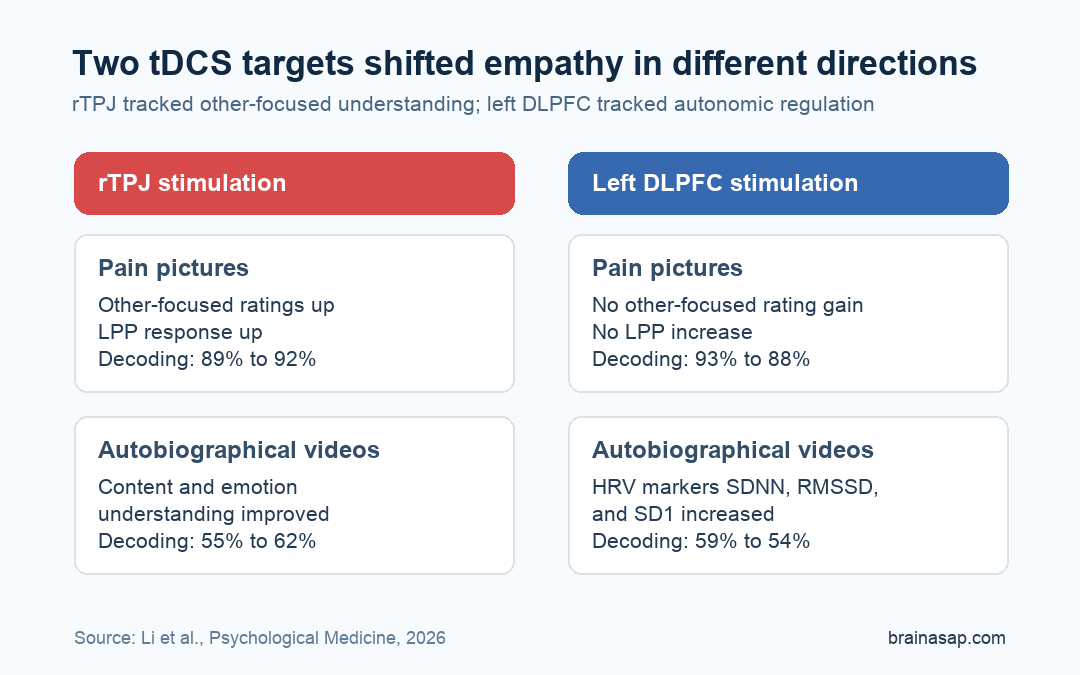
Machine-learning decoding gave a related readout. Across five classifiers, rTPJ stimulation increased painful-versus-nonpainful classification accuracy from about 86% to 92% in the somatic task and from about 89% to 92% overall.
lDLPFC stimulation moved in the opposite direction. Decoding accuracy fell from about 93% to 88% in the combined pain-empathy condition, consistent with a regulatory effect that made overt empathic signals less separable.
Autobiographical Videos Separated Understanding From Regulation
Study 2 enrolled 120 healthy adults, with 40 people assigned to lDLPFC stimulation, rTPJ stimulation, or sham stimulation. Participants watched autobiographical videos before and after stimulation and rated content understanding, emotion understanding, empathic concern, and emotional contagion.
The rTPJ effect extended beyond static pain pictures. Compared with lDLPFC and sham groups, rTPJ stimulation produced greater improvements in two cognitive-empathy ratings:
- Content understanding: rTPJ-tDCS improved understanding of what happened in the speaker’s autobiographical event.
- Emotion recognition: rTPJ-tDCS improved recognition of the target person’s emotional state.
lDLPFC stimulation instead changed physiology. Compared with sham stimulation, lDLPFC-tDCS increased SDNN, RMSSD, and SD1, three HRV measures tied to autonomic flexibility and parasympathetic regulation.
Those changes did not mean lDLPFC made people rate more empathy. The study’s interpretation is narrower: lDLPFC stimulation may have helped the body regulate during emotionally rich social material, even when explicit ratings did not rise.
Decoding Results Matched the Two-Target Pattern
The decoding analysis asked whether ratings plus physiological signals could classify the emotional valence of the autobiographical videos. This was a computational way to test how readable the empathic state became after stimulation.
The target split appeared again:
- rTPJ-tDCS: classification accuracy increased from about 55% before stimulation to about 62% after stimulation.
- lDLPFC-tDCS: classification accuracy decreased from about 59% before stimulation to about 54% after stimulation.
- Sham stimulation: accuracy stayed near 58% before and after stimulation.
Lower decodability is not automatically worse. If lDLPFC stimulation increased regulation, the participant’s outward physiological and rating pattern might become less tightly coupled to the video’s emotional category.
For clinical translation, that distinction is important. A future intervention for poor social understanding might not use the same target as an intervention for overwhelming personal distress.
Healthy Participants and Single-Session Stimulation Limit the Claim
The study was not a treatment trial. All experiments involved healthy young adults, so the results cannot be assumed to apply directly to autism, schizophrenia, psychopathy, burnout, trauma-related distress, or other conditions where empathy and regulation can be altered.
Stimulation was also single-session. Researchers did not test whether repeated tDCS would produce durable changes, whether effects would accumulate, or whether people with clinical symptoms would respond similarly.
Practical takeaway: the study supports a mechanistic split, not a clinic-ready protocol. rTPJ stimulation was more closely tied to representing another person’s state, while lDLPFC stimulation was more closely tied to regulating the body’s response during social-emotional material.
Citation: DOI: 10.1017/s0033291726104218. Study authors et al. Modulating empathy with tDCS: dissociable roles of rTPJ and lDLPFC. Psychological Medicine. 2026.
Study Design: Two healthy-adult tDCS experiments using pain-empathy pictures, autobiographical videos, EEG, ECG-derived HRV, and machine-learning decoding.
Sample Size: 76 participants in Study 1 after exclusions and 120 participants in Study 2.
Key Statistic: rTPJ-tDCS increased overall pain-empathy decoding accuracy from about 89% to 92%, while lDLPFC-tDCS reduced it from about 93% to 88%.
Caveat: The experiments used healthy participants and single-session stimulation, so clinical and durable-treatment claims remain untested.