TL;DR: A 2026 study in Cureus found that a 55-year-old woman developed anxiety, somatic hypervigilance, and eventual delusional infestation after illicit cosmetic biopolymer injections, raising the possibility that chronic inflammatory exposure can help tip vulnerable patients into a secondary Ekbom syndrome.
Key Findings
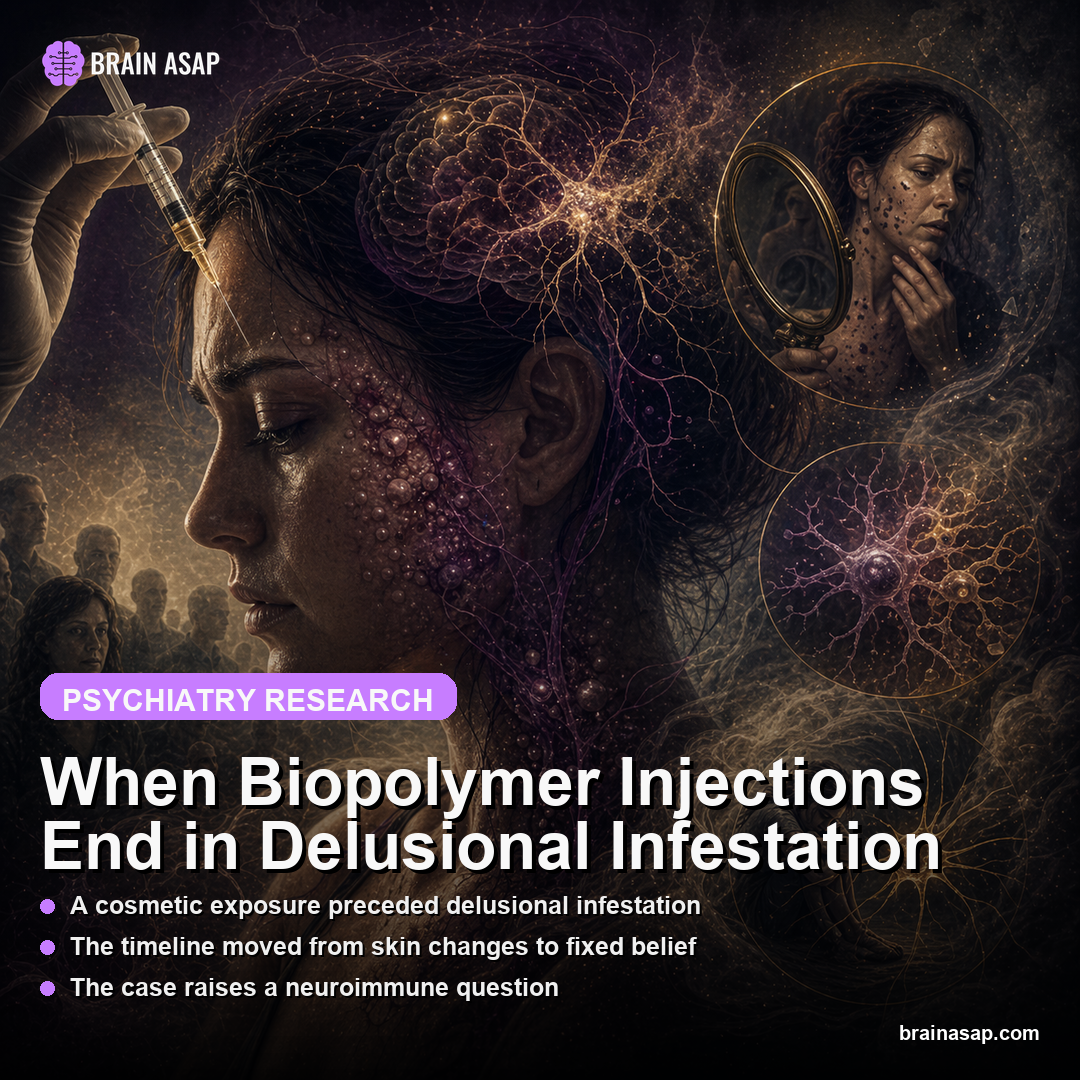
- One 55-year-old patient with no prior psychiatric history: The case centers on a woman who underwent cosmetic biopolymer injections in a non-medical setting, then developed progressive neuropsychiatric symptoms roughly 1.5 years later.
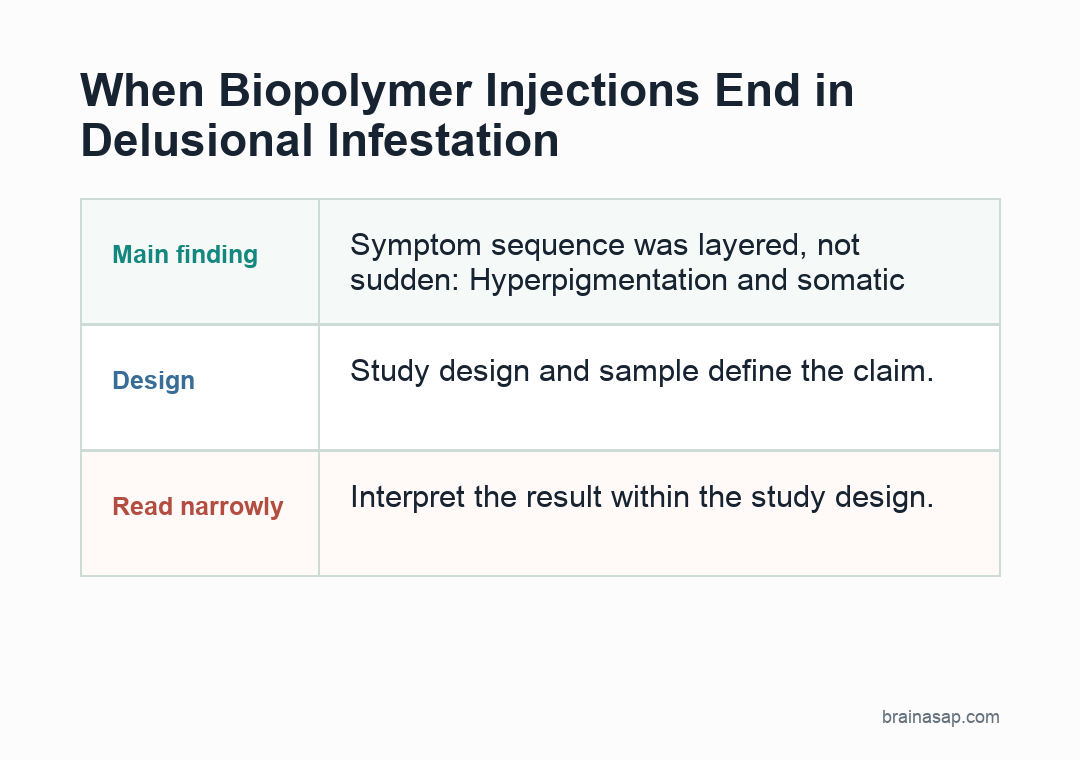
- Skin changes came before the delusion: Hyperpigmentation and disproportionate concern about bodily changes preceded the fixed infestation belief, which makes the syndrome look more like an escalating somatic pathway than a sudden isolated psychosis.
- Anxiety built alongside somatic hypervigilance: The authors describe insomnia, psychomotor agitation, muscle tension, and ruminative bodily focus before the belief of parasites under the skin fully crystallized.
- Routine testing did not reveal another clear organic cause: Laboratory work-up and cross-sectional imaging did not identify a cleaner neurological or medical explanation for the presentation.
- Treatment used olanzapine plus sertraline: The patient was started on olanzapine 10 mg/day and sertraline 50 mg/day, alongside referrals to dermatology and plastic surgery.
Source: Cureus (2026) | Galindo et al.
Case reports are weak evidence for broad claims, but they can be strong evidence for odd clinical possibilities.
This one is important because it links a cosmetic exposure better known for local tissue damage to a highly specific psychiatric syndrome.
Why This Is More Than a Dermatology Oddity
Ekbom syndrome, also called delusional infestation, sits in an uncomfortable border zone between psychiatry, dermatology, and neurology.
Study details:
- One 55-year-old patient with no prior psychiatric history: The case centers on a woman who underwent cosmetic biopolymer injections in a non-medical setting, then developed progressive neuropsychiatric symptoms roughly 1.5 years later
- Skin changes came before the delusion: Hyperpigmentation and disproportionate concern about bodily changes preceded the fixed infestation belief, which makes the syndrome look more like an escalating somatic pathway than a sudden isolated psychosis
- Anxiety built alongside somatic hypervigilance: The authors describe insomnia, psychomotor agitation, muscle tension, and ruminative bodily focus before the belief of parasites under the skin fully crystallized
- Routine testing did not reveal another clear organic cause: Laboratory work-up and cross-sectional imaging did not identify a cleaner neurological or medical explanation for the presentation
Patients are convinced something is crawling, burrowing, or living under their skin even though objective evidence is absent.
The syndrome can appear as a primary psychiatric disorder, but it can also be secondary to medical illness, drugs, neurological conditions, or chronic somatic distress.
That is what makes this case worth reading.
The precipitating event was not methamphetamine, dementia, or a classic psychotic illness.
It was a cosmetic procedure involving illicit biopolymer injections, followed by progressive cutaneous and psychological change.
Biopolymer complications are usually discussed in terms of granulomas, migration, chronic inflammation, and disfigurement.
The psychiatric consequences are much less explored.
This report suggests that for at least some patients, the body burden may not stay in the body.
How a Cosmetic Procedure Turned Into a Fixed Infestation Belief
The timeline matters.
According to the report, the patient had injections in the face, hands, feet, and dorsal region in a non-medical setting.
About one and a half years later, symptoms emerged gradually rather than explosively. First came progressive hyperpigmentation and a rising preoccupation with bodily changes.
Then came the anxiety syndrome: psychomotor agitation , insomnia , muscle tension, and rumination. Only later did the belief of infestation beneath the skin fully form.
That sequence makes the presentation look layered rather than abrupt: anxiety and bodily preoccupation developed before the fixed infestation belief.
It is describing a patient whose bodily threat-response system may have become chronically dysregulated first, with delusional interpretation arriving later as the explanatory frame hardened.
This is often how secondary psychiatric phenomena develop. The initial experience is not bizarre.
It is distressing, ambiguous, and difficult to reassure away. Over time, the mind starts demanding an explanation that matches the intensity of the sensation.
A fixed infestation belief is one possible outcome of that process. The authors’ proposed mechanism is plausible but remains untested in this case.
Chronic inflammatory exposure, especially from illicit injected materials, could alter somatic perception and stress signaling enough to increase the risk of a delusional interpretation.
That idea fits with a broader literature connecting inflammation, sensory distortion, and psychiatric symptoms.
What the case does not show is a direct biological chain from polymer to psychosis.
The work-up ruled out a more obvious organic cause with laboratory testing and imaging, but a negative work-up is not the same thing as a demonstrated mechanism.
There were no cytokine assays, neuroimaging biomarkers, or tissue-pathology measures linking the psychiatric state directly to immune activation.
Still, the hypothesis earns consideration because of the timing and the syndrome shape.
A patient with no prior psychiatric history developed a prolonged syndrome after an exposure already known to cause chronic tissue problems.
The dermatologic and psychiatric elements evolved together, not separately.
That combination makes a neuroimmune interpretation more plausible than if the psychiatric symptoms had appeared in total isolation years later.
What Olanzapine Plus Sertraline Says About the Clinical Read on the Case
The treatment choice also tells you how the clinicians interpreted the syndrome.
They used olanzapine 10 mg/day to target the psychotic component and sertraline 50 mg/day to address the anxiety dimension, while also involving dermatology and plastic surgery.
That is a pragmatic, multidisciplinary response.
Delusional infestation often goes badly when teams insist on choosing between “this is psychiatric” and “this is dermatologic.” Patients generally experience the problem as embodied.
If treatment invalidates that embodiment, alliance collapses fast.
In that sense, the report models a helpful stance even if the evidence level is low.
The patient was not treated as though her distress were imaginary.
She was treated as though the explanatory belief had become psychotic while the underlying bodily suffering remained real.
That distinction is one of the hardest parts of consultation-liaison psychiatry.
It is also one of the most important.
Patients can have a delusion about the cause of a sensation while still having genuine pathology, pain, inflammation, or disfigurement that deserves attention.
What This Case Can and Cannot Tell Us About Cosmetic Exposure and Psychosis
The obvious limitation is sample size: this is one patient.
It cannot estimate risk, identify which injected materials are most dangerous, or prove that biopolymers independently cause Ekbom syndrome.
It also comes from Cureus, which means the editorial threshold is lower than in a top-tier specialty journal.
But case reports earn their keep by doing something else. They alert clinicians to a link they might otherwise miss.
In cosmetic-complication cases, a new-onset fixed infestation belief is plausibly read as primary psychosis, dismissed as anxiety, or bounced between services.
Clinicians should at least consider secondary Ekbom syndrome when a fixed infestation belief follows complications from cosmetic biopolymer injections.
The deeper lesson is psychiatric.
When chronic bodily harm, inflammation, shame, and uncertainty combine, the resulting syndrome does not necessarily fit neatly into one specialty’s silo.
That is especially true after unregulated cosmetic procedures, where the tissue burden can persist long after the injection itself.
This report does not settle the mechanism.
What it does do is widen the clinical map.
It suggests that in rare cases, the psychiatric fallout from cosmetic injury can end not only in anxiety or depression, but in a highly specific psychotic misinterpretation of the body itself.
What the Case Report Can and Cannot Show
- Case-level signal: The timeline makes cosmetic biopolymer exposure clinically relevant to the psychiatric presentation.
- Mechanistic uncertainty: The report cannot prove that inflammation caused the delusion.
- Care implication: Treatment needs both psychiatric management and attention to the underlying tissue injury.
Citation: DOI: 10.7759/cureus.107117. Galindo et al. Ekbom syndrome following cosmetic biopolymer injections presenting with neuropsychiatric manifestations: a case report. Cureus. 2026;18:e107117.
Study Design: Clinical case report
Sample/Model: One 55-year-old patient with no prior psychiatric history: The case centers on a woman who underwent cosmetic biopolymer injections in a non-medical setting, then developed progressive neuropsychiatric symptoms roughly 1.5 years later.
Key Statistic: Skin changes came before the delusion: Hyperpigmentation and disproportionate concern about bodily changes preceded the fixed infestation belief, which makes the syndrome look more like an escalating somatic pathway than a sudden isolated psychosis.
Caveat: Single-study evidence; interpret with the source design and sample.