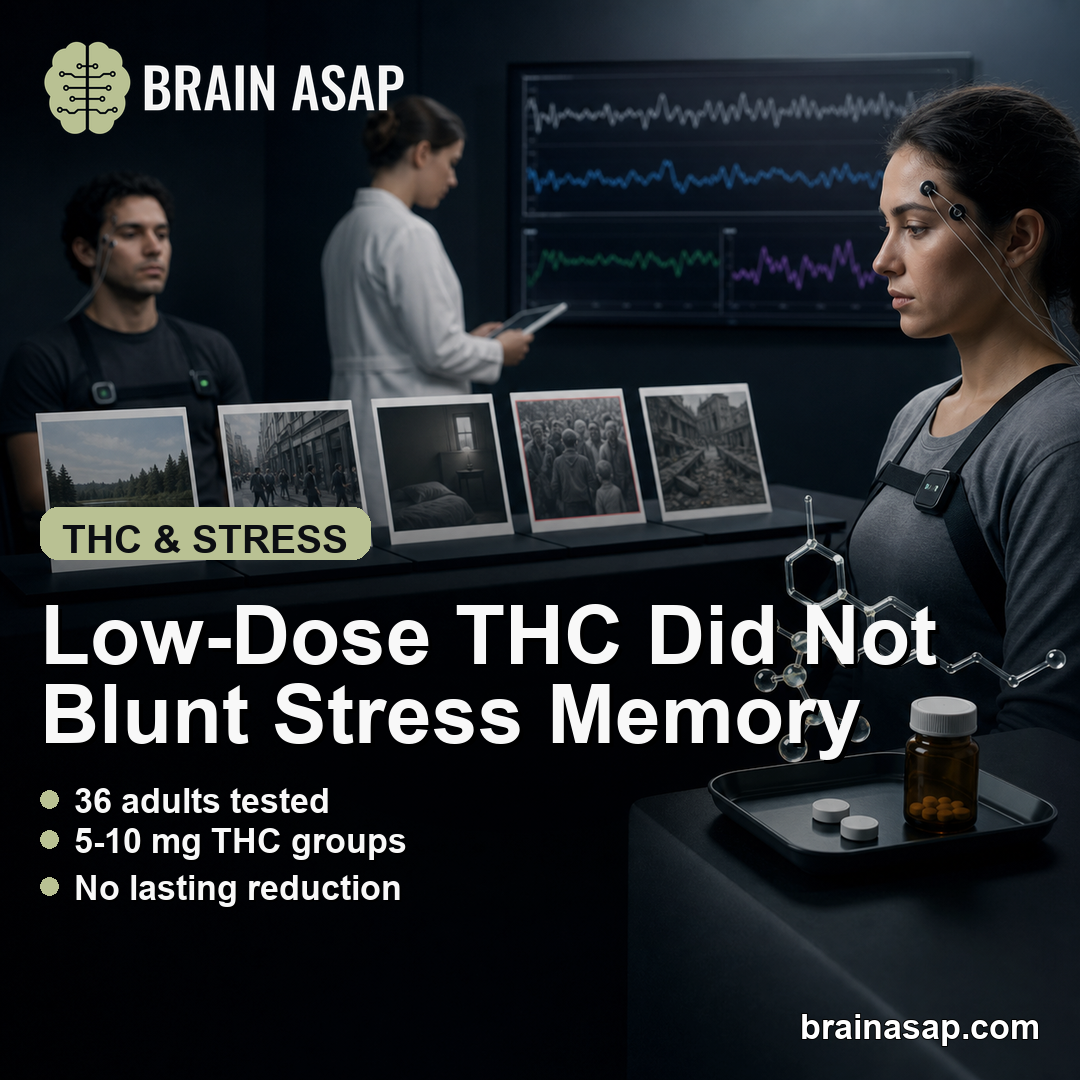
TL;DR: A 2026 study in Psychopharmacology found that low oral THC doses did not meaningfully reduce most subjective or physiological responses when healthy adults retrieved memories of a prior social stress task.
Key Findings
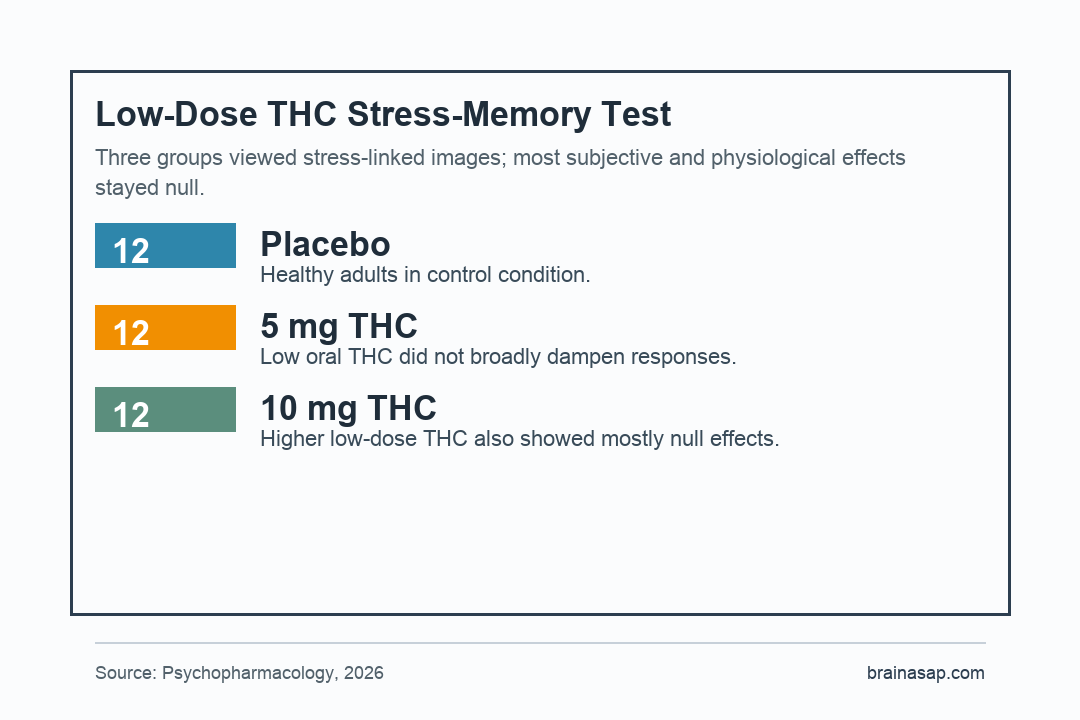
- Low-dose THC groups: Participants aged 18-35 were assigned to placebo, 5 mg THC, or 10 mg THC groups, with 12 people in each group.
- Three-session stress design: The first session created stress and neutral images, the second tested THC during memory retrieval, and the third retested images without drug.
- TSST images worked: Images tied to the Trier Social Stress Test increased distress and arousal compared with control images during memory retrieval.
- Most THC effects were null: Low-dose THC did not dampen most subjective or physiological responses to the stress images.
- No lasting reduction: One week later, without drug administration, the study found no lasting THC effect on image-elicited responses.
Source: Psychopharmacology (2026) | Molla et al.
Low-Dose THC Did Not Blunt Most Stress-Memory Responses
Low-dose oral THC was tested against a common real-world claim: that cannabis reduces stress or softens the emotional impact of stressful memories. The trial used a controlled laboratory design rather than asking people to recall cannabis use in daily life.
Participants first completed the Trier Social Stress Test, a standardized social-evaluative stress procedure. Researchers then used individualized images from the stress session and a non-stress control task to trigger memory retrieval in later sessions.
- Placebo group: Participants received no active THC before viewing stress and neutral images.
- 5 mg THC group: Participants received a low oral THC dose before the retrieval task.
- 10 mg THC group: Participants received a higher low-dose oral THC condition before the same task.
The stress-memory manipulation was successful. During the second session, TSST-linked images increased distress and arousal relative to control images, which means the study had a working memory-retrieval challenge.
The timing shaped the interpretation. THC was given before the memory-retrieval task, not before the original stress exposure.
The question was whether THC would change response to a remembered stressor after the memory had already been formed.
Subjective and Physiological Measures Mostly Stayed the Same
The overall result was a lack of broad THC benefit. Across most outcomes, 5 mg and 10 mg THC did not reduce the emotional or physiological response to stressful images.
The one exception was affective facial expression during stress-image presentation. THC reduced responses on that measure, but the broader pattern remained null across self-report and physiological measures.
That distinction is important because facial expression can change without a matching change in the person’s reported distress or physiology. A visible affective-response shift is informative, but it does not by itself show broad stress relief.
- Distress: Stress images increased subjective distress, but THC did not clearly dampen the response.
- Arousal: Stress images increased arousal, again without a broad THC reduction.
- Physiology: The study did not find a consistent THC effect across physiological stress markers.
- Facial expression: Affective facial responses were the main measure where THC reduced stress-image responding.
The Third Session Found No Delayed THC Benefit
The design also tested whether THC during memory retrieval changed later responses to the same stress cues. One week after the drug session, participants returned for a third session without THC or placebo administration.
That delayed test found no lasting reduction in image-elicited responses. In practical terms, THC did not appear to rewrite or weaken the stress memory response in this small healthy-volunteer sample.
The third session also helps separate acute intoxication effects from memory-updating effects. If THC had changed the stress memory itself, researchers would expect the image response to be lower when participants returned without the drug.
The study did not show a lower response at the later visit, so the delayed test did not support a memory-weakening interpretation.
- Immediate test: THC was given before stress-image retrieval in Session 2.
- Delayed test: The same image responses were reassessed one week later without drug.
- Durability result: The study did not find persistent THC-related dampening of stress responses.
Small Sample Size Makes the Null Result Specific
The study included 12 people per group, so it should not be read as a final answer about cannabis, anxiety, trauma, or stress-related disorders. It tested low oral THC doses in healthy adults using a specific social-stress memory task.
Even with that limitation, the Bayesian analyses supported the null interpretation for many outcomes. The cleanest reading is narrow: in this design, low-dose THC did not substantially reduce most stress-memory responses.
That narrow reading is still clinically relevant because cannabis is often described as a stress-relief tool. The experiment tested one plausible pathway for that claim and found little support: low oral THC did not broadly dampen responses to retrieved social-stress memories.
The result also separates laboratory stress from clinical treatment. A healthy participant remembering a standardized speech-and-arithmetic stressor is not the same as a patient working through trauma, panic, or chronic anxiety symptoms in care.
The Bayes factor analyses add context for the small sample. They do not make the study large, but they support the conclusion that many outcomes were closer to a null effect than to a hidden broad THC benefit.
- Population limit: The participants were healthy adults, not patients with PTSD, anxiety disorders, or chronic stress conditions.
- Dose limit: Only 5 mg and 10 mg oral THC were tested.
- Task limit: Stress memories came from a standardized lab stressor, not from naturally occurring trauma.
Citation: DOI: 10.1007/s00213-026-07064-1. Molla et al. Acute and delayed effects of THC on memory retrieval of social stress in healthy adults. Psychopharmacology. 2026.
Study Design: Double-blind randomized laboratory experiment with placebo, 5 mg THC, and 10 mg THC groups.
Sample Size: 36 healthy adults aged 18-35, with 12 participants per group.
Key Statistic: THC failed to dampen most subjective or physiological stress-image responses, and no lasting drug effect was observed one week later.
Caveat: The small healthy-volunteer sample limits conclusions about clinical anxiety, PTSD, or therapeutic cannabis use.