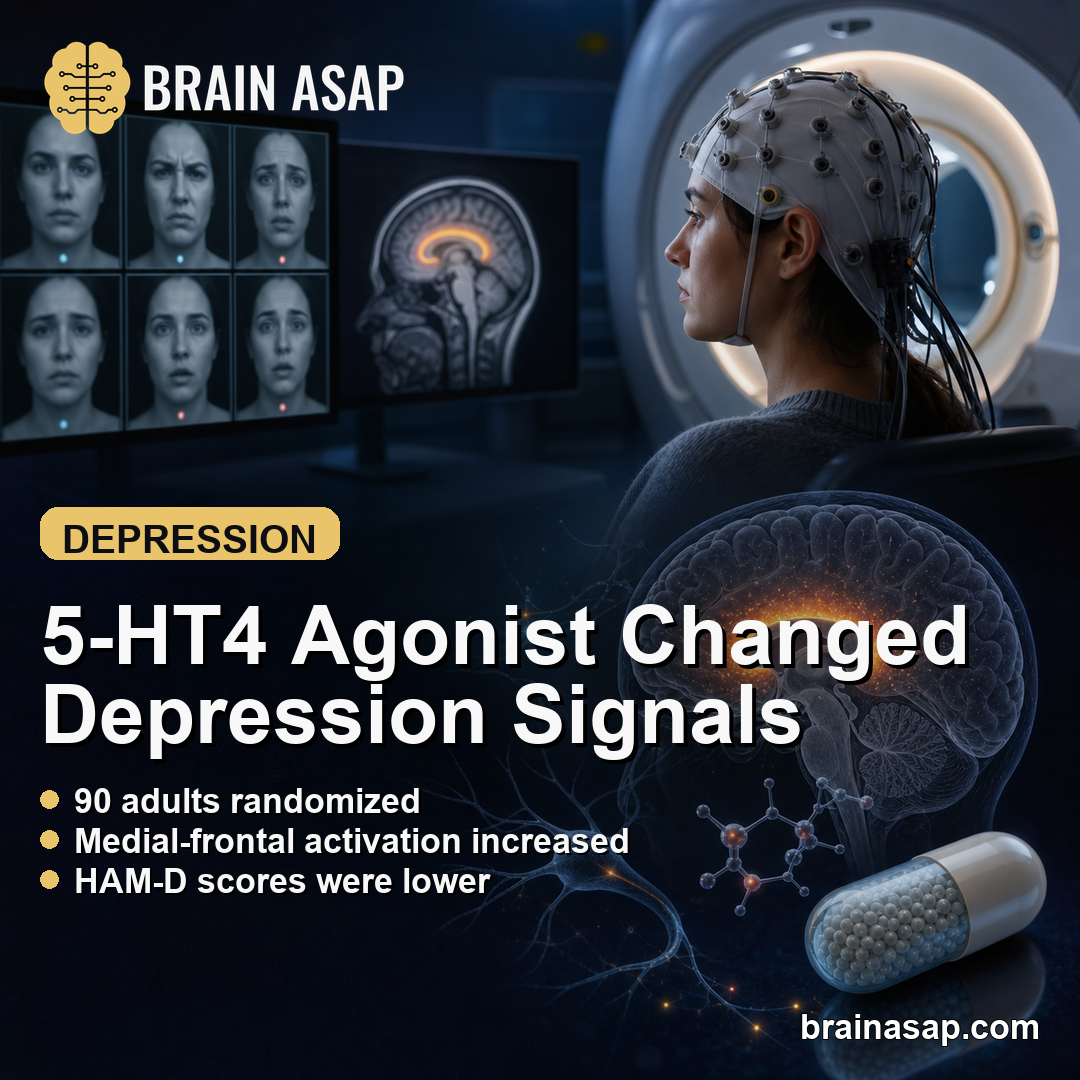
TL;DR: A 2026 randomized study in The British Journal of Psychiatry found that the experimental 5-HT4 receptor agonist PF-04995274 did not mimic citalopram’s early emotional-bias effects in unmedicated depression, but it was linked with lower depression ratings and increased medial-frontal brain activation after about 1 week.
Key Findings
- 90 randomized adults: The RESTAND study assigned adults with unmedicated major depressive disorder to PF-04995274, citalopram, or placebo for 7 days.
- 15 mg PF-04995274: The 5-HT4 receptor partial agonist was tested at 15 mg once daily, while the citalopram positive-control group received 20 mg once daily.
- No SSRI-like bias shift: PF-04995274 did not reduce negative emotional face bias or amygdala activity, while citalopram showed the expected negative-bias and left-amygdala pattern.
- Medial-frontal activation: PF-04995274 increased medial-frontal cortex BOLD response across emotional face valences compared with placebo, F(1,100) = 5.98, p = 0.016.
- Lower HAM-D scores: Final Hamilton Depression Rating Scale scores averaged 12.7 with PF-04995274 and 12.7 with citalopram, compared with 15.5 with placebo.
Source: The British Journal of Psychiatry (2026) | Gillespie et al.
PF-04995274 is an experimental partial agonist of the 5-HT4 receptor, a serotonin receptor subtype studied for mood, cognition, and neuroplasticity. Animal research has suggested that 5-HT4 receptor stimulation may produce faster antidepressant-like effects than standard SSRIs.
Researchers tested whether a week of the drug produced early brain and emotion-processing changes like a standard selective serotonin reuptake inhibitor (SSRI).
Antidepressant drug development often looks for early cognitive and neural markers before running larger clinical trials. In this study, the SSRI comparator behaved as expected, but the 5-HT4R drug produced a different early pattern.
RESTAND Tested PF-04995274 Against Citalopram and Placebo
The RESTAND study was a double-blind, placebo-controlled experiment in adults with major depressive disorder (MDD), a depressive disorder diagnosed here using DSM-5 criteria. Participants had not received drug treatment or face-to-face psychological treatment for depression in the previous 6 weeks.
Researchers randomized 90 participants between August 2018 and July 2022. The groups received PF-04995274, citalopram, or placebo for 7 days, with up to 2 additional days allowed to handle scheduling.
- PF-04995274 group: Participants received 15 mg once daily of the 5-HT4 receptor partial agonist.
- Citalopram group: Participants received 20 mg once daily of the SSRI, included as a positive control.
- Placebo group: Participants received matched placebo tablets or capsules for comparison.
- Assessment window: Emotional-cognition testing and functional MRI took place around days 6 to 9.
The baseline depression level was mild to moderate. The mean Hamilton Depression Rating Scale (HAM-D) score for the full sample was 16.1, and the baseline group means were reasonably similar.
Citalopram Shifted Emotional Face Bias, but PF-04995274 Did Not
The behavioral task was a facial expression recognition task. Participants saw 250 briefly presented faces showing happiness, fear, anger, disgust, sadness, surprise, or neutral expressions, then classified the expression.
This type of task is used because depression is often linked with negative emotional processing bias. Earlier SSRI work suggests that some antidepressants reduce negative bias before the full clinical effect is obvious.
- Citalopram accuracy shift: Compared with placebo, citalopram produced a significant medication-by-valence interaction for emotional face accuracy, F(1,56) = 4.30, p = 0.043.
- Citalopram reaction-time shift: Citalopram also produced a significant medication-by-valence interaction for reaction time, F(1,56) = 6.78, p = 0.012.
- PF-04995274 accuracy result: PF-04995274 did not significantly change overall accuracy or valence-specific accuracy compared with placebo.
- PF-04995274 reaction-time result: PF-04995274 also did not significantly change reaction time or valence-specific reaction time.
The SSRI positive-control arm showed the expected early emotional-bias pattern, which supports the task. The 5-HT4R agonist did not show that same pattern.
That means the early mood result cannot be described as simply SSRI-like.
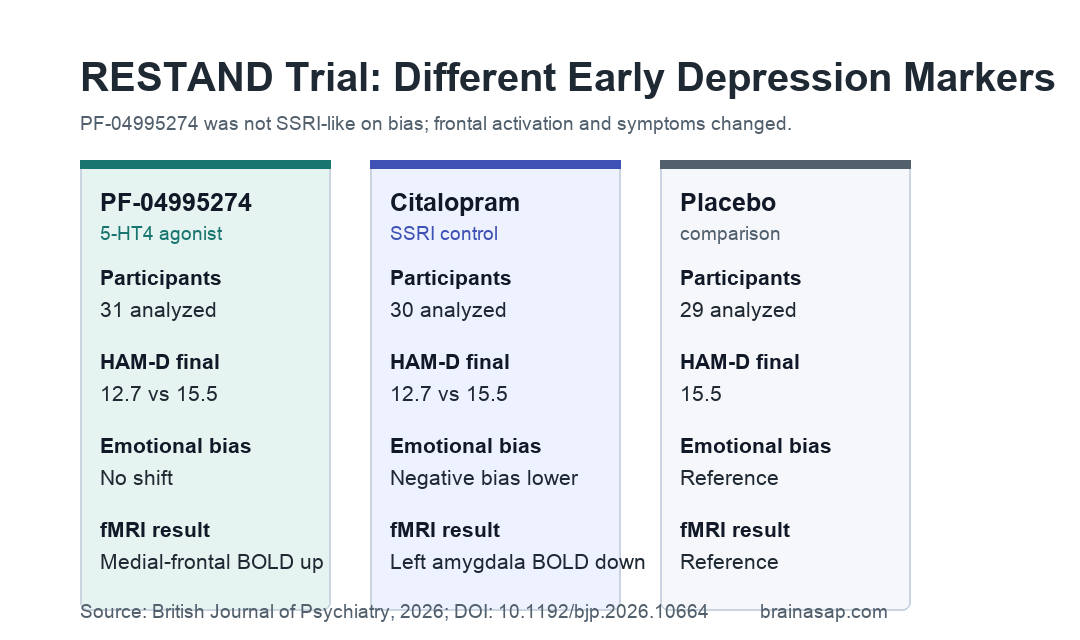
PF-04995274 Increased Medial-Frontal fMRI Activation
The fMRI task used emotional faces without asking participants to judge the emotion. Instead, participants indicated the apparent gender of each face while the scanner measured blood-oxygen-level-dependent (BOLD) activity, a common fMRI readout related to local neural activity.
In the amygdala, a brain region involved in emotional salience, citalopram again showed the expected pattern. The citalopram group had reduced left-amygdala BOLD response across valences compared with placebo.
PF-04995274 did not significantly change left or right amygdala response. Its main neural result was in the medial-frontal cortex, where PF-04995274 was linked with greater BOLD response across emotional face valences compared with placebo.
- Amygdala comparison: PF-04995274 showed no significant left- or right-amygdala main effect or interaction compared with placebo.
- Medial-frontal result: PF-04995274 increased medial-frontal cortex BOLD response, F(1,100) = 5.98, p = 0.016.
- No valence interaction: The medial-frontal result did not depend on happy versus fearful face valence, F(1,100) = 0.042, p = 0.84.
- Orbito-frontal result: The orbito-frontal cortex analysis did not show a significant difference for any group comparison.
This means the 5-HT4R drug did something measurable during emotional processing, but it was not the classic SSRI amygdala-bias result. The authors framed this as a possible alternative early pathway, not as proof of clinical efficacy.
Depression Ratings Improved After 1 Week, With Important Caveats
Although the trial was not designed as a definitive treatment trial, both active-drug groups had lower observer-rated depression severity than placebo at the final research visit. The placebo group’s final HAM-D mean was 15.5, compared with 12.7 in both active groups.
The PF-04995274 comparison reached p = 0.008, and the citalopram comparison reached p = 0.02, after controlling for baseline severity. The effect also remained in sensitivity checks that removed the sleep subscale or potential outliers.
Self-reported outcomes added a more mixed pattern. PF-04995274, but not citalopram, was associated with lower Beck Depression Inventory scores and lower state-anxiety scores than placebo at the final visit.
Both active-drug groups reported lower negative affect.
- Observer-rated depression: HAM-D scores were lower in both active groups than placebo after about 1 week.
- Self-rated depression: The PF-04995274 group, but not the citalopram group, reported significantly lower BDI scores than placebo.
- State anxiety: PF-04995274 was the only active treatment linked with lower state anxiety than placebo.
The side-effect evidence was limited but still relevant. A total of 5 participants withdrew because of adverse events: 2 on placebo, 2 on citalopram, and 1 on PF-04995274.
All resolved within 24 hours after stopping. New fatigue was reported more often in the PF-04995274 group, and those reports were described as mild to moderate.
The 5-HT4R Signal Needs Larger Depression Trials
The study’s clearest message is that 5-HT4 receptor agonism should not be assumed to work through the same early emotional-bias pathway as SSRIs. Citalopram reduced negative-bias markers and left-amygdala activation; PF-04995274 did not.
At the same time, the 5-HT4R agonist produced lower depression ratings, lower self-reported anxiety, and increased medial-frontal activation over the same short window. Those findings justify further testing, but they do not establish PF-04995274 as an antidepressant.
The sample was modest, the treatment window was short, and the trial excluded people with antidepressant nonresponse in the current depressive episode or clinically significant suicide risk.
The results are best read as experimental medicine evidence: human data that help decide whether larger, longer, symptom-focused trials are warranted.
Citation: DOI: 10.1192/bjp.2026.10664. Gillespie et al. Early effects of a novel 5-HT4R agonist (PF-04995274) and the SSRI citalopram on emotional cognition in unmedicated depression: RESTAND study. The British Journal of Psychiatry. 2026.
Study Design: Double-blind, randomized, placebo-controlled experimental medicine trial with an SSRI positive-control arm.
Sample Size: 90 adults with unmedicated major depressive disorder were randomized; baseline table counts were 31 PF-04995274, 30 citalopram, and 29 placebo participants.
Key Statistic: Final HAM-D scores averaged 12.7 with PF-04995274 and 15.5 with placebo, F(1,56) = 7.61, p = 0.008.
Caveat: The study tested early emotional-cognition and neuroimaging markers over about 1 week, not long-term antidepressant efficacy.