TL;DR: A 2026 review in Purinergic Signalling argues that ATP-gated P2X receptors, especially P2X7 and P2X4, may connect stress-related neuroinflammation with depression and bipolar-disorder biology.
Key Findings
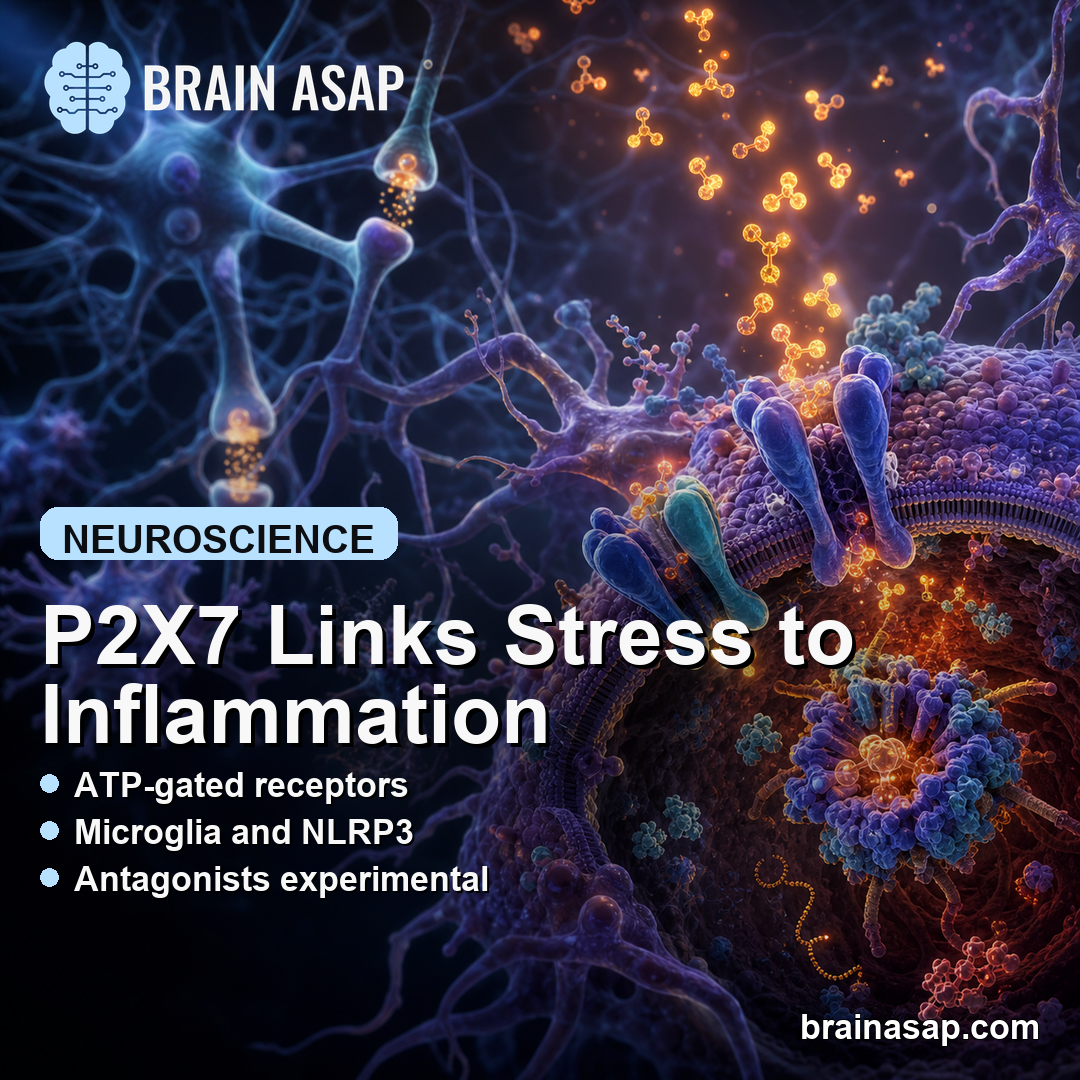
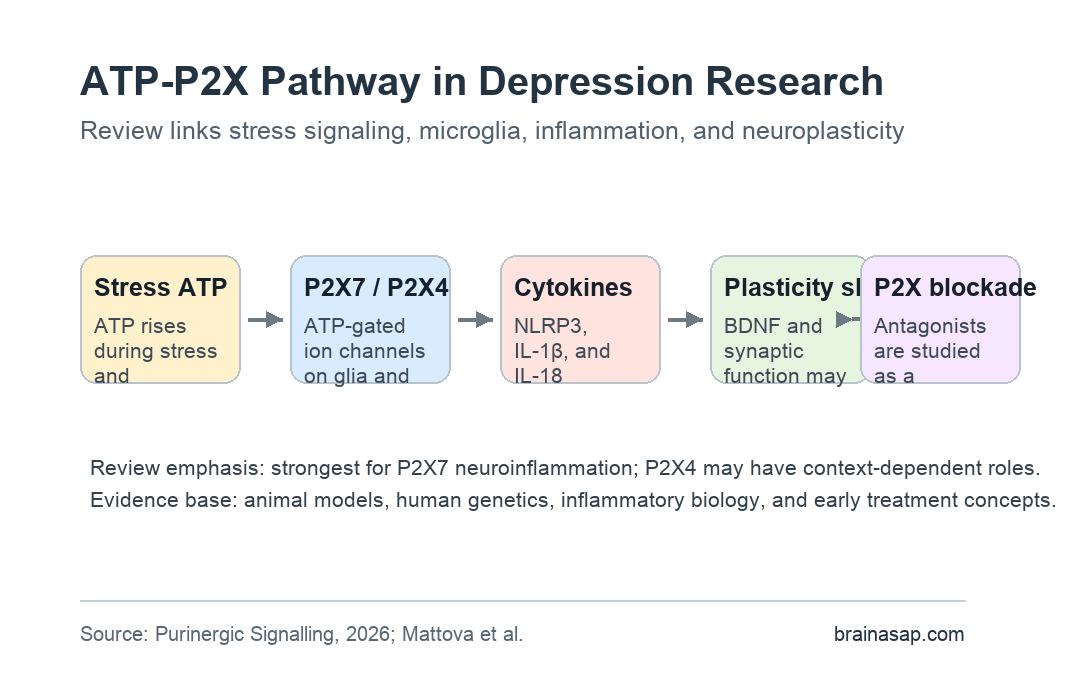
- P2X7 focus: The review describes P2X7 receptor signaling as a major link between stress, microglial activation, NLRP3 inflammasome signaling, cytokine release, and lower neuroplasticity.
- P2X4 context: P2X4 receptors are presented as mood-relevant but more context-dependent, with possible effects on microglia, BDNF, pain, and depression-like behavior.
- 300 million affected: The paper cites WHO estimates that depressive disorder affects more than 300 million people worldwide and occurs almost twice as often in women as in men.
- Genetic contrast: The review cites genetic contribution estimates of 0.85 for bipolar disorder and 0.43 for DSM-IV major depressive disorder.
- Antagonist pathway: P2X7 antagonists such as Brilliant Blue G, A-438079, and A-804598 are discussed as experimental tools for reducing inflammatory depression-like signaling.
Source: Purinergic Signalling (2026) | Mattova et al.
P2X receptors are ATP-gated ion channels, meaning they respond to extracellular adenosine triphosphate rather than using ATP only as cellular fuel. In the brain and immune system, that ATP signal can act as a danger or stress signal.
The review frames major affective disorders through this purinergic lens. Its central claim is not that one receptor explains depression; it is that P2X signaling gives researchers a concrete route from stress and inflammation to synaptic and mood-related changes.
P2X7 Receptors Link Stress ATP Signals to Microglial Inflammation
The strongest emphasis falls on P2X7 receptors. These receptors are expressed on immune and glial cells, including microglia, and require relatively high ATP concentrations for activation.
That property fits a stress-inflammation model. When ATP rises outside cells during injury, inflammation, or stress, P2X7 activation can promote microglial responses and the NLRP3 inflammasome, a protein complex that helps produce inflammatory cytokines.
- Microglial activation: The review describes microglia as a central cellular site for P2X7-related neuroinflammatory signaling.
- Cytokine release: P2X7/NLRP3 signaling can increase IL-1beta and IL-18, inflammatory molecules linked in the review to depressive biology.
- Plasticity effects: The pathway is tied to downstream changes in BDNF, synaptic density, and stress-sensitive brain circuits.
Brain-derived neurotrophic factor (BDNF) is a protein involved in neuronal growth, synaptic adaptation, and stress recovery. The review treats reduced BDNF signaling as one possible bridge between inflammation and impaired mood regulation.
P2X7 Antagonists Reduced Depression-Like Behavior in Animal Models
The review summarizes animal evidence in which genetic deletion or pharmacological blockade of P2X7 changed depression-like behavior. These studies are preclinical, but they make the receptor more than a correlation marker.
Several antagonist examples appear in the review. Brilliant Blue G, A-438079, and A-804598 are discussed as compounds used to test whether blocking P2X7 reduces inflammatory or behavioral readouts in stress models.
- Forced-swim and tail-suspension models: The review describes P2X7 blockade or deletion as reducing immobility-like behavior in standard rodent assays.
- Learned helplessness model: P2X7 deletion was linked with resistance to stress-induced behavioral changes and synapse-density loss in cited work.
- BDNF route: A-804598 is described as reducing immobility through BDNF-mediated signaling in the ventral hippocampus.
Those examples should not be read as proof that a P2X7 drug already treats human depression. They show why the receptor is being studied as a drug target: it sits near the intersection of stress biology, immune signaling, and synaptic adaptation.
P2X4 Receptors May Affect Depression Through Pain and BDNF Pathways
P2X4 receptors receive a more nuanced treatment. The review describes P2X4 signaling as relevant to microglia, neuroinflammation, chronic pain, and BDNF, but not as a simple one-direction switch.
That complexity is important because BDNF can be protective or maladaptive depending on timing, cell type, and brain region. The same receptor family can therefore appear in both injury recovery and depression-like signaling.
- Comorbid pain: P2X4 antagonism is discussed in relation to chronic pain with depression-like behavior.
- Hippocampal microglia: The review highlights hippocampal immune signaling as one route by which P2X4 could affect mood-related circuits.
- Regional effects: P2X4-related BDNF signaling may not mean the same thing in every brain region or disease stage.
This makes P2X4 a harder target to summarize than P2X7. It may still be relevant for treatment development, especially where pain, inflammation, and depression overlap.
Genetic and Platelet Evidence Extend the P2X Model Beyond Microglia
The review also connects purinergic signaling to human genetics and platelet biology. It cites a strong genetic contribution estimate for bipolar disorder, 0.85, compared with 0.43 for DSM-IV major depressive disorder.
These numbers are not P2X-specific effect sizes. They appear in the paper’s broader setup for why biological vulnerability differs between bipolar disorder and unipolar depression.
- Genetic context: P2X-related genes are discussed as part of a larger inherited-risk landscape for major affective disorders.
- Platelet signaling: P2X1 and other purinergic mechanisms in platelets are reviewed because platelets release ATP and participate in inflammatory and vascular biology.
- System-wide model: The receptor family is not limited to neurons; immune cells, glia, vascular cells, and platelets all shape the biological picture.
That wider scope is useful, but it also raises caution. A broad review can gather plausible mechanisms without proving which one drives symptoms in a given patient group.
P2X Depression Treatments Still Need Human Clinical Evidence
The treatment implication is clear but early. P2X receptor antagonists could become a mechanistically distinct antidepressant strategy if human studies show that blocking these pathways improves mood symptoms without unacceptable side effects.
At this stage, the most defensible conclusion is that P2X7 antagonism is a strong preclinical hypothesis. The review supports the biological rationale, but clinical translation will require patient trials with defined inflammatory profiles, mood outcomes, safety monitoring, and comparison against existing treatments.
- Mechanistic strength: P2X signaling links extracellular ATP, inflammation, cytokines, and neuroplasticity in a coherent pathway.
- Clinical boundary: The review does not show that a P2X antagonist has already improved depression in a large randomized patient trial.
- Best next test: Human studies should identify which depressed or bipolar subgroups have measurable purinergic-inflammation signatures.
For now, the review makes P2X receptors a serious research target in mood disorders. It shifts part of the depression discussion from serotonin-only framing toward immune-neural communication that can be measured and experimentally blocked.
Citation: DOI: 10.1007/s11302-026-10147-5. Mattova et al. ATP and major affective disorders: the involvement of P2X receptors in pathophysiology. Purinergic Signalling. 2026;22:38.
Study Design: Narrative mechanistic review of P2X receptor biology in major depressive disorder, bipolar disorder, neuroinflammation, platelet signaling, and experimental treatment targets.
Sample Size: Review article; no new patient or animal cohort was enrolled for this paper.
Key Statistic: The review cites more than 300 million people affected by depressive disorder worldwide and genetic contribution estimates of 0.85 for bipolar disorder versus 0.43 for DSM-IV major depressive disorder.
Caveat: The strongest treatment evidence discussed is largely preclinical, so P2X antagonists remain experimental for mood disorders.