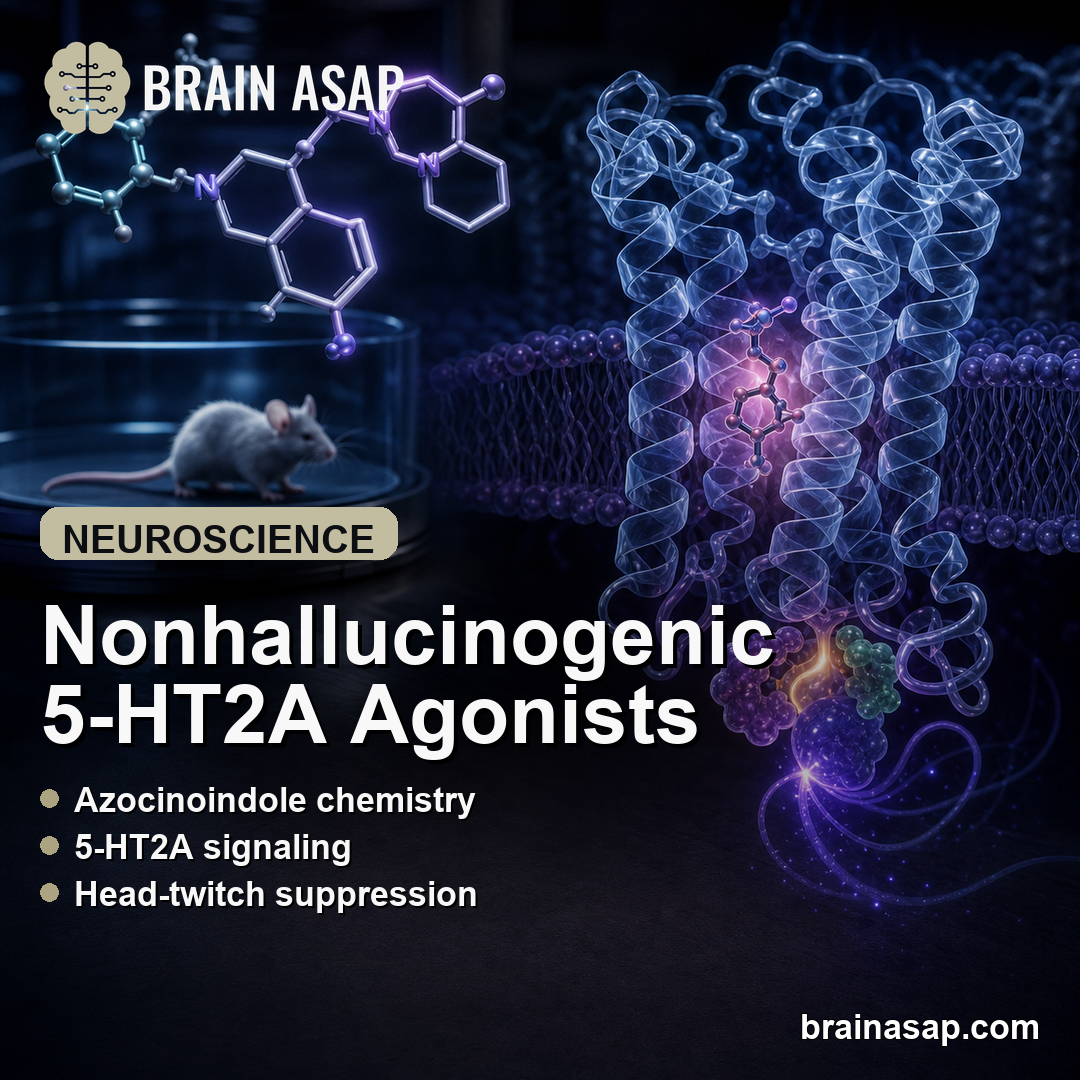
TL;DR: A 2025 study in Journal of the American Chemical Society used photochemistry to turn amino-acid-linked tryptamines into azocinoindoles that activated serotonin 5-HT2A signaling while suppressing the mouse head-twitch response.
Key Findings
- C4 indole route: The method used light-induced cyclization to functionalize the indole ring at the C4 position.
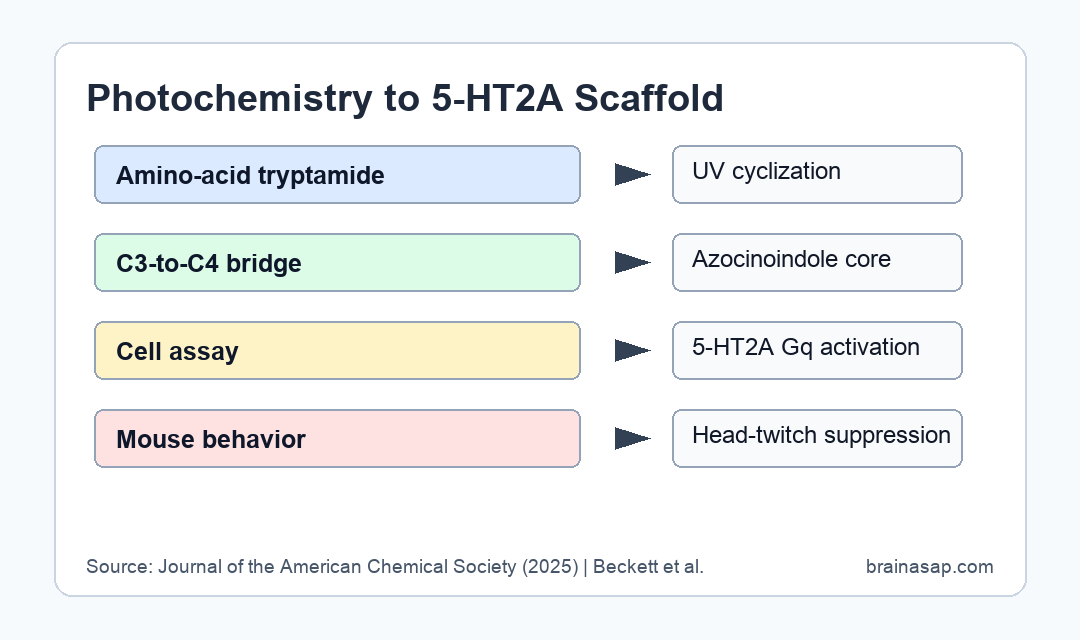
- Amino-acid inputs: Amino acids were coupled to tryptamine and irradiated to create lactams bridging the C3 and C4 positions.
- Cleaner products: The optimized precursor strategy produced C3-to-C4 bridged indoles without the C2 regioisomers seen with some older substrates.
- 5-HT2A signaling: Reduced lactams called azocinoindoles showed full or partial serotonin 5-HT2A Gq activation in vitro.
- Head-twitch suppression: In mice, the compounds suppressed the head-twitch response, suggesting a nonhallucinogenic 5-HT2A agonist profile.
Source: Journal of the American Chemical Society (2025) | Beckett et al.
Azocinoindoles are ring-constrained tryptamine-like compounds. The source is mainly a chemistry study, but it becomes BrainASAP-relevant because researchers tested the resulting molecules at the serotonin 5-HT2A receptor.
Serotonin 5-HT2A is central to classic psychedelic pharmacology. The study explored whether a new scaffold could support receptor activation without the usual mouse behavioral signal associated with hallucinogenic activity.
Photochemistry Created C3-to-C4 Bridged Tryptamine Analogs
The technical problem was indole functionalization. Tryptamine-like molecules are important in neuropharmacology, but direct modification at the C4 position can be difficult because indole chemistry often favors other positions.
The researchers developed a light-induced radical spin-center shift process. Amino acids were coupled to tryptamine, then irradiated with ultraviolet light to form lactams bridging the C3 and C4 positions of the indole nucleus.
- Starting logic: The chemistry began with amino-acid-linked tryptamides rather than an already finished psychedelic scaffold.
- Reaction target: The method aimed to build a ring-constrained indole core with medicinal-chemistry flexibility.
- Optimization: Alpha-acetoxy and alpha-lactone substituted tryptamides improved access to the desired bridged products.
Drug-discovery scaffolds need more than one active compound. A practical route lets chemists vary substituents and test structure-activity relationships.
The Optimized Route Avoided C2 Regioisomer Problems
The paper emphasized a cleaner synthetic route. The optimized conditions produced C3-to-C4 bridged indoles in good to excellent yields and avoided C2 regioisomers that can appear with alpha-halo tryptamide substrates.
The key takeaway is not the full reaction mechanism. Researchers made the desired molecular architecture more reliably, which makes biological testing and future chemical variation easier.
- Regioselectivity: The reaction favored the intended C4-linked product instead of common off-position products.
- Scaffold access: The route generated a library of bridged indole lactams.
- Drug-discovery value: The azocinoindole core can be diversified for serotonin-receptor screening.
The study then moved from chemistry into pharmacology. The reduced lactams resembled known psychoactive tryptamines enough to test at serotonin 5-HT2A receptors.
Azocinoindoles Activated 5-HT2A Gq Signaling In Vitro
Serotonin 5-HT2A is a receptor strongly associated with psychedelic drug effects. In this paper, azocinoindoles showed full and partial agonist activity on the 5-HT2A Gq signaling pathway.
Gq activation is only one part of receptor pharmacology. A molecule can activate one signaling arm, show weak or strong activity across other pathways, and still differ behaviorally from classic psychedelics.
- In silico testing: The team modeled receptor interactions before biological assays.
- In vitro testing: Cell-based assays measured 5-HT2A Gq activation.
- Activity range: Compounds included both full and partial agonist profiles.
- Interpretive limit: Receptor activation alone does not prove antidepressant, anxiolytic, or psychedelic-like efficacy.
The boundary should stay precise. The experiments did not test depression, anxiety, addiction, or cognition outcomes. They tested a chemical platform and early pharmacological readouts.
Mouse Head-Twitch Suppression Suggested a Nonhallucinogenic Profile
The head-twitch response is a common mouse readout associated with hallucinogenic 5-HT2A agonists. The azocinoindoles in this study suppressed the head-twitch response in vivo.
The result suggests these compounds may belong to a growing class of nonhallucinogenic 5-HT2A agonists. The word “suggests” is doing real work: mouse head-twitch behavior is a proxy, not a direct human hallucination measure.
- What was shown: The compounds activated 5-HT2A signaling and reduced a mouse behavioral proxy linked to hallucinogenic activity.
- What remains open: Safety, dosing, brain exposure, therapeutic efficacy, and human subjective effects were not established.
- Drug-discovery value: A reliable scaffold could help researchers separate therapeutic receptor signaling from unwanted psychedelic-like behavior.
The value is early-stage. The azocinoindole core gives medicinal chemists a new platform for probing serotonin-receptor biology, not a ready clinical drug.
Nonhallucinogenic 5-HT2A Agonists Remain an Early Drug-Discovery Goal
The broader field is trying to separate potentially therapeutic serotonin-receptor signaling from acute hallucinogenic or perceptual effects. Compounds that activate 5-HT2A without producing the head-twitch response are one way to probe that separation.
The experiments contribute a scaffold and a route, not a final therapeutic profile. A clinical drug candidate would still need pharmacokinetics, selectivity across serotonin receptors, toxicology, brain exposure, behavioral efficacy, and reproducible nonhallucinogenic evidence.
- Useful early signal: 5-HT2A Gq activity shows that the scaffold can engage a central psychedelic-related receptor.
- Important behavioral screen: Head-twitch suppression suggests the compounds do not behave like typical hallucinogenic agonists in mice.
- Remaining work: The study does not establish antidepressant-like, anxiolytic, cognitive, or addiction-relevant effects.
The finding is a chemistry-enabled starting point for neuropharmacology, not evidence that a new psychedelic-like medicine is ready. Its value is the combination of cleaner synthesis, receptor engagement, and a behavioral screen that points away from classic hallucinogenic activity.
Future experiments would need to compare these compounds with known psychedelic and nonpsychedelic 5-HT2A ligands across multiple signaling pathways. Repeated dosing, metabolism, receptor selectivity, and brain exposure would decide whether the scaffold remains productive beyond the first screening stage.
Citation: DOI: 10.1021/jacs.5c19817. Beckett et al. Transforming amino acids into serotonin 5-HT2A receptor ligands using photochemistry. Journal of the American Chemical Society. 2025;147:48400-48415.
Study Design: Synthetic chemistry study with computational, in vitro receptor, and mouse behavioral pharmacology assays.
Sample/Model: Amino-acid-derived tryptamide compounds, cell-based 5-HT2A assays, and mouse head-twitch testing.
Key Statistic: Azocinoindoles activated 5-HT2A Gq signaling while suppressing the mouse head-twitch response.
Caveat: The study does not test clinical efficacy or human hallucinogenic effects.