TL;DR: A 2026 rat study in Brain Structure and Function found that ventral pallidum activity supports juvenile social play, while activating inhibitory nucleus accumbens inputs to the ventral pallidum reduced play behavior in both male and female rats.
Key Findings
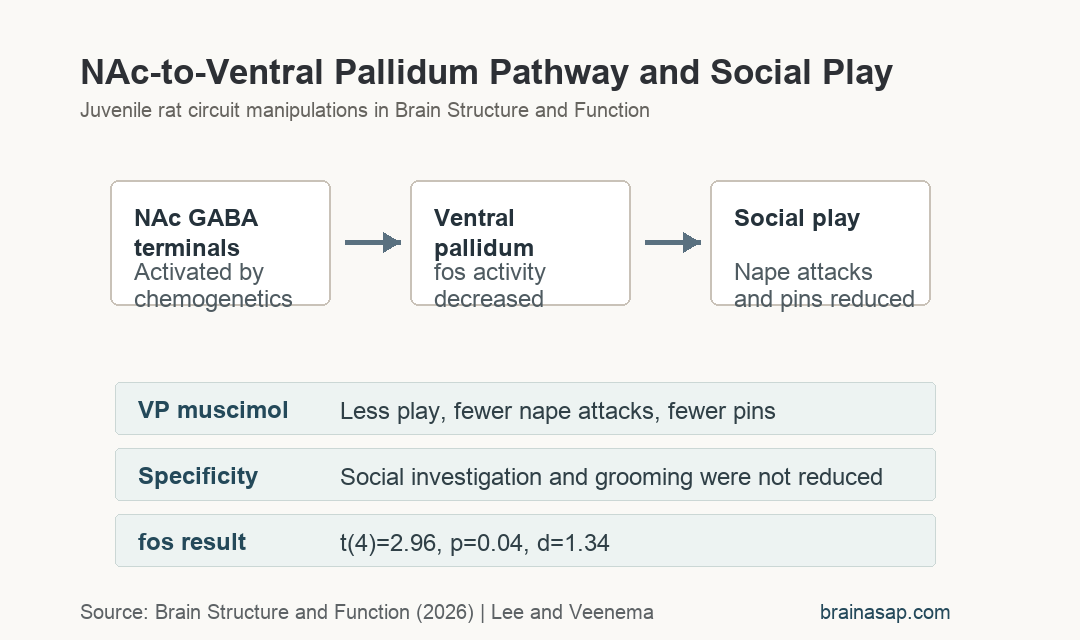
- Ventral pallidum inactivation: Bilateral muscimol microinfusion into the ventral pallidum reduced juvenile rat social play, nape attacks, and pins.
- Social behavior specificity: Muscimol did not reduce social investigation or allogrooming, suggesting the effect was not a broad social shutdown.
- NAc GABA terminal activation: Chemogenetic stimulation of nucleus accumbens GABA terminals in the ventral pallidum decreased play behavior in both sexes.
- Lower VP fos activity: In Gad1-iCre rats, CNO stimulation reduced ventral pallidum fos-positive cells, t(4) = 2.96, p = 0.04, d = 1.34.
- Male-specific shell activation: Equal play behavior in males and females was associated with a male-specific decrease in fos activation of NAc shell neurons projecting to the ventral pallidum.
Source: Brain Structure and Function (2026) | Lee and Veenema
Social play behavior is an early peer interaction that helps mammals practice social behavior. Juvenile rats are a common model because their play includes measurable behaviors such as nape attacks, pins, investigation, and grooming.
This study focused on a reward circuit question: how do the nucleus accumbens and ventral pallidum interact when young animals play?
Ventral Pallidum Activity Was Required for Juvenile Rat Social Play
The ventral pallidum is part of the mesolimbic reward system, the same broad circuit family involved in motivation and reward processing. Researchers first tested whether acutely reducing ventral pallidum activity changed social play in juvenile rats.
At postnatal day 35, male and female rats received bilateral microinfusions of either vehicle or muscimol, a GABA-A receptor agonist that temporarily inhibits local neural activity. The social-play test lasted 10 minutes with an unfamiliar stimulus rat.
- Vehicle group: Male and female rats received artificial cerebrospinal fluid before the social-play test.
- Muscimol group: Rats received 10 ng/0.5 microliters per side into the ventral pallidum.
- Behavior scoring: Researchers measured play behaviors including nape attacks and pins, plus non-play social behaviors.
- Sex comparison: The experiment included both male and female juvenile rats rather than treating play circuitry as male-only.
Muscimol-treated rats showed less social play, fewer nape attacks, and fewer pins than vehicle-treated rats. They did not show lower social investigation or allogrooming.
Muscimol Reduced Play Without Reducing All Social Contact
The specificity result matters because a broad sedation or avoidance effect would be expected to reduce several social behaviors together.
Instead, play behaviors decreased, while social investigation and grooming remained similar. Muscimol-treated rats also showed more non-social cage exploration, making reduced locomotion an unlikely explanation.
- Social play: Reduced after ventral pallidum inactivation.
- Nape attacks: Reduced after ventral pallidum inactivation.
- Pins: Reduced after ventral pallidum inactivation.
- Social investigation: Not reduced in the same way.
The result supports a focused role for the ventral pallidum in the rewarding, play-specific part of juvenile interaction. It does not suggest that the ventral pallidum is the only region involved in play.
NAc GABA Inputs to the Ventral Pallidum Suppressed Play
The second experiment tested the pathway from the nucleus accumbens (NAc) to the ventral pallidum. The NAc is another reward-related region, and many of its projection neurons are GABAergic, meaning they inhibit downstream targets.
Using Gad1-iCre rats, researchers expressed excitatory DREADD receptors in NAc GABA neurons and stimulated their terminals in the ventral pallidum. Activating those inhibitory terminals reduced ventral pallidum neuronal activation and reduced social play.
- DREADD method: The chemogenetic receptor allowed pathway-specific activation after clozapine-N-oxide (CNO) administration.
- VP activity check: CNO lowered fos-positive cells in the ventral pallidum of Gad1-iCre rats, t(4) = 2.96, p = 0.04.
- Wildtype control: CNO did not change ventral pallidum fos activity in rats without the DREADD construct.
- Behavioral result: Stimulating NAc GABA terminals in the ventral pallidum decreased social play in both sexes.
Together with the muscimol result, this supports a circuit model: ventral pallidum activation facilitates play, and stronger inhibitory input from the NAc can reduce that activation.
Male and Female Rats Reached Similar Play Through Different NAc Activity
The study also examined whether sex differences in the NAc-to-ventral-pallidum projection helped explain play behavior. Male and female rats showed similar numbers of NAc neurons projecting to the ventral pallidum.
During play exposure, however, males showed a specific reduction in fos activation among NAc shell neurons projecting to the ventral pallidum. Females did not show that same pattern.
This finding suggests that similar observed play levels may be supported by partially different circuit activity in males and females. It is a neural-activation result, not proof that one sex has better or worse social motivation.
Social Reward Circuit Findings May Inform Autism-Relevant Questions
The paper frames juvenile social play as relevant to social development because reduced peer play is common in some autism spectrum disorder contexts. The rat experiments do not model autism directly, but they identify a reward-circuit pathway that controls play expression.
A careful translation would focus on circuit principles: social play depends on reward-related output regions, and inhibitory input from the NAc can regulate that output. Human social development is more complex than rat play, but the pathway gives researchers a testable circuit target.
The main limitation is that these were acute circuit manipulations in juvenile rats. Long-term development, disease models, and human social behavior require separate evidence.
Citation: DOI: 10.1007/s00429-026-03100-0. Lee and Veenema. The nucleus accumbens to ventral pallidum pathway regulates social play behavior in male and female juvenile rats. Brain Structure and Function. 2026;231:54.
Study Design: Juvenile rat circuit-manipulation study using pharmacological inactivation, chemogenetic pathway stimulation, and fos activation mapping.
Sample/Model: Male and female juvenile rats tested during a 10-minute social-play interaction.
Key Statistic: Chemogenetic stimulation of NAc GABA terminals reduced ventral pallidum fos-positive cells in Gad1-iCre rats, t(4) = 2.96, p = 0.04, d = 1.34.
Caveat: Acute rat circuit manipulations clarify pathway function but do not directly establish human social-development or autism mechanisms.