TL;DR: A 2026 longitudinal study in Cerebral Cortex linked neighborhood disadvantage in childhood to lower adolescent cortical thickness and surface area, while better educational and health/environmental opportunities tracked greater MRI-estimated cortical thickness and surface area with slower developmental decline.
Key Findings
- 11,639 adolescents: The analysis used ABCD Study neuroimaging data from 11,639 participants with at least one usable scan, yielding 22,166 imaging observations.
- Three scan waves: Participants were followed from about age 9.9 to 14.1, letting researchers model cortical change across early and middle adolescence.
- Two cortical measures: Mean cortical thickness and total cortical surface area both showed significant individual variability in baseline level and rate of change.
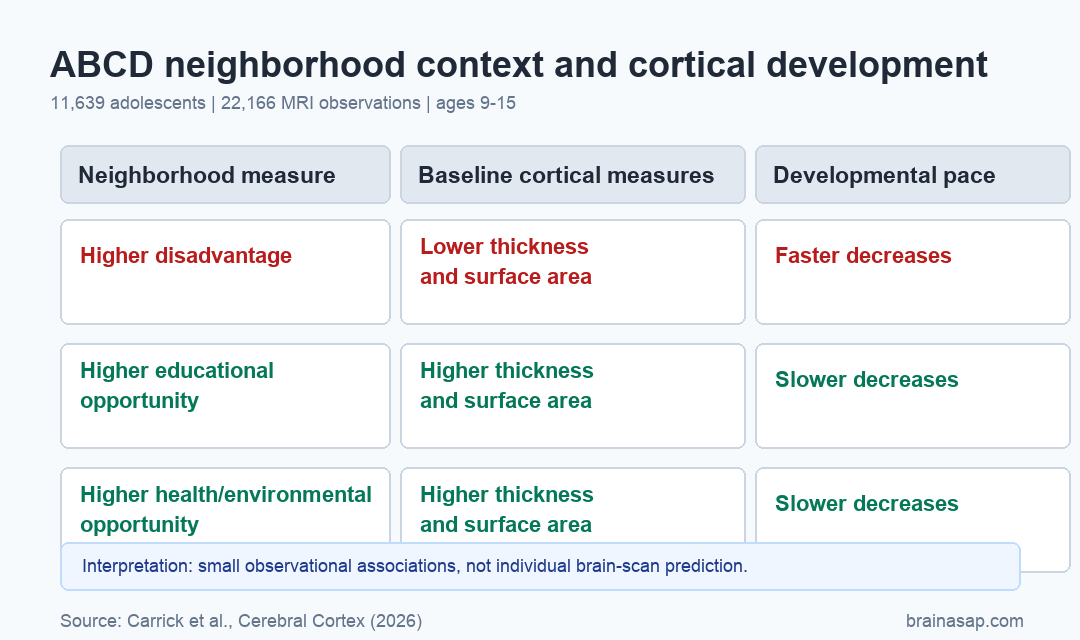
- Disadvantage pattern: Higher neighborhood disadvantage was associated with lower baseline cortical thickness and surface area and faster decreases across development.
- Opportunity pattern: Higher educational and health/environmental opportunity scores were associated with greater baseline cortical thickness and surface area and slower decreases over time.
Source: Cerebral Cortex (2026) | Carrick et al.
Neighborhood disadvantage is not just a family-income variable. It can include local deprivation, school access, environmental stress, and health-related opportunity around a child’s home.
Researchers used the Adolescent Brain Cognitive Development Study, known as ABCD, to ask whether those neighborhood features tracked individual differences in cortical development.
The models did not identify a sharp brain subtype; they found a small but consistent association with where adolescents started and how quickly cortical measures changed.
ABCD Brain Scans Tracked Cortical Thickness and Surface Area From Ages 9 to 15
The analysis included 11,639 participants from the ABCD cohort after image-quality exclusions. Together, those adolescents contributed 22,166 observations across up to three neuroimaging timepoints.
Average ages were about 9.92 years at the first scan, 11.96 years at the second scan, and 14.08 years at the third scan. That age span is useful because cortical gray matter typically changes substantially during adolescence.
- Cortical thickness: Researchers measured mean cortical thickness, a structural MRI estimate of how thick the cortical sheet is across the brain.
- Cortical surface area: They also measured total cortical surface area, a related but distinct measure of cortical size and folding.
- Growth modeling: Latent growth models estimated both the baseline level, called the intercept, and the pace of change, called the slope.
The models showed that average cortical thickness and surface area decreased over time, although surface area looked relatively stable until later in the age window. Adolescents also differed from one another in both baseline cortical measures and developmental pace.
Neighborhood Measures Separated Disadvantage From Opportunity
The study did not treat neighborhood context as one simple good-or-bad score. Researchers modeled neighborhood disadvantage, educational opportunity, and health/environmental opportunity separately.
Neighborhood disadvantage came from the Area Deprivation Index, which reflects deprivation characteristics around a participant’s primary address. Opportunity scores came from the Child Opportunity Index and captured access to educational resources, health-related resources, green space, and environmental conditions.
- Disadvantage score: Higher values represented more neighborhood deprivation at baseline, when participants were about 9 to 10 years old.
- Educational opportunity: Higher values represented better access to educational resources, including features such as early-childhood education availability.
- Health/environmental opportunity: Higher values represented better health and environmental conditions, including reduced exposure to hazards and better local resources.
Household income-to-needs ratio was included in adjusted analyses, along with sex and scanner type. Neighborhood context can overlap with family socioeconomic status but is not identical to it.
Disadvantaged Neighborhoods Tracked Lower Cortical Measures and Faster Decline
Higher neighborhood disadvantage was associated with lower baseline cortical thickness and lower baseline cortical surface area. It was also associated with faster decreases in those metrics across development.
The direction is easy to misread if the cortical terms are left vague. The study did not show that brain regions were physically “lower.” It reported thinner cortex and smaller surface-area estimates in adolescents exposed to more neighborhood disadvantage.
- Baseline difference: More disadvantage was linked to lower starting values for both cortical thickness and surface area.
- Developmental pace: More disadvantage was linked to faster decreases in cortical measures across the observed adolescent period.
- Small effects: The researchers described the effect sizes as small, so the finding is a population-level association rather than an individual diagnostic marker.
- No brain subtype: Clustering analyses did not identify distinct subgroups of cortical-development trajectories.
A sensitivity analysis that adjusted for total intracranial volume kept the surface-area findings largely unchanged. For cortical thickness, the slope association with disadvantage was no longer statistically significant after that adjustment, suggesting part of the thickness-change pattern may reflect broader brain-size variation.
Educational and Environmental Opportunity Tracked Slower Cortical Decline
Opportunity measures showed a different association. Higher educational opportunity and higher health/environmental opportunity were associated with greater baseline cortical thickness and surface area.
Those opportunity measures were also associated with slower decreases across development. In the researchers’ specificity analysis, neighborhood opportunities explained unique variance in the pace of cortical-thickness development, while both disadvantage and opportunity measures related to baseline cortical levels.
- Educational resources: Better educational opportunity was linked to greater cortical thickness and surface area and slower developmental decline.
- Health/environment conditions: Better health and environmental opportunity showed the same broad direction, including the most persistent cortical-thickness slope signal after intracranial-volume adjustment.
- Multiple-neighborhood model: When all three neighborhood measures were considered together, opportunity measures remained especially informative for cortical-thickness pace.
This does not show that neighborhood opportunity “builds a thicker cortex” in a simple causal sense. It shows that neighborhood opportunity scores were associated with MRI-estimated cortical-development trajectories after the study accounted for several key covariates.
The Study Supports Contextual Brain Development, Not Individual Prediction
Neighborhood variables explained only a small part of cortical-development variation. Adolescents’ trajectories varied, and residential context was one contributor among many.
The limits are also clear. Neighborhood measures were assigned from residential context, the effect sizes were small, and the analysis was observational.
The findings cannot prove that moving a child to a different neighborhood would produce a specific cortical change.
- Population-level result: The associations describe group-level patterns, not a clinical brain scan rule for individual adolescents.
- Observational design: The study adjusted for several covariates, but unmeasured family, school, genetic, or policy factors could still contribute.
- Global brain metrics: Whole-brain cortical thickness and surface area are broad measures, so they do not identify one specific circuit or mental-health pathway.
These data support studying adolescent brain development with more than family-level socioeconomic measures alone. Neighborhood deprivation and opportunity are part of the developmental environment, and they may shape the range of cortical trajectories seen across a large population.
Citation: DOI: 10.1093/cercor/bhag034. Carrick et al. Individual differences in adolescent cortical development are associated with neighborhood characteristics: Longitudinal findings from the ABCD study. Cerebral Cortex. 2026;36:bhag034.
Study Design: Longitudinal neuroimaging analysis using latent growth models in the ABCD cohort.
Sample Size: 11,639 adolescents with at least one usable scan, contributing 22,166 observations across up to three scan waves.
Key Statistic: Higher neighborhood disadvantage was associated with lower cortical thickness and surface area and faster decreases; higher opportunity scores were associated with greater cortical thickness and surface area and slower decreases.
Caveat: The effect sizes were small and the observational design cannot prove that neighborhood characteristics caused the cortical-development differences.