TL;DR: A 2026 Nature Communications study used long-read single-cell RNA sequencing to map full-length isoforms in glioblastoma and found tumor-specific transcripts that short-read methods often miss.
Key Findings
- 27 GBM samples: Researchers profiled histologically confirmed IDH-wildtype glioblastoma samples using matched short-read and long-read single-cell sequencing.
- 100 million reads: The optimized long-read workflow produced a median output of about 100 million reads per sample.
- 0.94 gene concordance: Short-read and long-read gene-level estimates showed strong agreement, with R squared = 0.94.
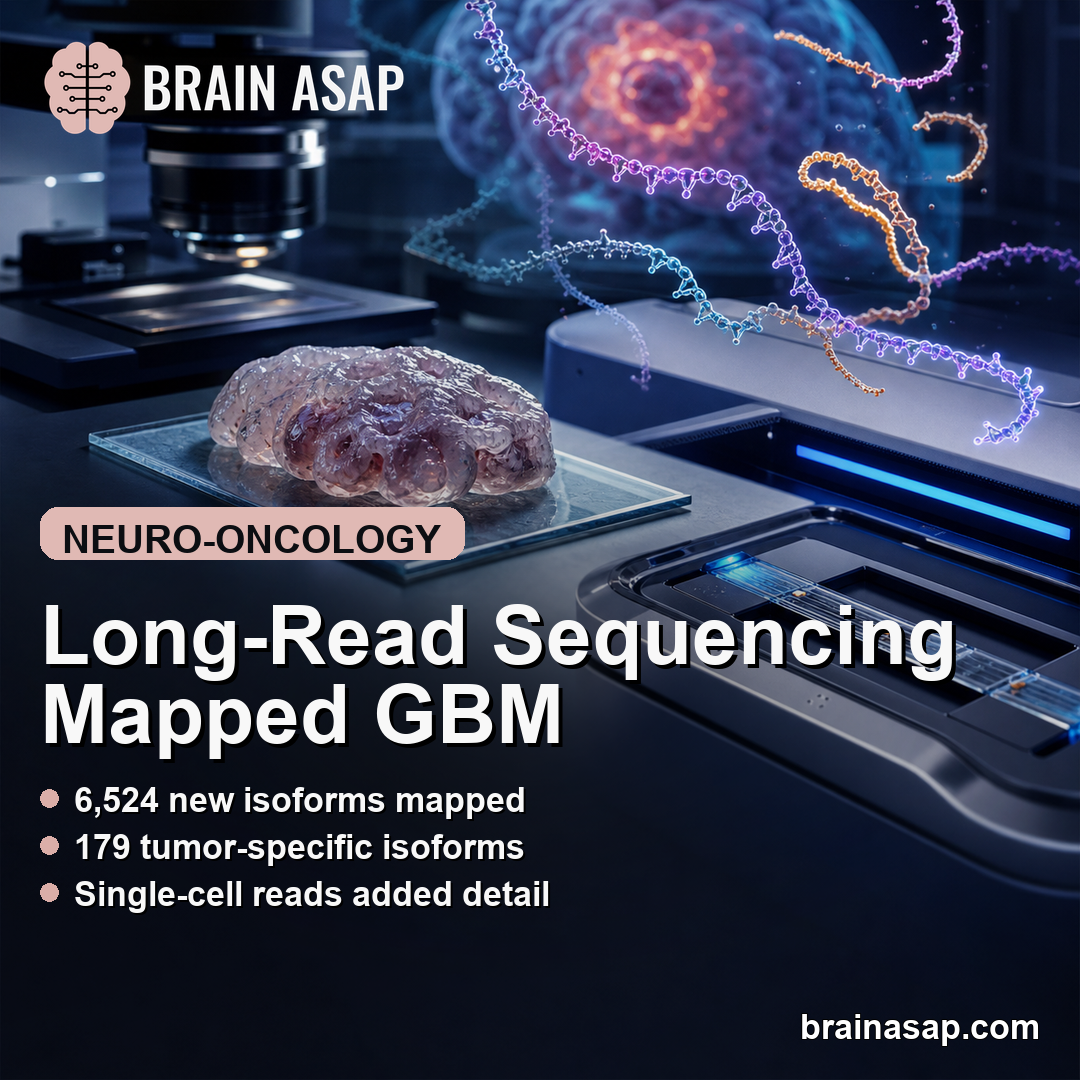
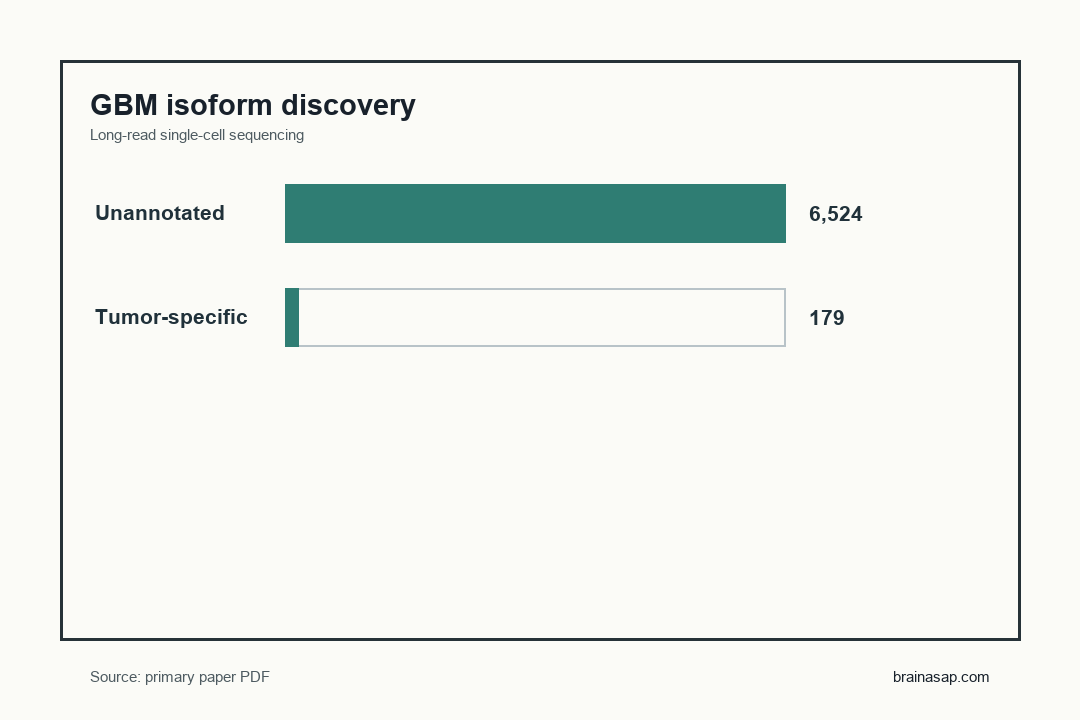
- 6,524 newly mapped isoforms: The study discovered thousands of isoforms not represented in existing transcript references.
- 179 tumor-specific isoforms: A subset appeared tumor-specific, with predicted peptide binding to MHC class I molecules.
Source: Nature Communications (2026) | Tang et al.
Glioblastoma (GBM) is an aggressive adult brain tumor partly defined by cellular heterogeneity. Two cells in the same tumor can look genetically related but behave differently because they express different RNA transcripts and protein isoforms.
This study focused on that isoform layer. Instead of asking only which genes were active, researchers used single-cell long-read RNA sequencing to read fuller transcript structures inside tumor cells.
Long-Read Single-Cell Sequencing Resolved Full-Length GBM Isoforms
Conventional short-read single-cell RNA sequencing is powerful for cell states, but short fragments often cannot identify the exact full-length transcript.
That limitation is important in GBM because alternative splicing can reshape receptors, intracellular proteins, immune visibility, and treatment resistance.
The team generated single-cell libraries on 27 tumor samples from IDH-wildtype GBM patients. Samples were sequenced with both Illumina short-read methods and Oxford Nanopore long-read sequencing.
- Patient sample: The cohort included 19 male and 8 female patients, with median ages of 63 and 57 years respectively.
- Sequencing approach: The same single-cell libraries were evaluated with short-read and long-read platforms.
- Technical concordance: Gene-level estimates from the two methods were strongly aligned, with R squared = 0.94.
That concordance is important because the long-read method was not just producing unrelated signal. It preserved the broad gene-expression picture while adding the transcript-structure detail that short-read sequencing usually cannot resolve.
The long-read workflow also used biotin enrichment to remove template-switch oligo artifacts and improve sequencing yield. The paper reported a median read length of 639 base pairs and an N50 of about 1 kilobase, supporting the transcript-resolution goal.
GBM Cells Carried Hundreds of Differentially Used Isoforms
The paper identified hundreds of isoforms with differential transcript usage across distinct tumor cell populations. Different tumor-cell states favored different versions of the same gene’s RNA product.
This is not a small technical distinction. If one isoform has a cell-surface region and another does not, the therapeutic target can exist in one cell state but not another.
If an isoform creates a new peptide sequence, it can alter immune recognition.
GBM is especially suited to this question because tumor recurrence and treatment resistance are often linked to intratumoral heterogeneity.
A bulk profile can miss whether a transcript feature belongs to many tumor cells, one aggressive cell state, or a rare population that survives therapy.
- Cell-state resolution: Isoform usage was mapped at single-cell level, not averaged across a whole tumor block.
- Transcript structure: Long reads helped reconstruct fuller RNA molecules rather than isolated fragments.
- Tumor heterogeneity: The approach directly addressed the within-tumor diversity that complicates GBM treatment.
Tumor-Restricted Isoforms Suggested Paired Therapy Targets
The analysis developed a framework to prioritize tumor-restricted isoforms and identify surface-intracellular target pairs in 7 patients.
The proposed idea is dual specificity: a therapy can use a surface feature to reach the cell and an intracellular isoform-derived feature to refine targeting.
That remains a discovery framework, not a tested treatment. Still, it is clinically relevant because GBM therapies often fail when a target is too broad, too inconsistent, or shared with normal tissue.
The target-pair logic is meant to reduce that problem. A surface marker alone can reach too many cells, while an intracellular isoform alone is harder to access; pairing them can help researchers prioritize candidates with both delivery and specificity advantages.
- Surface component: A cell-surface target can help a ligand-based therapy find tumor cells.
- Intracellular component: A tumor-restricted isoform can add specificity through isoform-derived peptides.
- Patient-level pairing: The target-pairing framework was applied across 7 patients, emphasizing individualized tumor architecture.
Unannotated Isoforms May Add Neoantigen Candidates
The study discovered 6,524 isoforms not represented in existing transcript references, including 179 tumor-specific isoforms.
Peptides derived from these isoforms showed strong predicted binding to major histocompatibility complex class I molecules.
MHC class I binding is one step in immune visibility. It does not prove that a peptide will become an effective vaccine target or immunotherapy target, but it helps narrow which tumor-specific transcripts deserve follow-up.
For cancer immunotherapy research, this distinction is important. A predicted neoantigen is not a treatment, but it can become a testable lead if researchers confirm expression, processing, presentation, and immune recognition in tumor-relevant systems.
- Annotation gap: Existing transcript references did not contain many of the isoforms observed in the GBM samples.
- Tumor specificity: The 179 tumor-specific isoforms are the most relevant candidates for avoiding normal-tissue signal.
- Immune prediction: Predicted MHC class I binding supports further testing as possible neoantigen sources.
The Atlas Is a Target-Discovery Resource, Not a Treatment Result
The strongest claim is methodological and biological: GBM contains isoform-level diversity that can be read at single-cell resolution. The study does not show that targeting any one isoform improves survival.
The resource is upstream of therapy. By resolving the full-length transcript landscape, the atlas gives researchers a cleaner map of which tumor-cell states express which targetable or immunologically useful isoforms.
For patients, this does not change current GBM care today. For researchers, it argues that the next generation of GBM target discovery needs to look beyond gene names and ask which exact transcript version a tumor cell is using.
Citation: DOI: 10.1038/s41467-026-72258-2. Tang et al. Mapping glioblastoma’s isoform diversity using long-read single-cell analysis. Nature Communications. 2026.
Study Design: Single-cell long-read and short-read RNA-sequencing atlas of human glioblastoma samples.
Sample Size: 27 IDH-wildtype glioblastoma tumor samples.
Key Statistic: 6,524 unannotated isoforms identified, including 179 tumor-specific isoforms.
Caveat: Candidate isoforms and predicted neoantigens require functional and clinical validation.