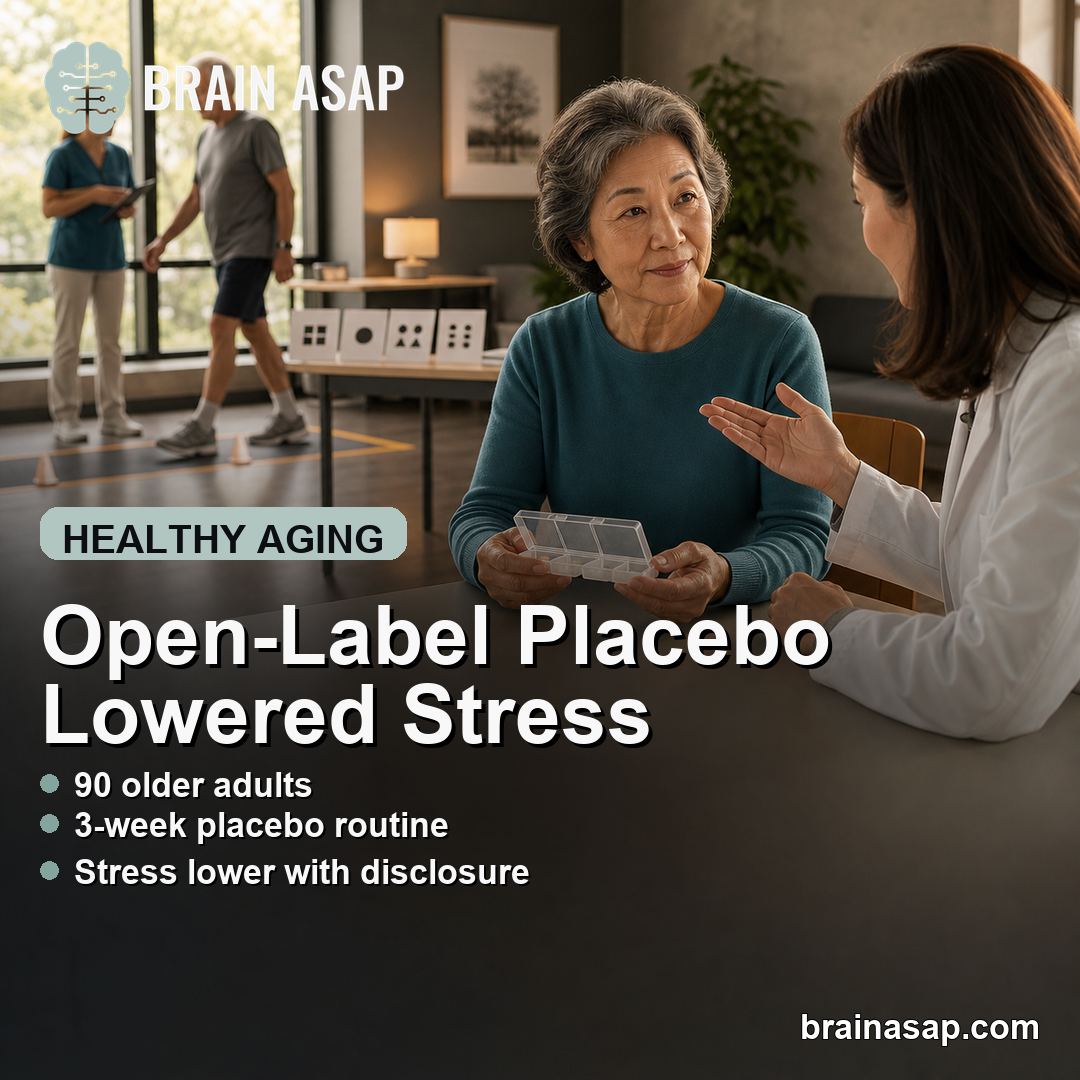
TL;DR: A 2026 randomized trial in International Journal of Clinical and Health Psychology found that older adults who knowingly took placebo pills for 3 weeks reported lower stress and performed better on Digit Span than controls.
Key Findings
- Aging trial context: The trial randomized 90 healthy community-dwelling adults in Milan, ages 65 to 90, into control, deceptive placebo, or open-label placebo groups.
- Open-label meant disclosed: Participants were told the pills were inert but might still trigger beneficial mind-body responses.
- Stress was lower: After 3 weeks, the open-label placebo group had a lower median Perceived Stress Scale score than both the control and deceptive-placebo groups.
- Memory span improved: The open-label group scored higher than controls on Digit Span, a short-term verbal and working-memory test.
- Evidence stayed preliminary: The sample was small, the intervention lasted 3 weeks, and Stroop gains across all groups suggest practice effects influenced some outcomes.
Source: International Journal of Clinical and Health Psychology (2026) | Barbiani et al.
Open-Label Placebo Reduced Stress Without Deception
Open-label placebo means the person is told the pill is a placebo. In this trial, that transparent version performed better than a deceptive placebo on the clearest psychological result: perceived stress after 3 weeks.
The study tested whether placebo procedures could influence functions that often matter in aging, including stress, memory, attention, and physical performance. The researchers recruited 90 healthy older adults from retirement centers, university-area flyers, and word of mouth in Milan, Italy.
Participants were randomly assigned to three equal groups:
- Control group: No pill treatment, with the same baseline and follow-up testing schedule.
- Deceptive placebo: Inert tablets described as a multivitamin supplement for people over 65.
- Open-label placebo: The same inert tablets, openly described as placebo pills with a mind-body rationale.
Both pill groups received 21 tablets and were asked to take one tablet per day for 3 weeks. The key distinction was disclosure: one group was misled about the pills, while the open-label group was told the truth and given a rationale for why expectations and context can still matter.
The Main Between-Group Result Favored the Transparent Placebo
The strongest result was not a broad improvement across every outcome. It was a more specific pattern: after the intervention, the open-label placebo group had lower perceived stress than both comparison groups.
Perceived stress was measured with the 10-item Perceived Stress Scale (PSS-10), where higher scores mean more stress. At post-intervention, the open-label group had a median score of 11.0, compared with 15.0 in controls and 13.5 in the deceptive-placebo group.
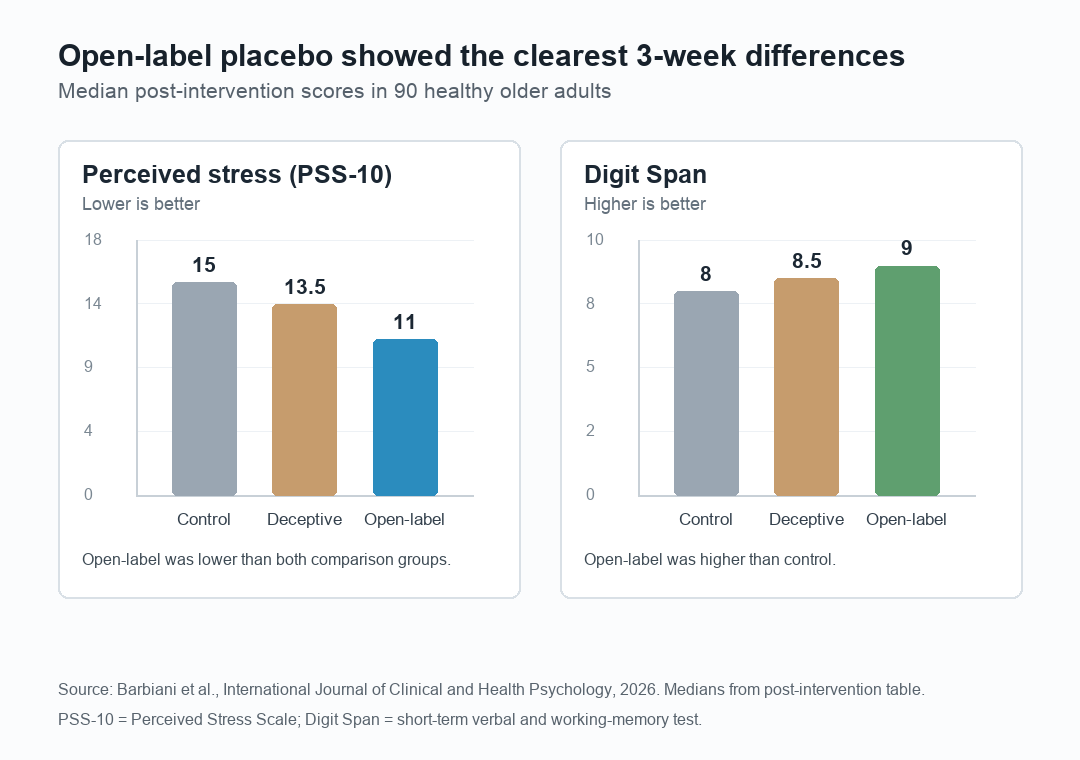
The between-group difference was statistically significant for stress. Post hoc comparisons indicated that the open-label group differed from both control and deceptive placebo after correction.
That detail matters because it narrows the claim. The result does not say any pill-like ritual improves aging. It says a transparent placebo explanation, paired with daily use, was associated with lower short-term stress in this small older-adult sample.
Digit Span Improved More Clearly Than Stroop Attention
The cognitive result was also selective. Digit Span, a test of short-term verbal memory and working memory, was higher in the open-label group than in controls after the intervention.
The open-label group reached a median post-intervention Digit Span score of 9.0, compared with 8.0 in controls and 8.5 in the deceptive-placebo group. The significant post-intervention comparison was open-label placebo versus control; deceptive placebo did not significantly differ from control on that between-group test.
The researchers also measured selective attention and inhibition with a short Stroop task. Stroop completion time improved in all three groups, including controls.
- Digit Span: The best between-group evidence favored open-label placebo over control.
- Stroop time: All groups became faster, which points to practice or habituation from repeated testing.
- Interpretation: The cognitive signal is most defensible for memory span, not for a broad attention claim.
That distinction keeps the finding practical. A reader should not take the study as proof that transparent placebo pills sharpen cognition generally. The more careful conclusion is that one memory-span measure improved relative to control.
Physical Performance Rose Within the Placebo Groups
Physical functioning was measured with the Short Physical Performance Battery (SPPB), which combines balance, 4-meter walking speed, and repeated chair-stand performance. Scores range from 0 to 12, with higher values indicating better performance.
Both placebo groups improved from a median of 10.0 before the intervention to 11.0 afterward. The control group stayed at a median of 10.0.
The authors treated these physical findings cautiously. The within-group improvements suggest a possible role for expectations, perceived capability, motivation, or movement confidence, but the strongest statistical footing still comes from between-group outcomes favoring open-label placebo for stress and Digit Span.
The same caution applies to mood-adjacent measures that did not move. The study did not find significant post-intervention group differences for psychological well-being, daytime sleepiness, fatigue, optimism, self-efficacy, or aging stereotypes.
The Rationale May Have Mattered More Than the Pill
The open-label script did more than say “this is a placebo.” It explained placebo effects as a real mind-body phenomenon and emphasized that taking the tablets on schedule was important.
That makes the intervention partly a context and expectation procedure. The transparent group may have gained from several ingredients:
- Honest disclosure: Participants did not have to believe the pill contained an active supplement.
- Credible explanation: The rationale framed placebo responses as possible even without deception.
- Daily routine: Taking a pill each day may have reinforced attention to stress, functioning, and self-regulation.
- Research contact: Experimenter tone, trust, and engagement may have shaped expectations.
The study did not measure expectations with a standardized scale, so it cannot separate those mechanisms cleanly. It also cannot prove whether the pill-taking ritual, the explanation, the researcher interaction, or their combination drove the result.
The Findings Are Promising but Not Ready for Broad Clinical Use
The trial has clear limits. The sample size was 30 people per group, chosen for feasibility rather than a formal power calculation. Smaller effects may have been missed, and some significant findings could be unstable because many outcomes were tested.
The sample was also unusually selected. Participants were healthy, community-dwelling older adults who spoke Italian, were functionally independent, and were not taking medications or supplements. That excludes many older adults who would be seen in ordinary clinical settings.
- Short follow-up: The intervention lasted only 3 weeks, so durability is unknown.
- No formal cognitive screen: The study did not use a standard baseline MMSE or MoCA assessment.
- No biological markers: Cortisol, heart-rate variability, EEG, and other physiology measures were not included.
- No preregistration: The authors noted that preregistered larger studies would strengthen confidence.
The practical takeaway is narrow and useful: in a small randomized study, a transparent placebo procedure was linked to lower short-term stress and better memory-span performance in healthy older adults. It supports further testing of ethical placebo-based routines, not self-treatment or replacement for medical care.
Citation: DOI: 10.1016/j.ijchp.2026.100673. Barbiani D, Antonietti A, Pagnini F. Placebo mechanisms in aging: A randomized controlled trial comparing deceptive and open-label placebos on psychological, cognitive, and physical functioning in older adults. International Journal of Clinical and Health Psychology. 2026;26:100673.
Study Design: Randomized controlled trial comparing open-label placebo, deceptive placebo, and no-treatment control over 3 weeks.
Sample Size: 90 healthy community-dwelling older adults in Milan, Italy, with 30 participants per group.
Key Statistic: Post-intervention perceived stress was lower in the open-label placebo group (median PSS-10: 11.0) than in controls (15.0) and deceptive placebo (13.5).
Caveat: The study was small, short, not preregistered, and did not include formal cognitive screening or physiological markers.