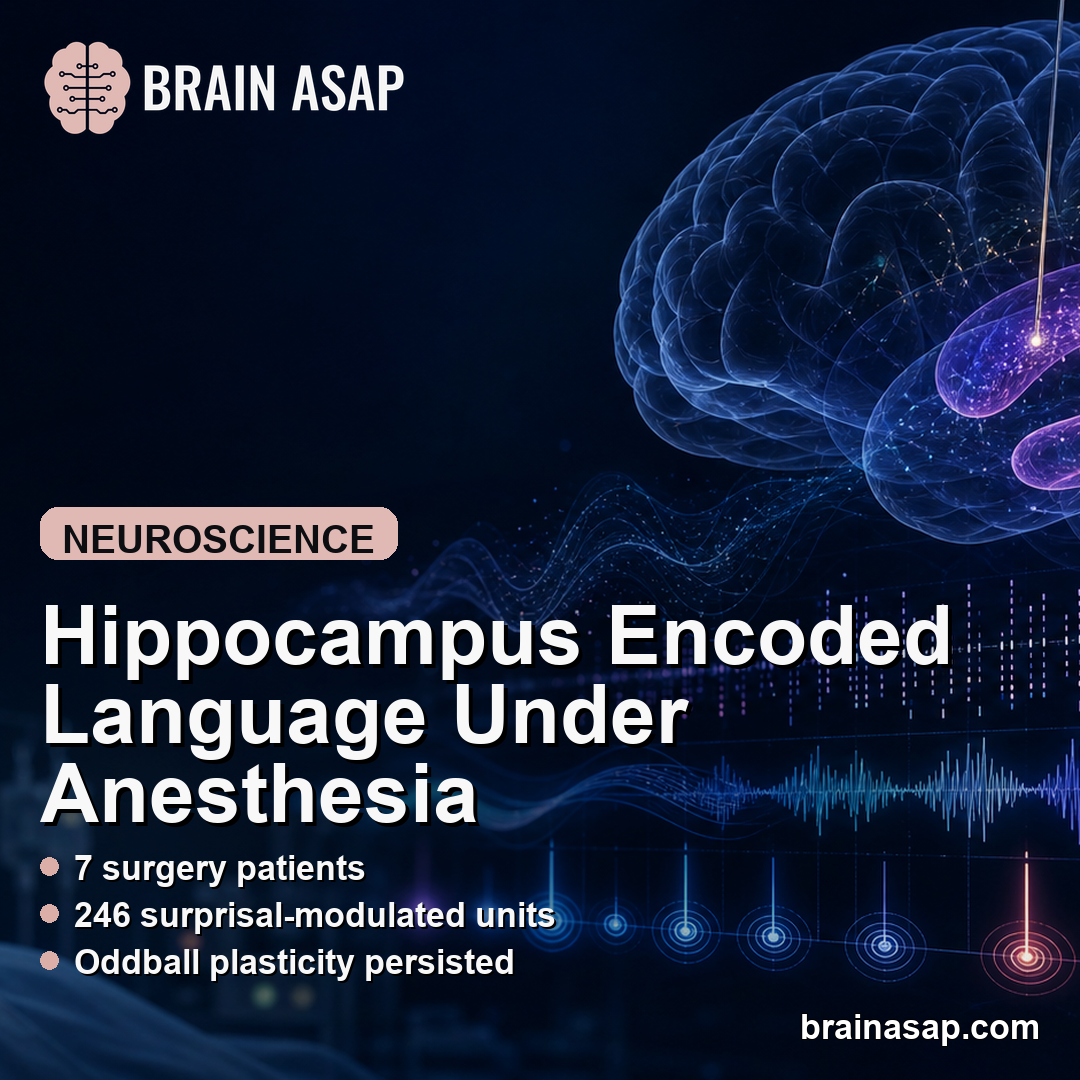
TL;DR: A 2026 study in Nature recorded human hippocampal neurons during propofol anesthesia and found preserved oddball-tone discrimination, short-term plasticity, and language-related semantic coding during surgical loss of consciousness.
Key Findings
- 7 surgical patients: Researchers recorded hippocampal activity with Neuropixels probes during general anesthesia in patients undergoing epilepsy surgery.
- 172 tone-responsive units: The tone task identified hippocampal neurons that responded to auditory stimuli even while patients were unconscious.
- 43 oddball-responsive units: Population decoding of oddball identity improved from early to late tone blocks.
- 4 language participants: Speech recordings showed word-frequency, semantic-category, grammatical, and surprisal effects in anesthetized hippocampal activity.
- Propofol-specific caveat: The results may not generalize to sleep, coma, or other anesthetics, and the study could not test hemispheric language dominance.
Source: Nature (2026) | Katlowitz et al.
Neuropixels hippocampal recording gave researchers a rare look at single-neuron and local-field-potential activity in the human hippocampus while patients were under stable surgical anesthesia.
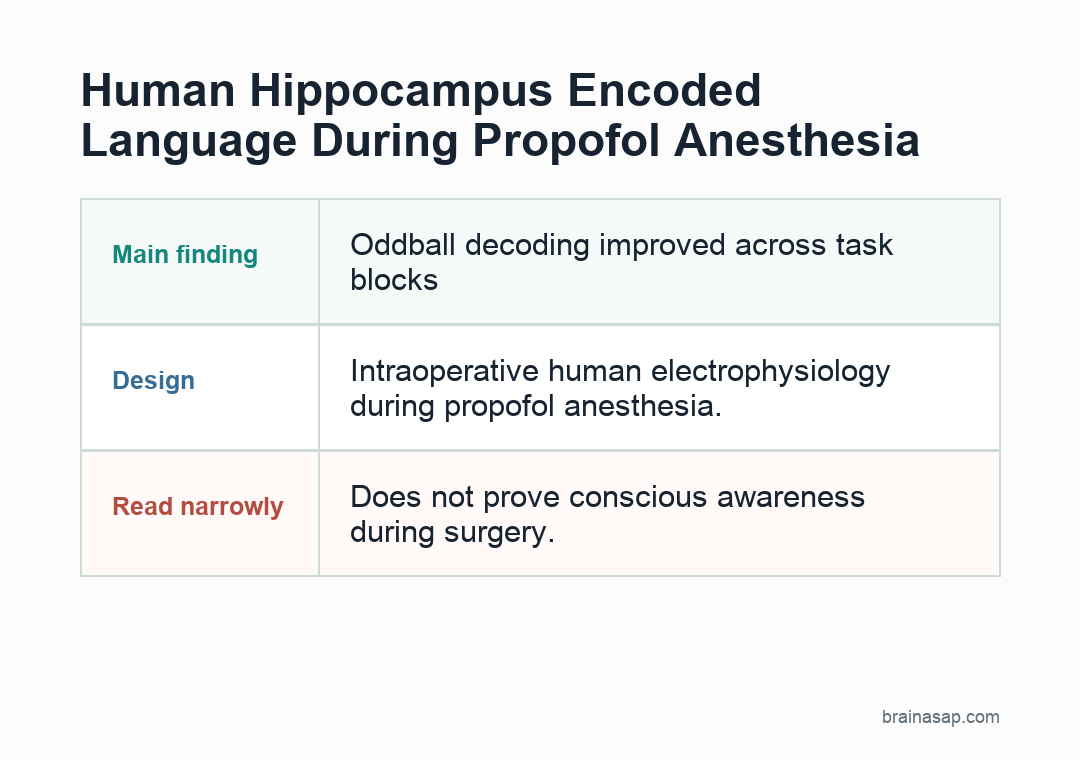
The study does not show conscious awareness during surgery. It shows that several forms of structured neural processing can remain measurable in the hippocampus during propofol-supported loss of consciousness.
Human Hippocampal Neurons Still Detected Oddball Tones Under Anesthesia
Researchers played repeated tones while recording directly from the hippocampus. In the oddball task, 1 tone was common and another was rare, then the probabilities were switched after a block of trials.
That design separates simple sound detection from a contextual question: whether the hippocampus can track that the same tone has become unexpected in the current sequence.
- Recording method: High-density Neuropixels probes measured single-unit spiking and local field potentials.
- Anesthetic state: All patients were under total intravenous anesthesia, with propofol as the main anesthetic during the protocol.
- Tone analysis: The paper reported 172 tone-responsive units across 3 patients and 150 units for later oddball analyses in 2 patients.
Some hippocampal units distinguished tone identity, while others responded differently when a tone was rare rather than standard. The hippocampus is not a primary auditory cortex, so the result points to contextual processing downstream from the early sensory pathway.
The measured result was specific: auditory context coding reached hippocampal circuits during anesthesia and was not limited to low-level sound responses.
Oddball Decoding Improved Over About 10 Minutes
The strongest tone result was not only that oddball coding was present. The population representation changed over the short experiment.
Across patients p5 and p6, population decoding for oddball identity improved from early to late task blocks among 43 oddball-responsive units. The figure caption reports a paired-test result of P = 0.004 for that early-versus-late change.
- Initial discrimination: Hippocampal responses encoded tone identity and oddball context.
- Short-term change: The oddball representation strengthened across the block rather than appearing as a fixed response.
- Model support: A recurrent neural network trained on flexible tone discrimination reproduced the emergence of oddball-like representations.
Researchers interpreted this as representational plasticity. A simpler reading is that the anesthetized hippocampus was still updating some population-level coding as the sequence continued.
Natural Speech Encoded Semantic and Grammar Features in 4 Patients
The language analysis used podcast audio in 4 participants. Researchers aligned neural activity to word timing and tested whether hippocampal activity tracked properties of natural speech.
Several language features were recoverable from hippocampal activity:
- Word frequency: Single-unit firing correlated with how common words were in a standard database.
- Semantic categories: Neural activity encoded word meaning clusters.
- Part of speech: Activity also encoded grammatical class, such as noun or verb category.
- Surprisal: Many units were modulated by how expected a word was given prior context, a language-model-style measure.
For word frequency, the paper reported a mean single-unit correlation of r = 0.48 across anesthetized patients and a group-level result of P < 0.0001. For surprisal, 246 of 375 units were significant in the anesthetized group.
These are not memory findings in the ordinary conscious sense. The study did not test whether patients remembered the speech later, understood it consciously, or formed reportable experiences.
Semantic Prediction Did Not Prove Awareness During Surgery
The analysis also tested whether hippocampal activity around 1 word encoded nearby future words. Semantic features of upcoming words could be decoded from current neural activity.
That result needs careful wording. The study notes that this does not necessarily prove active prediction beyond contextualization.
- What the result supports: The anesthetized hippocampus retained structured coding of speech context.
- What it does not show: The recordings do not demonstrate conscious comprehension or postoperative recall.
- Consciousness question: The data push against a strict view that high-order semantic coding disappears completely during anesthesia.
Loss of consciousness did not shut off every measured hippocampal computation related to pattern recognition, language context, and recent input.
Small Propofol Surgery Sample Limits the Consciousness Claim
The study’s limits are central to the conclusion. The sample was small, the participants were epilepsy-surgery patients, and the recordings were obtained during a specific anesthetic protocol rather than across many unconscious states.
Researchers also could not test whether effects differed by language-dominant hemisphere, and some processes may not have been unique to the hippocampus. Other brain regions had to format sensory input before hippocampal circuits received it.
- State specificity: Propofol anesthesia is not the same as natural sleep, coma, sedation with other drugs, or ordinary waking unconscious processing.
- Regional specificity: Hippocampal activity may reflect inputs shaped by auditory and language networks elsewhere.
- Behavioral limit: The recordings do not establish awareness, intention, or memory formation during anesthesia.
Within those boundaries, the study gives rare human single-neuron evidence that the anesthetized hippocampus can still encode meaningful structure in sound and speech.
Citation: DOI: 10.1038/s41586-026-10448-0. Katlowitz et al. Plasticity and language in the anaesthetized human hippocampus. Nature. 2026;654:714-723.
Study Design: Intraoperative human electrophysiology study during general anesthesia, with tone, speech, and computational-model analyses.
Sample Size: 7 surgical patients overall, with tone and language analyses performed in smaller task-specific subsets.
Key Statistic: Oddball population decoding improved across blocks in 43 responsive units, and 246 of 375 units showed significant surprisal modulation during speech.
Caveat: The results do not prove conscious awareness and may not generalize beyond propofol anesthesia or epilepsy-surgery recording conditions.