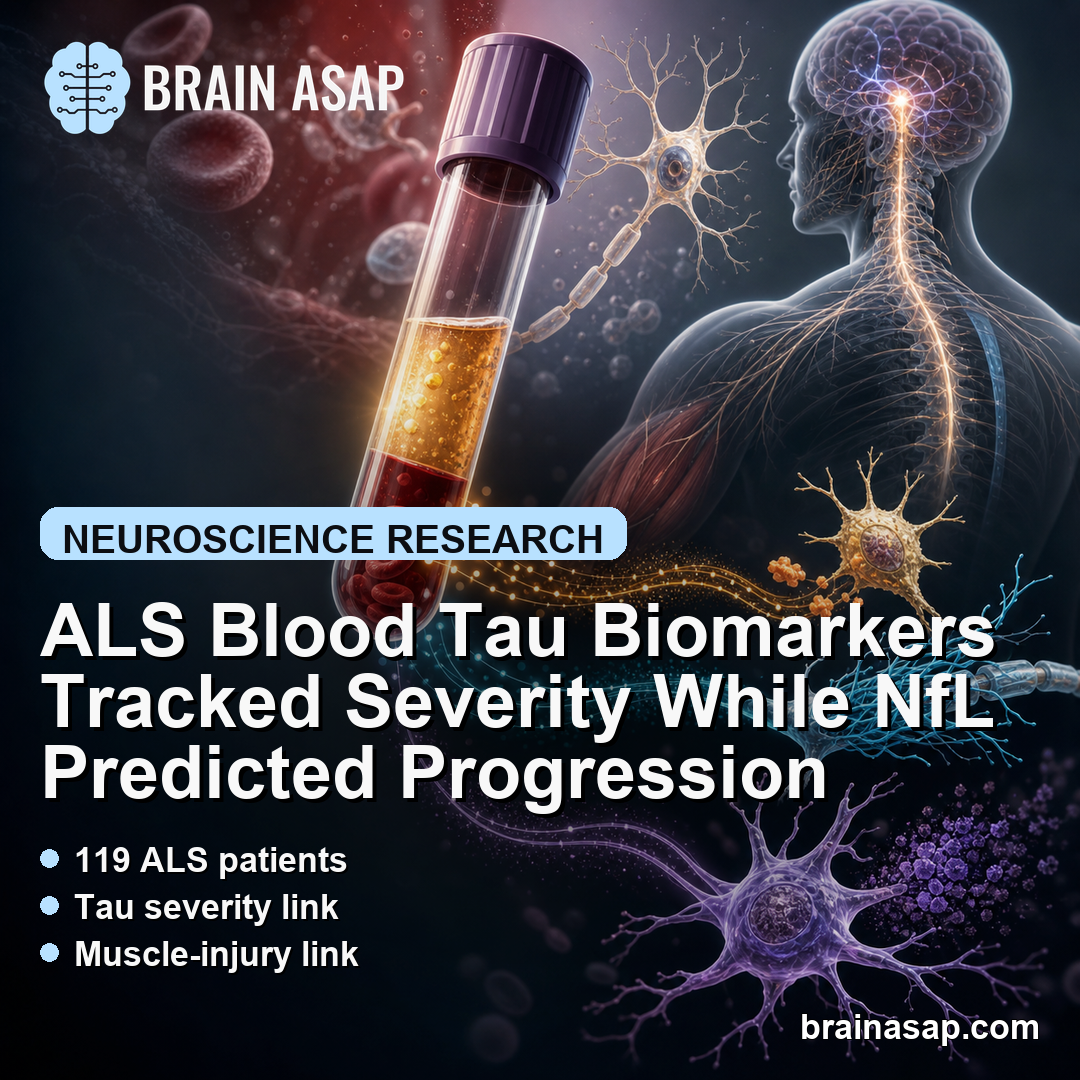
TL;DR: A 2026 preprint on medRxiv found that blood tau markers and neurofilament light tracked different parts of amyotrophic lateral sclerosis (ALS), with tau markers linked more to current lower-motor-neuron and muscle-injury features while neurofilament light was the clearest marker of faster decline and shorter survival.
Key Findings
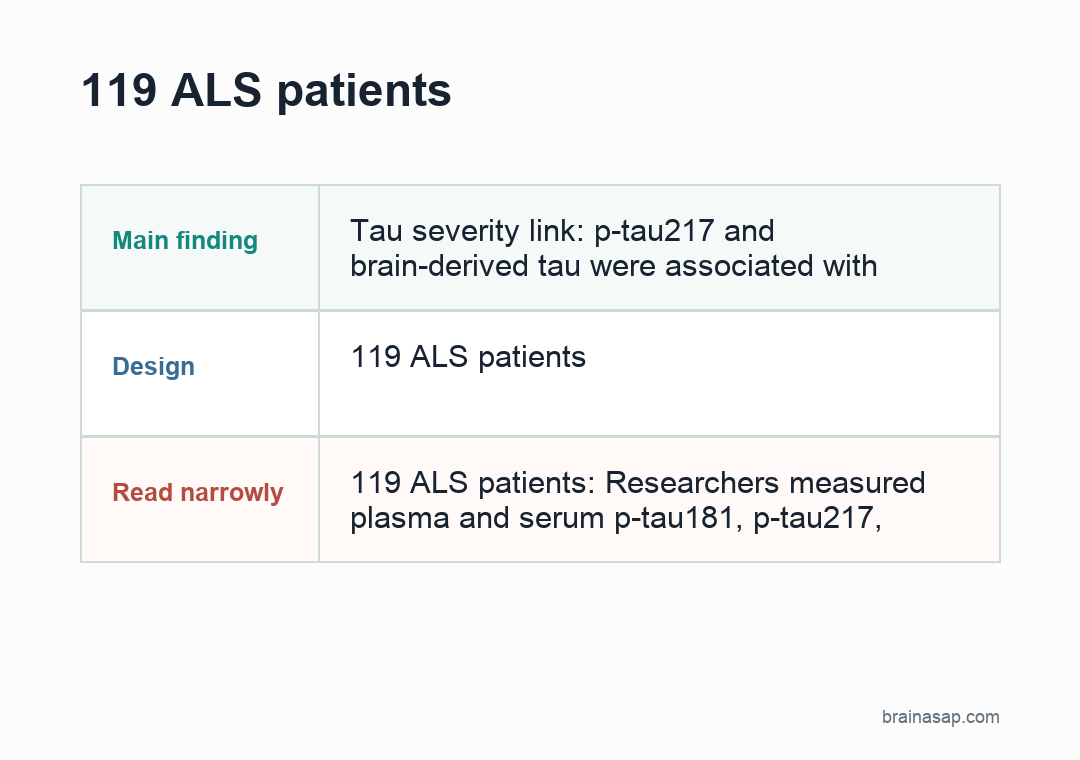
- 119 ALS patients: Researchers measured plasma and serum p-tau181, p-tau217, p-tau231, brain-derived tau, neurofilament light, and glial fibrillary acidic protein (GFAP) in a longitudinal observational ALS cohort.
- Tau severity link: p-tau217 and brain-derived tau were associated with lower ALS Functional Rating Scale-Revised scores, a marker of greater cross-sectional disease severity.
- Muscle-injury link: Tau-related biomarkers were associated with higher creatine kinase and high-sensitivity cardiac troponin T, while p-tau181 and p-tau231 also tracked greater lower motor neuron involvement.
- NfL prognosis link: Plasma and serum neurofilament light were associated with faster ALSFRS-R decline and shorter survival across analytical platforms.
- GFAP separation: GFAP did not show the same lower-motor-neuron or muscle-injury associations seen for tau markers, supporting a multi-marker interpretation rather than one generic blood test.
Source: medRxiv (2026) | Castro et al.
Amyotrophic lateral sclerosis is difficult to summarize with one blood marker because the disease affects motor neurons, muscle function, respiratory capacity, and survival at the same time. This preprint asked whether several blood proteins might separate those dimensions instead of competing as one all-purpose ALS test.
The practical distinction is between a marker of current clinical state and a marker of likely future course. In this cohort, tau-related proteins were closer to the current clinical and muscle-injury picture, while NfL had the strongest prognostic role.
Blood Tau Biomarkers Tracked Current ALS Severity
Researchers studied 119 patients with ALS from a longitudinal observational cohort and measured several blood-based proteins using Lumipulse and Simoa assays. The panel included phosphorylated tau forms, brain-derived tau, neurofilament light, and glial fibrillary acidic protein.
The clinical anchors were ordinary ALS measures: ALS Functional Rating Scale-Revised (ALSFRS-R), slow vital capacity, lower motor neuron involvement, blood markers of muscle injury, progression rate, and survival. That setup let the team ask whether each biomarker pointed toward the same disease process or toward different clinical compartments.
- p-tau217: This tau-related marker was associated with lower ALSFRS-R scores, meaning worse current functional severity.
- Brain-derived tau: BD-tau also tracked lower ALSFRS-R scores, supporting a cross-sectional severity link.
- NfL: Neurofilament light separated from the tau pattern by showing the strongest relationship with future decline and survival.
The paper did not frame tau as a standalone diagnostic shortcut. A narrower reading is that tau biomarkers may add phenotypic detail when clinicians or researchers are trying to characterize an ALS patient at a given point in the disease course.
Tau Markers Were Linked to Lower Motor Neuron and Muscle Injury Signals
The strongest tau-specific pattern involved lower motor neuron and muscle-injury measures. Plasma and serum p-tau181, p-tau217, p-tau231, and BD-tau were associated with higher creatine kinase and high-sensitivity cardiac troponin T, two blood measures that can reflect muscle involvement or injury.
p-tau181 and p-tau231 also showed associations with greater lower motor neuron involvement. ALS is not only a disease of measured disability scores; lower motor neuron damage, muscle denervation, and systemic muscle injury can shape how the condition appears clinically.
- Functional severity: p-tau217 and BD-tau were tied to lower ALSFRS-R scores.
- Muscle markers: multiple tau measures tracked CK and hs-cTnT.
- Lower motor neuron involvement: p-tau181 and p-tau231 were associated with greater LMN involvement.
Those findings make the tau pattern more specific than a vague “brain injury” label. In this dataset, tau-related proteins overlapped with the motor-unit and muscle-injury side of ALS biology.
Neurofilament Light Was the Clearest Progression and Survival Marker
Neurofilament light behaved differently from the tau markers. Across plasma and serum assays, NfL was associated with faster ALSFRS-R decline and shorter survival.
This was the central clinical split in the source. Tau-related biomarkers were more closely tied to current severity and muscle-related dimensions, while NfL was the only marker independently associated with both disease progression and survival.
- Progression: Higher NfL was associated with faster decline in ALSFRS-R over time.
- Survival: Higher NfL was associated with shorter survival.
- Platform consistency: The NfL relationship was present across analytical platforms, which strengthens the marker-level interpretation.
Blood biomarkers are often described as a single future diagnostic category, but this study points to a narrower interpretation. Different blood proteins may answer different ALS questions: current motor phenotype for some markers, future trajectory for others.
GFAP Did Not Follow the Tau or NfL Pattern
Glial fibrillary acidic protein (GFAP), a marker often discussed in relation to astrocyte injury or glial activation, did not show the same associations with muscle involvement or lower motor neuron involvement. NfL and GFAP also did not map onto the tau-related muscle-injury pattern.
That separation reduces the chance that the whole panel is merely measuring nonspecific disease burden. A stronger multi-marker panel would need each marker to add a distinct kind of information.
- Tau-related markers: current severity, lower motor neuron involvement, and muscle-injury associations.
- NfL: progression rate and survival associations.
- GFAP: no matching lower-motor-neuron or muscle-injury association in this report.
This is not a clinical algorithm yet. It is a biomarker-mapping study showing that the same blood draw can contain markers with different clinical meanings.
ALS Biomarker Interpretation Still Needs Prospective Validation
The main limitation is that this is a medRxiv preprint, so the findings should be read as preliminary until peer review and independent replication are complete.
The cohort was also observational, which means biomarker associations cannot prove that a marker causes faster decline or directly reflects one tissue process.
Practical interpretation should stay narrow. The data support complementary biomarker roles in ALS phenotyping and prognosis research, not routine clinical use of tau markers to classify an individual patient’s future.
- Clinical setting: the cohort came from one longitudinal ALS research context.
- Design limit: observational associations cannot establish causality.
- Translation step: multi-marker panels need validation in additional cohorts before becoming decision tools.
The strongest near-term application is research design. If future ALS trials collect tau markers, NfL, GFAP, clinical severity scores, motor-neuron involvement measures, and survival data together, they may be able to separate phenotypic state from prognosis more cleanly.
Citation: DOI: 10.64898/2026.07.03.26356752. Castro et al. Distinct Clinical Associations of Blood Tau Biomarkers and Neurofilament Light in Amyotrophic Lateral Sclerosis. medRxiv. 2026.
Study Design: Longitudinal observational ALS cohort with cross-sectional and prognostic biomarker analyses.
Sample Size: 119 patients with ALS.
Key Statistic: NfL was the only biomarker independently associated with both ALSFRS-R decline and survival.
Caveat: This is a preprint from an observational cohort, so the marker roles need peer review and external validation.