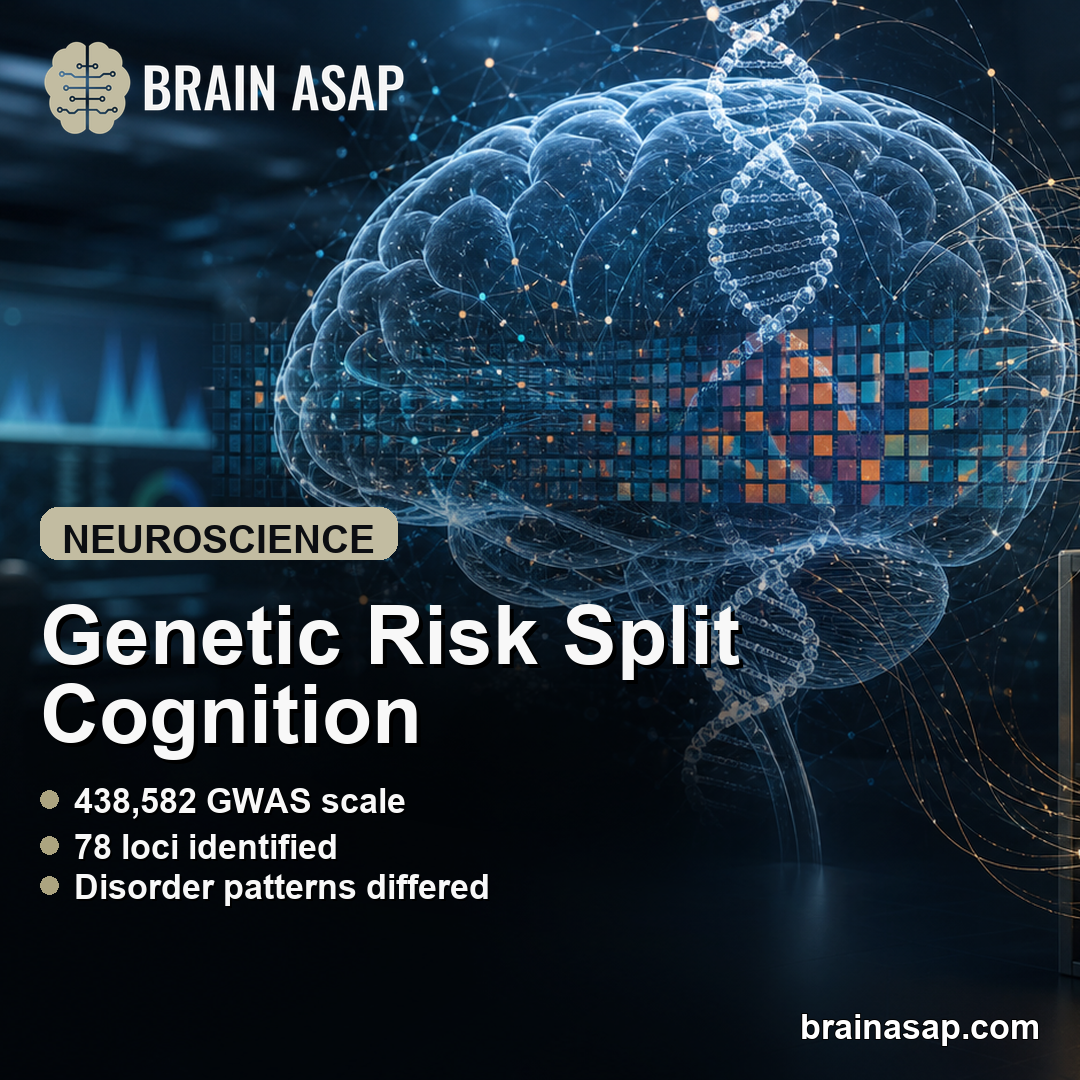
TL;DR: A 2026 study in Nature Communications found that neuropsychiatric disorder risk did not map onto cognition as one general trait. Schizophrenia, bipolar disorder, ADHD, autism, and Alzheimer’s disease showed different genetic links with reaction time, fluid reasoning, crystallized knowledge, and noncognitive educational skills.
Key Findings
- 439,000-person GWAS scale: The crystallized-knowledge genome-wide association study had power roughly equivalent to a univariate GWAS of 438,582 people.
- 78 crystallized-knowledge loci: Researchers identified 78 independent genome-wide significant loci for crystallized knowledge, including 5 novel to any cognitive trait.
- Psychosis risk split by domain: Schizophrenia and bipolar disorder risk showed negative genetic correlations with reaction-time and fluid-reasoning factors, but positive correlations with crystallized knowledge and noncognitive educational skills.
- ADHD moved differently: ADHD risk showed a slight positive association with the reaction-time factor but negative associations with fluid reasoning, crystallized knowledge, and noncognitive educational skills.
- Genetic correlation, not diagnosis: The study does not show that a person’s DNA score can diagnose a disorder or determine intelligence.
Source: Nature Communications (2026) | Londono-Correa et al.
Crystallized knowledge means accumulated knowledge, vocabulary, and learned facts. Fluid reasoning means solving new problems and recognizing patterns without relying mainly on memorized information.
A new genetics study argues that those two forms of cognition should not be collapsed into one broad “intelligence” bucket when researchers study psychiatric risk.
The paper used genomic structural equation modeling, a statistical method that can separate overlapping genetic patterns. The researchers modeled cognitive performance as several related factors: reaction time, fluid reasoning, crystallized knowledge, and a noncognitive educational-attainment factor tied to traits such as persistence, curiosity, and schooling-related behavior.
Genetic Risk Did Not Map to One General Cognitive Pattern
The main result was not that psychiatric disorders were simply linked to lower cognition. Instead, the genetic associations changed direction depending on the disorder and the cognitive domain being measured.
Schizophrenia and bipolar disorder had the most similar pattern. In the study’s model, genetic risk for both conditions was negatively correlated with the reaction-time and unique fluid-reasoning factors, with genetic correlations ranging from -0.16 to -0.28.
Those same disorder risks were positively correlated with unique crystallized knowledge and noncognitive educational skills, with genetic correlations from 0.11 to 0.15.
ADHD looked different. The ADHD genetic signal showed a slight positive association with the reaction-time factor, but negative associations with fluid reasoning, crystallized knowledge, and the noncognitive educational factor, with genetic correlations ranging from -0.12 to -0.46 for those negative links.
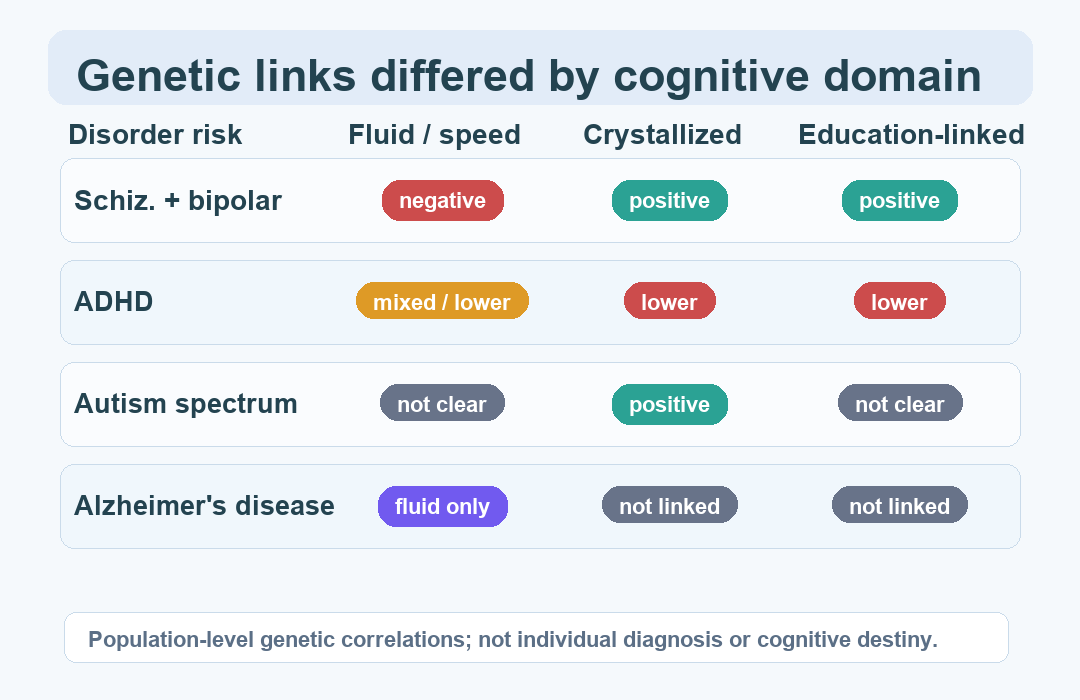
Autism spectrum disorder showed a positive association with unique crystallized knowledge. Alzheimer’s disease was narrower in this analysis: it was associated only with the unique fluid-reasoning factor, not with crystallized knowledge, reaction time, or the noncognitive educational factor.
Crystallized Knowledge Had 78 Significant Genetic Loci
The paper also reported a genome-wide association study for crystallized knowledge. The multivariate crystallized-knowledge GWAS had an effective sample size of about 438,582, giving it enough power to detect many common-variant associations.
They identified 4,777 genome-wide significant SNPs, which are individual DNA variants associated with the modeled trait. After clumping nearby variants into independent regions, those associations formed 78 independent loci.
- Five loci were novel: They had not previously been linked to any cognitive trait in the GWAS catalog.
- One locus overlapped schizophrenia risk: The rs12433109 A allele was associated with higher schizophrenia liability and higher crystallized knowledge in the multivariate GWAS.
- Most crystallized-knowledge loci overlapped education: Many loci were in linkage disequilibrium with educational-attainment loci.
The overlap is important because education and cognition are not the same thing. Educational attainment can reflect cognitive ability, but it also reflects motivation, opportunity, personality, health, family context, and social conditions.
The model tried to separate pure cognitive factors from noncognitive educational factors rather than treating all school-related genetic overlap as intelligence.
Brain Enrichment Looked Similar, but Timing May Differ
The researchers tested whether genes tied to fluid reasoning and crystallized knowledge were enriched in particular tissues and developmental windows. Both factors were most strongly enriched in brain tissues, including cortical regions and other brain structures.
The two cognitive factors were broadly similar in tissue enrichment, but there were differences. The hippocampus, a brain region involved in memory and flexible learning, showed stronger enrichment for fluid reasoning than crystallized knowledge.
Developmental timing also hinted at different trajectories. Fluid-reasoning genetic associations were enriched mainly in early development, including 21 post-conception weeks and age 1 year.
Crystallized-knowledge associations were enriched at later stages, including ages 19, 21, and 36 years. That fits the idea that accumulated knowledge keeps building across adolescence and adulthood.
The Findings Do Not Turn Genetics Into a Cognitive Scorecard
The study is about population-level genetic correlations. It does not say that schizophrenia risk makes a person more knowledgeable, that ADHD risk determines reasoning ability, or that autism risk directly causes higher crystallized knowledge.
The results describe how common genetic variation overlaps across traits in large samples.
Several caveats are important. The analysis relied heavily on existing GWAS summary statistics, and much of the underlying genetic data came from people of European ancestry.
That limits how confidently the same estimates can be generalized to more diverse populations.
Genetic correlation also does not prove biological causation. Nearby genetic variants can travel together statistically, and social selection can shape who enters a study or receives a diagnosis.
Some autism-related correlations could reflect selection or collider bias rather than a direct biological pathway.
- Not an individual test: The findings describe population-level overlap, not whether one person will develop a disorder or score higher on a cognitive test.
- Ancestry limits matter: Results based heavily on European-ancestry GWAS data need replication in broader populations.
- Direction is not causation: A positive or negative genetic correlation does not prove that one trait biologically causes the other.
The practical takeaway is narrower and more useful: cognitive genetics should separate the cognitive domain before interpreting psychiatric overlap. A single general cognition score can hide the fact that fluid reasoning, accumulated knowledge, response-speed factors, and education-linked noncognitive traits may point in different directions.
Citation: DOI: 10.1038/s41467-026-72477-7. Londono-Correa et al. Crystallized and fluid cognitive abilities have different genetic associations with neuropsychiatric disorders. Nature Communications. 2026.
Study Design: Multivariate genome-wide association and genetic-correlation study using genomic structural equation modeling.
Sample Size: Effective sample size was about 438,582 for the crystallized-knowledge GWAS; external disorder GWASs included schizophrenia, bipolar disorder, autism, ADHD, and Alzheimer’s disease datasets.
Key Statistic: The crystallized-knowledge GWAS identified 78 independent genome-wide significant loci, including 5 novel to any cognitive trait.
Caveat: Genetic correlations are population-level associations and do not prove individual diagnosis, cognitive destiny, or causal biological effects.