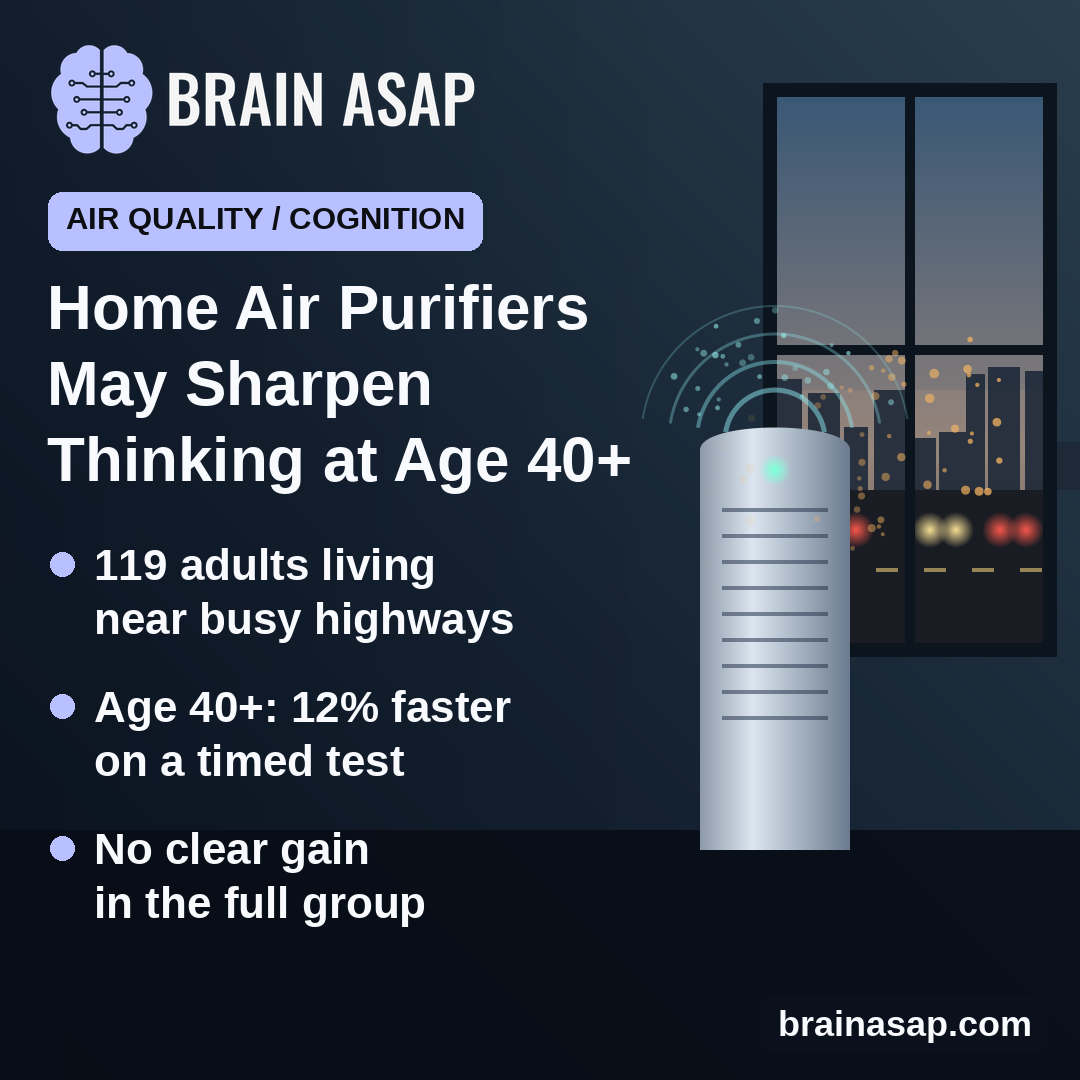
TL;DR: In a crossover trial of 119 adults living near busy highways, a month with a real HEPA air purifier did not clearly speed up a thinking test across the whole group. Among adults 40 and older, though, participants finished the harder test 12% faster after the real-purifier month than after the fake-purifier month. That age split was a post hoc look, so it is a lead to test, not a settled result.
Key Findings
- No clear overall gain: Across all 119 adults, the real-purifier month and the fake-purifier month did not differ significantly on either version of the test.
- Adults 40 and older: After the real-purifier month they finished the harder test in 54.0 seconds on average, versus 61.4 seconds after the fake-purifier month (12% faster).
- Adults under 40: No significant difference.
- Practice matters: People who had not yet used a real purifier still sped up by about 12 seconds just across three tests in a row.
- Everyone was healthy: No participant had known cognitive impairment, so the results say nothing about people with memory problems.
Source: Scientific Reports (2026) | Pellegrino et al.
Air purifiers have become a common household purchase, and one reason people give is their brain: cleaner air, clearer head. There is real research linking traffic pollution to worse brain health over the long run. What is much thinner is evidence that cleaning the air in your home changes how well you think.
This study tries a direct test. It compared a month of real air filtering to a month of fake filtering in the same people.
How the Trial Worked
The data come from a trial in Somerville, Massachusetts, called HAFTRAP. It enrolled adults 30 or older who lived within about 200 meters (roughly 650 feet) of a highway. Anyone who smoked or vaped, or who allowed smoking indoors, was excluded, because purifiers do little against those sources.
Each home got two purifiers, one in the living room and one in the bedroom. The design was a crossover, meaning everyone tried both conditions:
- One month with real HEPA purifiers, which filter out very fine particles.
- A one-month break with no purifier.
- One month with sham purifiers, which look and run the same but do not filter. The order was randomized, and participants did not know which was which.
Because each person is compared with themselves, differences like age, education, and health cancel out. In the 19 homes where the air was measured, the real purifiers cut indoor fine particles (PM2.5) by about half, 52%.
Thinking speed was a side measure. The trial’s main goal was blood pressure, and this paper is a secondary analysis of the cognitive results.
The Test: Connecting Dots Against the Clock
Participants took the Trail Making Test at home at the start and end of each month. It is a timed connect-the-dots task in two parts:
- Part A: connect numbers in order (1, 2, 3…). It mostly tests visual scanning and motor speed.
- Part B: alternate between numbers and letters (1, A, 2, B…). It leans on mental flexibility, the skill of switching between two rules.
Faster is better. The study used the time at the end of each month, adjusted for the time at the start.
Of 156 people who enrolled, 119 completed all four test sessions and were analyzed. Of the 37 who were left out, 23 had paper forms misplaced and 11 chose to skip a test. The 26 dropped for administrative reasons looked much like the people analyzed, but the 11 who skipped tended to be older and less educated.
What They Found
For the whole group, the real-purifier month and the fake-purifier month were not significantly different on Part A or Part B. Part A times were about 20 seconds either way.
Then the researchers asked whether age changed the answer. They split participants into adults under 40 (about 35 years old on average) and adults 40 and older (about 49 on average). The age difference in the effect on Part B was statistically significant.
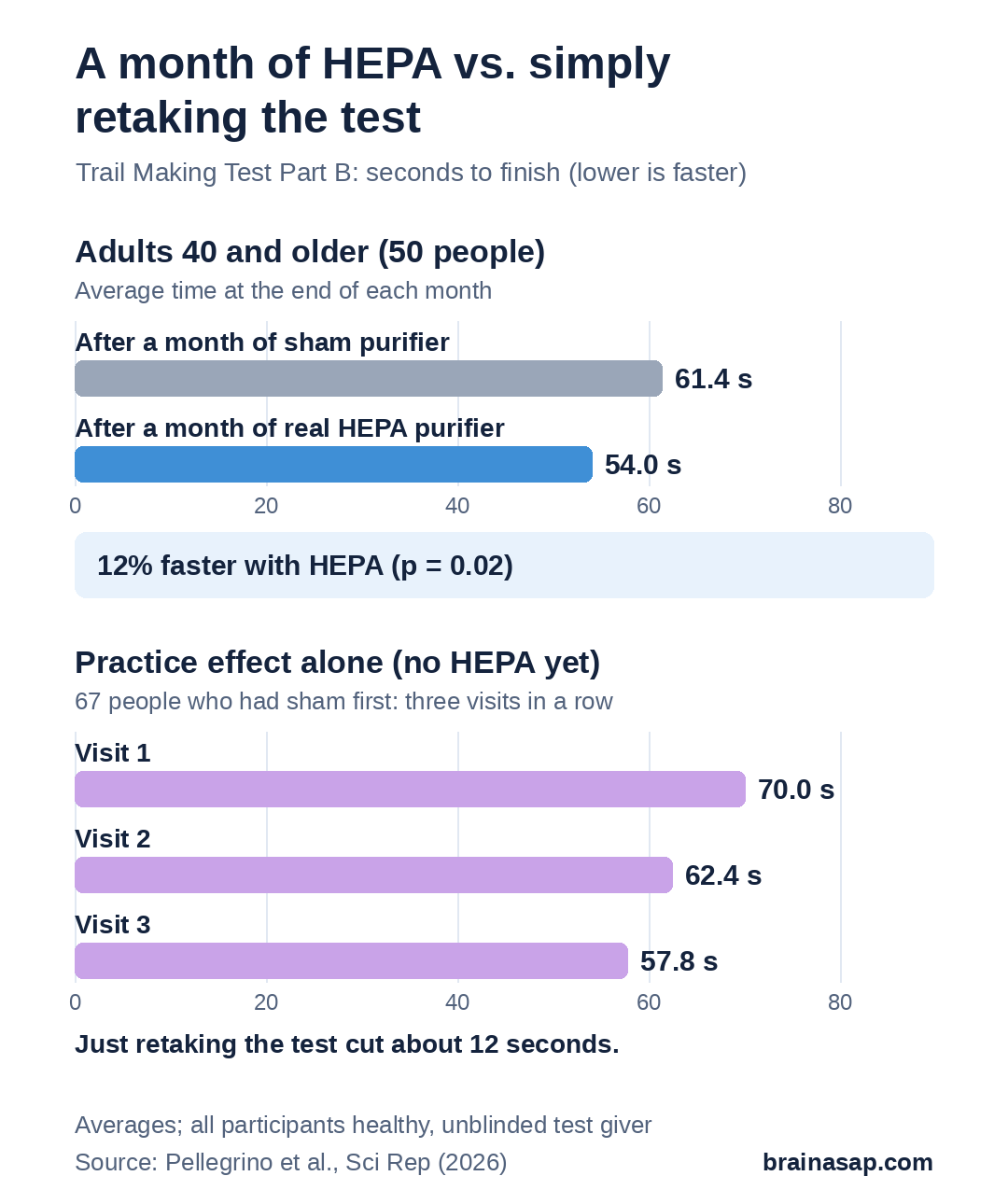
Among adults 40 and older, Part B took 54.0 seconds on average after a real-purifier month and 61.4 seconds after a fake-purifier month, a 12% difference. Adults under 40 showed no significant change, and neither age group changed on Part A.
The Practice Effect, in Perspective
The bottom half of that chart is worth a second look. Anyone who retakes a timed test tends to get faster. The researchers checked this in the 67 people who received the sham first. Their first three tests came before any real purifier, yet their Part B times fell from 70.0 to 62.4 to 57.8 seconds.
The crossover design is meant to handle this, since practice should help both conditions about equally. Still, it is a reminder that the gap of about 7 seconds in older adults is small next to what simple familiarity does to this test.
What This Study Can’t Tell Us
- The age split came after the fact: The authors describe testing age as a post hoc analysis. Splitting a result into subgroups after seeing it is a common way to find patterns that do not hold up next time.
- The main comparison was flat: The headline result for everyone was not significant, so the 12% applies to one subgroup only.
- Not fully blinded: Participants did not know which purifier they had, but the person giving the test did. The authors think this had little effect, though it cannot be ruled out.
- The sham may have helped a little: Moving air alone can remove some fine particles, which could have shrunk the difference between conditions.
- Short and narrow: Each condition lasted one month. Participants were mostly White, and generally better educated and better off than average.
- Healthy adults only: Nobody had known cognitive impairment, so this says nothing about dementia or mild cognitive impairment.
Why It Matters
If you live beside a busy road, this study does not show that a purifier will sharpen your thinking. What it offers is a well-designed, if small, first step: a real intervention, a fake one, and the same people in both. The signal in older adults matches earlier research suggesting that pollution’s effects on thinking show up more from around age 40, and that is the idea a bigger trial can now test.
The authors call for stronger studies, especially in people who already have some cognitive impairment, since they could benefit most.
Citation: DOI: 10.1038/s41598-026-48063-8. Pellegrino N, Eliasziw M, Fortinsky R, Gates H, Brugge D. Effect of HEPA filtration air purifiers on cognitive function from a secondary outcome analysis of a pragmatic randomized crossover trial. Scientific Reports. 2026;16:17737.
Study Design: Secondary outcome analysis of a pragmatic, blinded-participant randomized crossover trial (HAFTRAP; NCT04279249): one month of HEPA, a one-month washout, one month of sham filtration, or the reverse; Trail Making Test Parts A and B at the start and end of each period.
Sample Size: 119 adults living within 200 meters of highways in Somerville, MA (of 156 enrolled), analyzed in both conditions.
Key Statistic: Adults 40 and older finished Part B in 54.0 seconds after HEPA versus 61.4 seconds after sham filtration (ratio of means 0.88, p = 0.02; age interaction p = 0.02). The overall difference was not significant.
Caveat: Post hoc age subgroup within a secondary outcome; unblinded test administrator; healthy adults only.