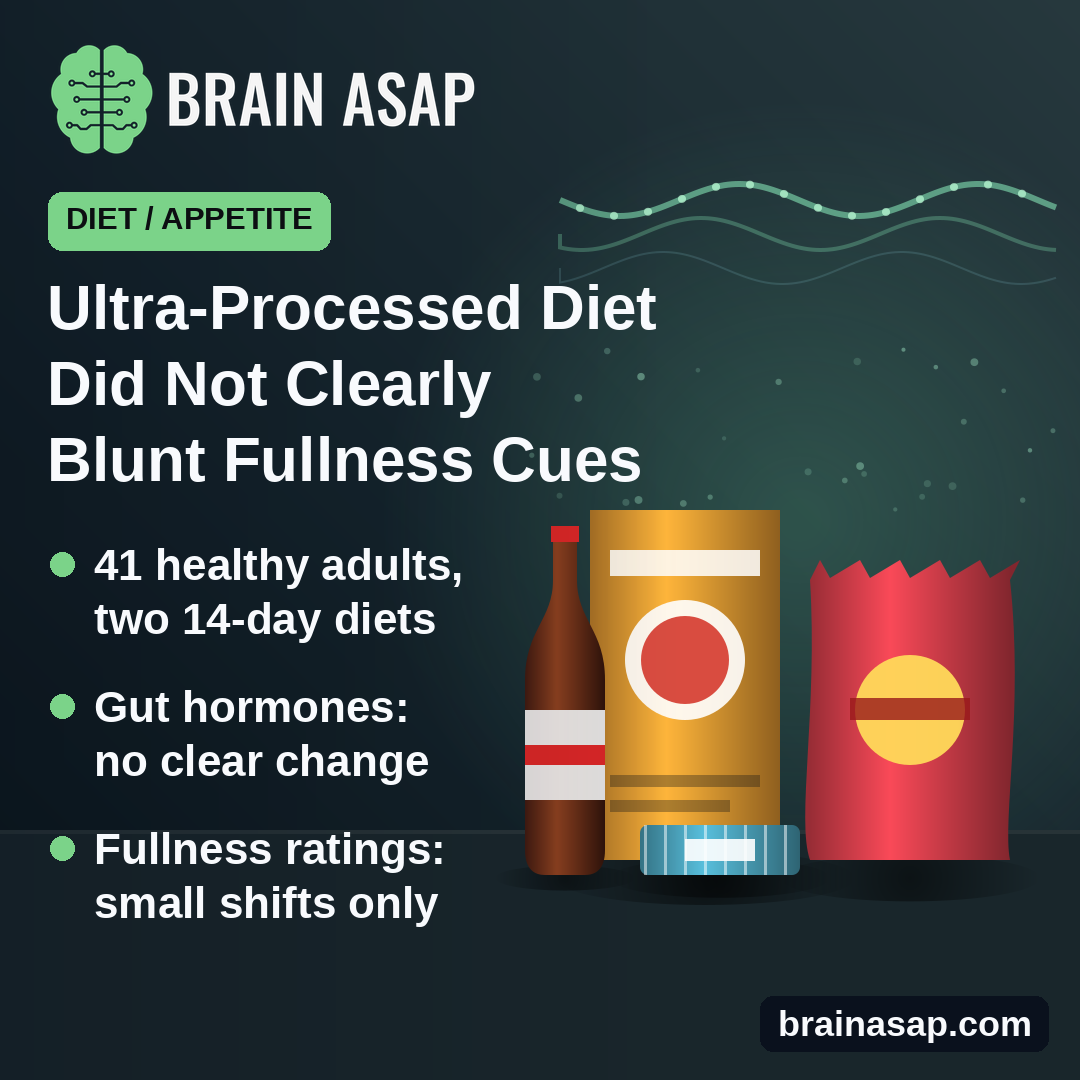
TL;DR: In a controlled Dutch feeding trial, 41 healthy young adults ate a diet made almost entirely of ultra-processed foods for two weeks, twice. Afterward, the gut hormones that help signal fullness responded to a test meal about the same as they had on the participants’ usual diets. Hunger and fullness ratings shifted only a little, and morning appetite did not creep up over the two weeks. This study does not support the idea that a short stretch of ultra-processed eating breaks the body’s fullness signals.
Key Findings
- Gut hormones: After a set 552-calorie meal, the responses of four hormones (GLP-1, ghrelin, PYY and pancreatic polypeptide) did not differ significantly from baseline after either ultra-processed diet (32 people).
- Small rating shifts: Over the 3 hours after the meal, total hunger was slightly higher and total fullness slightly lower than at baseline, but no single time point differed.
- Morning appetite stayed put: Hunger and fullness before breakfast did not trend up or down across the 14 days of either diet.
- Eating speed: The study found no clear difference in satiety measures between the fast-eating and slow-eating diets.
- One odd signal: Fasting PYY was 17% higher after the fast-eating diet than at baseline, which did not show up in the post-meal hormone responses.
Source: European Journal of Nutrition (2026) | van Bruinessen et al.
Ultra-processed foods (think packaged cereals, chips, soft drinks and ready meals) are linked in large observational studies to eating more and gaining weight. One popular explanation is that they scramble satiety, the sense of having had enough. The idea is that soft, quickly eaten, engineered foods might blunt the hormones that tell your brain to stop.
That is a testable claim, and this study tested it directly. The researchers asked whether living on ultra-processed food for two weeks changes how your body responds to a standard meal.
How the Trial Worked
Forty-one healthy adults in the Netherlands (average age about 27, with a typical body weight) finished the study. Their usual diets were relatively low in ultra-processed food, on average 45% of calories. The trial had three stages:
- Baseline week: participants ate as usual, and their appetite was tested once.
- Two 14-day ultra-processed diets: about 95% of calories came from ultra-processed foods, served in unlimited amounts at the research unit. A 14-day washout on their usual diet separated the two.
- The order was randomized. One diet was built from foods with textures that are eaten faster. The other used foods whose textures take longer to eat. Both were matched on portion size, calories per gram and liking.
I’ll call these the fast-eating diet and the slow-eating diet. On day 11 or 12 of each, participants came in for a test.
The Fullness Test
After fasting overnight, everyone ate the same set meal: 202 g of rice porridge with 200 mL of chocolate milk, 552 calories in all. Over the next 3 hours they rated their hunger, fullness and desire to eat on a 100 mm line, and blood samples tracked four hormones:
- GLP-1 and PYY: released by the gut after eating; they promote fullness.
- Ghrelin: the “hunger hormone,” which normally falls after a meal.
- Pancreatic polypeptide (PP): another gut signal tied to fullness.
Nine of the 41 could not be fitted with the cannula needed for repeated blood draws (fear of needles, a history of fainting or unsuitable veins), so the hormone results come from the other 32. Everyone also rated hunger and fullness each morning before breakfast throughout both diets, and the authors compared those daily ratings across the 14 days.
What They Found
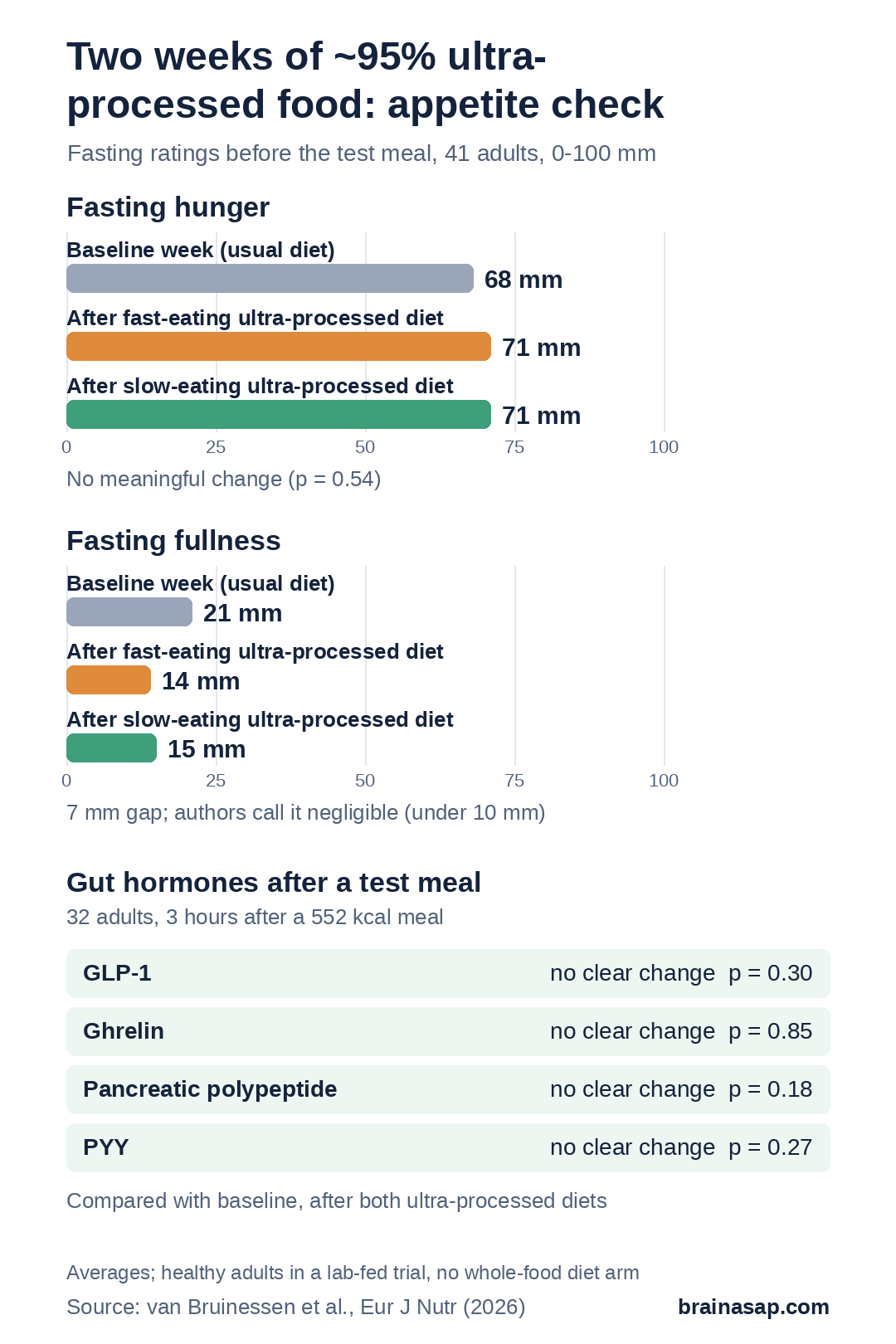
No clear change in post-meal hormones. The overall hormone responses to the test meal did not differ significantly between baseline and either ultra-processed diet: GLP-1 (p = 0.30), ghrelin (p = 0.85), PP (p = 0.18) and PYY (p = 0.27).
Ratings moved slightly. Summed over the 3 hours, hunger was higher and fullness lower after both ultra-processed diets than at baseline. The authors call these differences small, and they were not visible at any single time point. They suggest one possible reason: during the trial participants were offered around 6,000 calories a day, so a fixed 552-calorie meal may simply have felt small by comparison. That is speculation, not something the study tested.
Morning appetite was steady. On test mornings, before the meal, fasting hunger was 68 mm at baseline and 71 mm after each ultra-processed diet (p = 0.54). Fasting fullness was 21 mm at baseline, 14 mm after the fast-eating diet and 15 mm after the slow-eating diet. That is a statistically significant 7 mm gap, though the authors consider anything under 10 mm on this scale negligible. Across the 14 days, neither hunger nor fullness trended up or down.
Did How Fast the Food Is Eaten Matter?
The team also wondered whether the diet built from slow-to-eat foods would protect fullness signaling better than the fast-eating one. It did not: neither the ratings nor the hormones differed between the two diets.
That does not mean eating speed is irrelevant for intake. In the main trial, reported separately, people ate about 2,671 calories a day on the fast-eating diet versus 2,301 on the slow-eating one. This new analysis found no difference in satiety hormones or ratings between the two diets that would explain that gap.
The one exception among the hormones was fasting PYY, which was 17% higher after the fast-eating diet than at baseline (62 versus 73 pg/mL). It did not appear in the post-meal responses, and an earlier study of a different comparison found lower fasting PYY on an ultra-processed diet.
What This Study Can’t Tell Us
- No unprocessed comparison diet: Both diets were ultra-processed. The study compares them with participants’ usual eating, not with a whole-food diet, so it cannot say ultra-processed food is no more filling than minimally processed food.
- A loose baseline: The baseline was a week of free-living eating, not a controlled diet like the 14-day periods. The authors say a matched controlled baseline would have been better.
- A secondary analysis: The trial was designed around daily calorie intake, not satiety hormones. The authors call this an exploratory comparison.
- Young, healthy and short-term: Participants averaged about 27 years old with a typical BMI. Two weeks says little about years of eating this way, or about older people or people with obesity or diabetes.
- Lab setting: Participants ate at a research unit under observation. Feeling watched could nudge appetite ratings.
- One test meal: The set meal was one porridge-and-chocolate-milk combination. Other meals might behave differently.
- Funding: The trial was supported by a Dutch public-private research partnership, and the senior author reports past research support from several food companies. The authors say the analysis plan was pre-registered.
Why It Matters
If ultra-processed food is to blame for overeating, this study suggests the culprit is probably not a quick breakdown of the gut’s fullness hormones. People still ate more on the fast-eating version of the diet, so the food’s texture and eating speed may matter more than the label “ultra-processed.” The authors point to that direction for future work.
The result is a reassuring null, but a limited one. It shows that two weeks of these diets did not visibly disrupt the hormones measured. It does not show that ultra-processed eating is harmless.
Citation: DOI: 10.1007/s00394-026-04111-7. van Bruinessen M, Liu Z, Heuven LAJ, Stieger M, Lasschuijt MP, Forde CG. Satiety responsiveness following dietary exposure to ultra-processed foods differing in texture-derived eating rate: a secondary analysis of a randomized controlled crossover diet intervention. European Journal of Nutrition. 2026;65:261.
Study Design: Secondary analysis of a pre-registered randomized crossover diet trial (NCT06113146): a baseline week, then two 14-day diets with about 95% of energy from ultra-processed foods (fast-eating and slow-eating versions, randomized order) separated by a 14-day washout; mixed-meal tolerance test (552 kcal) at baseline and on day 11 or 12 of each diet, with appetite ratings and blood samples over 180 minutes.
Sample Size: 41 adults analyzed for appetite ratings; 32 with blood samples for GLP-1, ghrelin, PYY and pancreatic polypeptide.
Key Statistic: Post-meal total hormone responses did not differ across baseline and the two diets (GLP-1 p = 0.304, ghrelin p = 0.848, PP p = 0.176, PYY p = 0.266). Total hunger and fullness ratings differed slightly (p = 0.002 and p < 0.0001) but not at individual time points.
Caveat: Exploratory secondary analysis; no minimally processed comparison diet; free-living baseline; healthy young adults over two weeks.