TL;DR: A review of 17 randomized trials found that women who exercised had lower depression scores than women given usual care, both during pregnancy and after birth. The evidence is rated low to very low certainty, and the studies varied a lot. For anxiety during pregnancy, the review found no clear difference.
Key Findings
- Depression during pregnancy: The exercise group scored lower than the usual-care group (7 trials, 671 women; low-certainty evidence).
- Depression after birth: The exercise group scored lower here too (7 trials, 2,305 women), but results differed widely from trial to trial and the evidence was very low certainty.
- Women already struggling: In 3 small trials of women with elevated symptoms, an at-risk status, a diagnosis, or treatment, exercise also went with lower postpartum scores (192 women; very low certainty).
- Anxiety during pregnancy: No clear difference (3 trials, 191 women). That is “not enough evidence,” not proof that exercise does nothing.
- Best-looking routine: Programs of about 60 minutes, 3 times a week, looked strongest, but that comparison is exploratory.
Source: Archives of Women’s Mental Health (2026) | de Faria et al.
Pregnancy and the first year after birth are a high-risk stretch for low mood. The authors cite estimates that 10% to 40% of pregnant women report depressive symptoms, depending on the group studied and how it is measured. Medication raises extra concerns at this time, so a non-drug option like exercise is appealing.
Plenty of reviews have said exercise helps. This one tried to be stricter about what counted as evidence.
What the Researchers Did
They searched five research databases, with the last search in June 2026. From 10,938 records, 17 randomized trials made the cut. The rules were tight:
- Exercise only. Programs that mixed exercise with counseling, diet advice, or medication were left out. This made it easier to assess the exercise programs on their own.
- Usual care as the comparison. The comparison group got routine pregnancy or postnatal care, with no added intervention or exercise coaching.
- Self-report questionnaires. Symptoms were measured mostly with the Edinburgh Postnatal Depression Scale and similar checklists. These scores show how someone is feeling. They are not a diagnosis.
The review also split the trials by who joined. In 14 general-population trials, women were not picked because of depression or anxiety. In 3 already-struggling trials, women were recruited because they had elevated symptoms, a diagnosis, or an at-risk status, or were in treatment. The two types were analyzed separately.
The exercise varied: supervised aerobic classes, walking, water exercise, yoga, and home stretching routines, in countries from Spain and Colombia to Taiwan and Norway.
What They Found
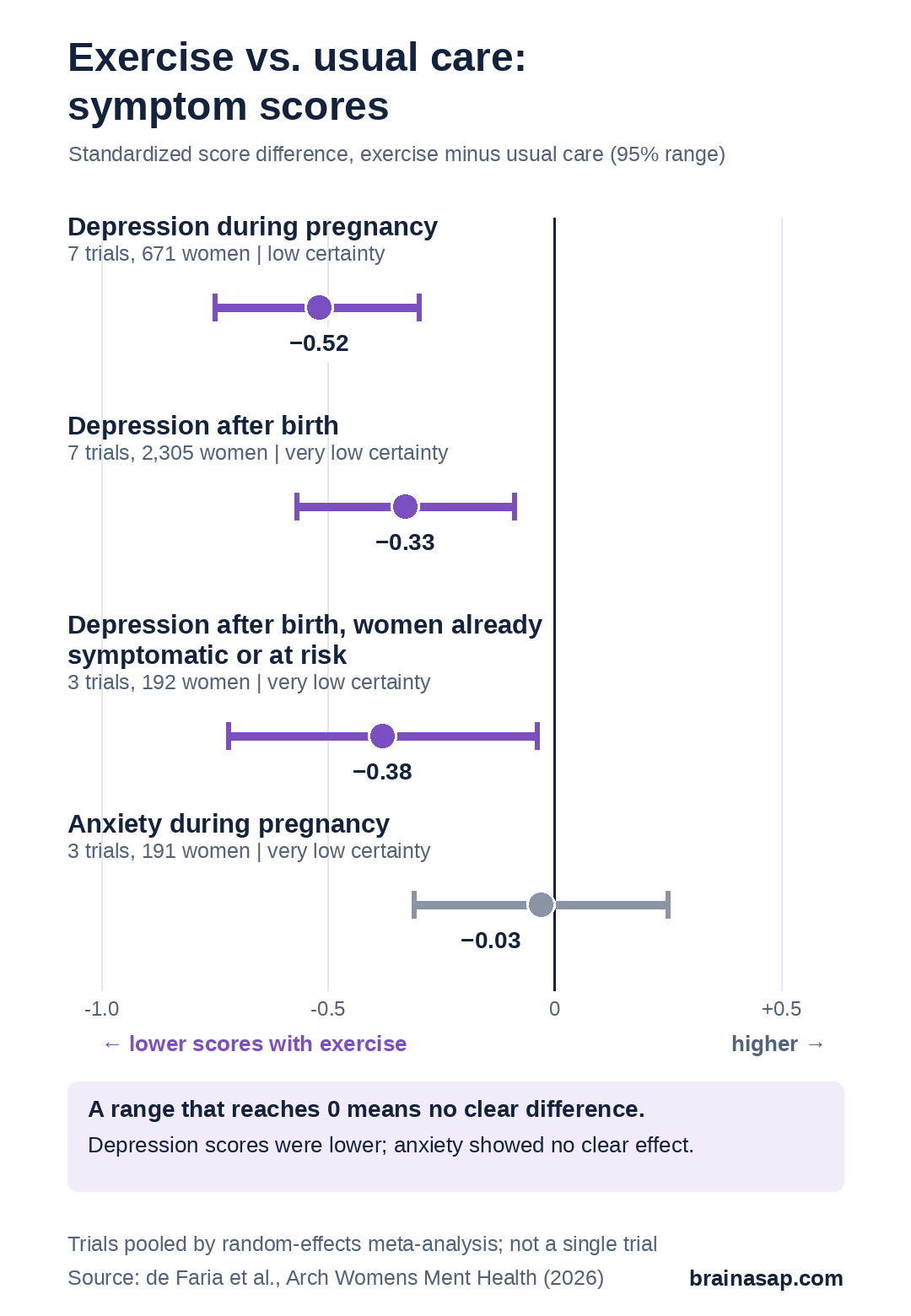
The results use a standardized difference, a way to combine questionnaires that score on different scales by measuring each gap in units of how much scores normally vary from woman to woman. Zero means no difference between the exercise group and the usual-care group. Negative numbers mean lower symptom scores with exercise. Roughly, 0.2 is small, 0.5 is medium, and 0.8 is large.
During pregnancy
Across 7 trials of 671 women, the exercise group had lower depression scores than the usual-care group (−0.52, 95% range −0.75 to −0.30), a medium-sized gap. The trials were reasonably consistent with each other, and this result earned the better of the two ratings, “low” certainty.
After birth
Across 7 trials of 2,305 women, the gap was smaller (−0.33, range −0.57 to −0.09), and the trials disagreed strongly with one another. The authors calculated a “prediction range,” the spread expected in a future trial. It ran from −0.95 to +0.28. That includes zero, so a new trial could well find no benefit. In some of these trials, women began exercising during pregnancy and were measured after delivery, so “after birth” does not always mean the exercise itself started then.
Women who already had symptoms
Three small trials (192 women) pointed the same way (−0.38, range −0.72 to −0.04). The range only just clears zero. The authors call this exploratory and say it should not be read as evidence that exercise treats postpartum depression.
Anxiety
Three trials of 191 pregnant women found nothing clear (−0.03, range −0.31 to +0.25). Three small trials are too few to say much either way.
What kind of exercise?
The team also asked whether certain programs looked better. These are secondary, exploratory comparisons. Each group had only 3 to 6 trials.
- Structured exercise (planned, repeated sessions with a set routine), compared with usual care: lower depression scores in pregnancy (−0.59, 5 trials) and after birth (−0.34, 6 trials).
- About 60 minutes, 3 times a week: −0.62 in pregnancy (5 trials, 545 women) and −0.57 after birth (3 trials, 1,106 women).
- Moderate intensity, after birth: All three trials used the same questionnaire, so results could be given in points. Women in the exercise group scored 1.61 points lower on its 0 to 30 scale (range 0.07 to 3.16 points lower; 3 trials, 979 women). That is a modest difference.
The authors warn against reading this as a best recipe. The confidence ranges were wide, and the trials differed in many ways beyond time and intensity.
What This Study Can’t Tell Us
- Low to very low certainty: Reviewers rated most of the evidence this way, meaning true effects could differ from these estimates.
- Trial quality concerns: On a 10-point quality scale, scores ranged from 3 to 8 (median 6). No trial reported concealing group assignment in advance, and participants could not be blinded, since everyone knows whether they are exercising.
- Very different studies: The trials used different exercise types, questionnaires, and starting symptom levels. Even among the general-population trials, some women already had elevated scores at the start.
- Scores are not diagnoses: The review cannot say how many women moved below a clinical cutoff.
- Averages hide individuals: A pooled average says nothing about whether exercise will help any one woman, and it does not replace treatment for depression.
- Small subgroups: The three-trial results for anxiety and symptomatic women are especially fragile.
Why It Matters
This review fits with current advice: guidelines recommend physical activity for most pregnant women without a medical reason to avoid it, and regular movement is tied here to somewhat lower depression scores. The finding lines up across pregnancy and after birth. The gap is small to medium, and the evidence behind it is not strong.
If you are pregnant or postpartum and feeling low, exercise may be one helpful part of your care, but it is not a substitute for talking to your doctor or midwife, especially if symptoms are heavy or persistent. The authors call for larger, better-designed trials that report exactly what the exercise involved.
Citation: DOI: 10.1007/s00737-026-01752-9. de Faria DA, Freire VAF, Marques DGM, da Fonseca PHN, Santos KF, Oliveira CB, et al. Isolated physical activity programs during pregnancy and postpartum: Meta-analysis of randomized trials with usual-care controls on depressive and anxiety symptoms. Archives of Women’s Mental Health. 2026;29:116.
Study Design: Systematic review and random-effects meta-analysis of randomized controlled trials of stand-alone physical activity versus usual care or no intervention (PROSPERO CRD42022301284; searches through June 2026). Trials were pooled separately by general-population versus symptomatic/treatment-oriented recruitment and by pregnancy versus postpartum outcomes.
Sample Size: 17 randomized trials (14 general-population, 3 symptomatic/treatment-oriented). Pooled analyses covered 671 women (pregnancy depression), 2,305 (postpartum depression), 191 (pregnancy anxiety), and 192 (postpartum depression, symptomatic trials).
Key Statistic: Depression during pregnancy: standardized mean difference −0.52 (95% CI −0.75 to −0.30; I² = 46%; low certainty). After birth: −0.33 (95% CI −0.57 to −0.09; I² = 86%; very low certainty). Pregnancy anxiety: −0.03 (95% CI −0.31 to 0.25).
Caveat: Low to very low certainty (GRADE); substantial heterogeneity; no concealed allocation and no participant blinding; postpartum prediction interval (−0.95 to 0.28) includes no effect; subgroup and dose analyses are exploratory.