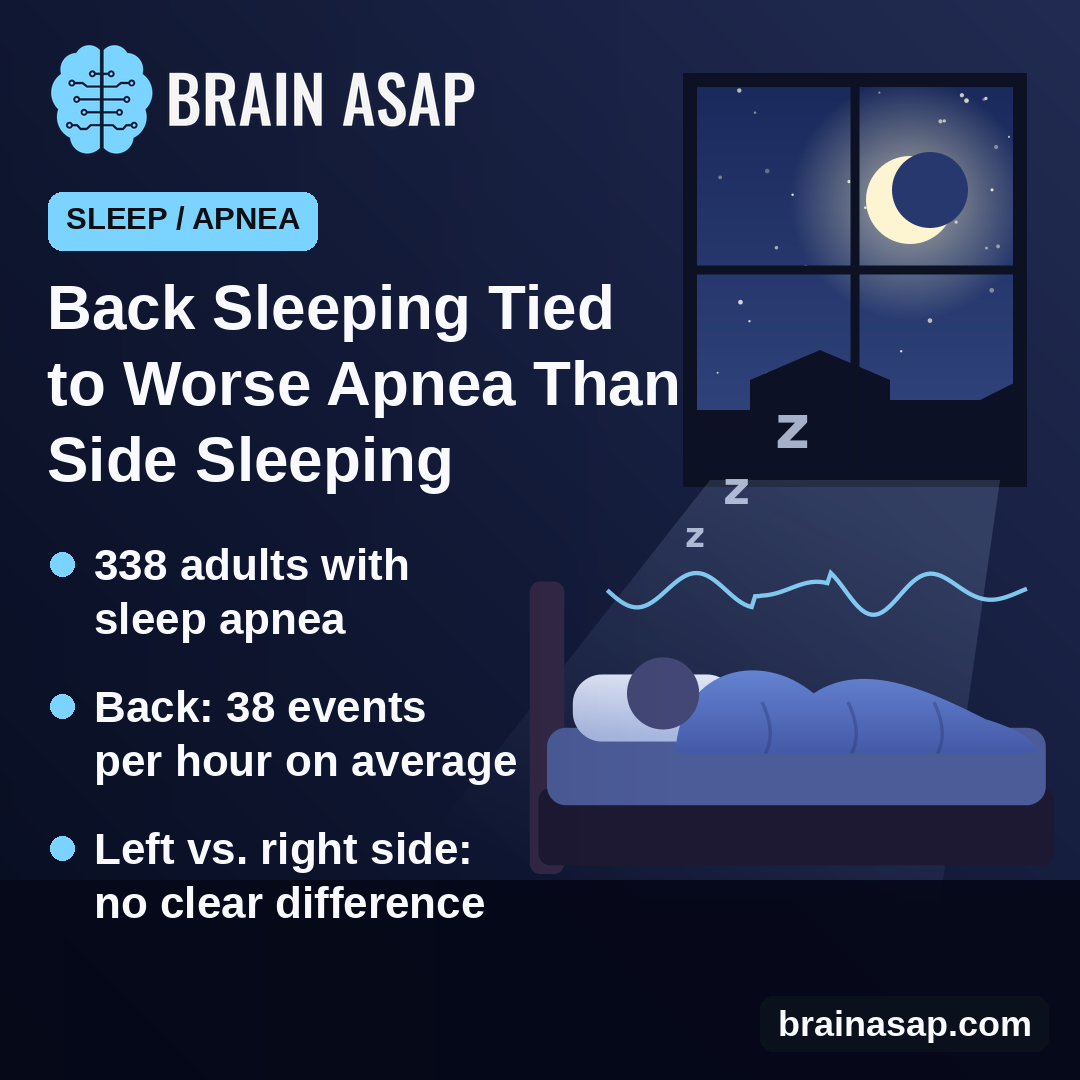
TL;DR: In 338 adults with sleep apnea, breathing events ran about 38 an hour on the back versus about 22 on either side. This past-records study shows a link, not that changing position helps.
Key Findings
- Back sleeping worst: Among people who spent over 20% of the night on their backs, average was 38.1 apnea events per hour, versus 22.2 on the right side and 22.1 on the left.
- Gap of about 17 to 18 events per hour: Adjusted for age, BMI, and sex, back ran 17.8 above the right side and 17.4 above the left.
- Left versus right: Adjusted difference 0.5 events per hour, with a range (−2.6 to +3.6) that comfortably includes zero.
- Bigger absolute gaps in severe apnea: Severe group averaged 67.8 events per hour on the back versus about 47 to 49 on the sides.
- Stomach sleeping looked lowest: Only 14 people slept that way enough to count; authors call it exploratory.
Source: Nature and Science of Sleep (2026) | Jereisat et al.
If you have sleep apnea, or share a bed with someone who does, you have probably heard the advice to stay off your back. The follow-up question is the one people argue about: does it matter which side you sleep on?
Internal medicine researchers in Houston went back through one community sleep clinic’s records. The back was clearly the worst position, and left and right were a tie.
What “events per hour” means
Obstructive sleep apnea (OSA) happens when the airway repeatedly narrows or closes during sleep. Doctors measure how bad it is with the apnea-hypopnea index (AHI): the number of breathing pauses (apneas) and shallow-breathing spells (hypopneas) per hour of sleep. Roughly, 5 to 14 events per hour is mild, 15 to 29 is moderate, and 30 or more is severe.
The usual explanation for why the back is a problem is gravity. Lying flat, the tongue and soft palate can slump backward and narrow the airway. Lying on your side keeps that from happening as easily.
Home sleep tests from 338 people, sorted by position
This was a retrospective study, meaning the researchers analyzed medical records from tests that had already happened. Nobody was assigned a position.
- Who: 338 adults diagnosed with OSA at a single outpatient community clinic, tested between January 2023 and January 2025. Average age 55, 63% men, average body mass index (BMI) 33, in the obese range. Overall average AHI 29.5, which is moderate.
- How position was tracked: Each person had a home sleep study, including a motion sensor (accelerometer) that recorded back, left side, right side, or stomach.
- What counted: For main comparisons, a position counted only if the person spent more than 20% of the night in it. Shorter stretches were treated as too little data.
The researchers began with 641 patients and excluded 303 under the study’s criteria, which ruled out central sleep apnea, tests shorter than 6 hours, and tests done on a different device.
The statistics account for the fact that the same person can appear in more than one position, since many people spend part of the night on their back and part on a side. The models also adjusted for age, BMI, and sex.
Back sleepers had about 17 more events per hour
Among people who spent enough time in each position, the average AHI was:
- Back: 38.1 events per hour (285 people).
- Right side: 22.2 (170 people).
- Left side: 22.1 (158 people).
- Stomach: 16.6 (only 14 people).
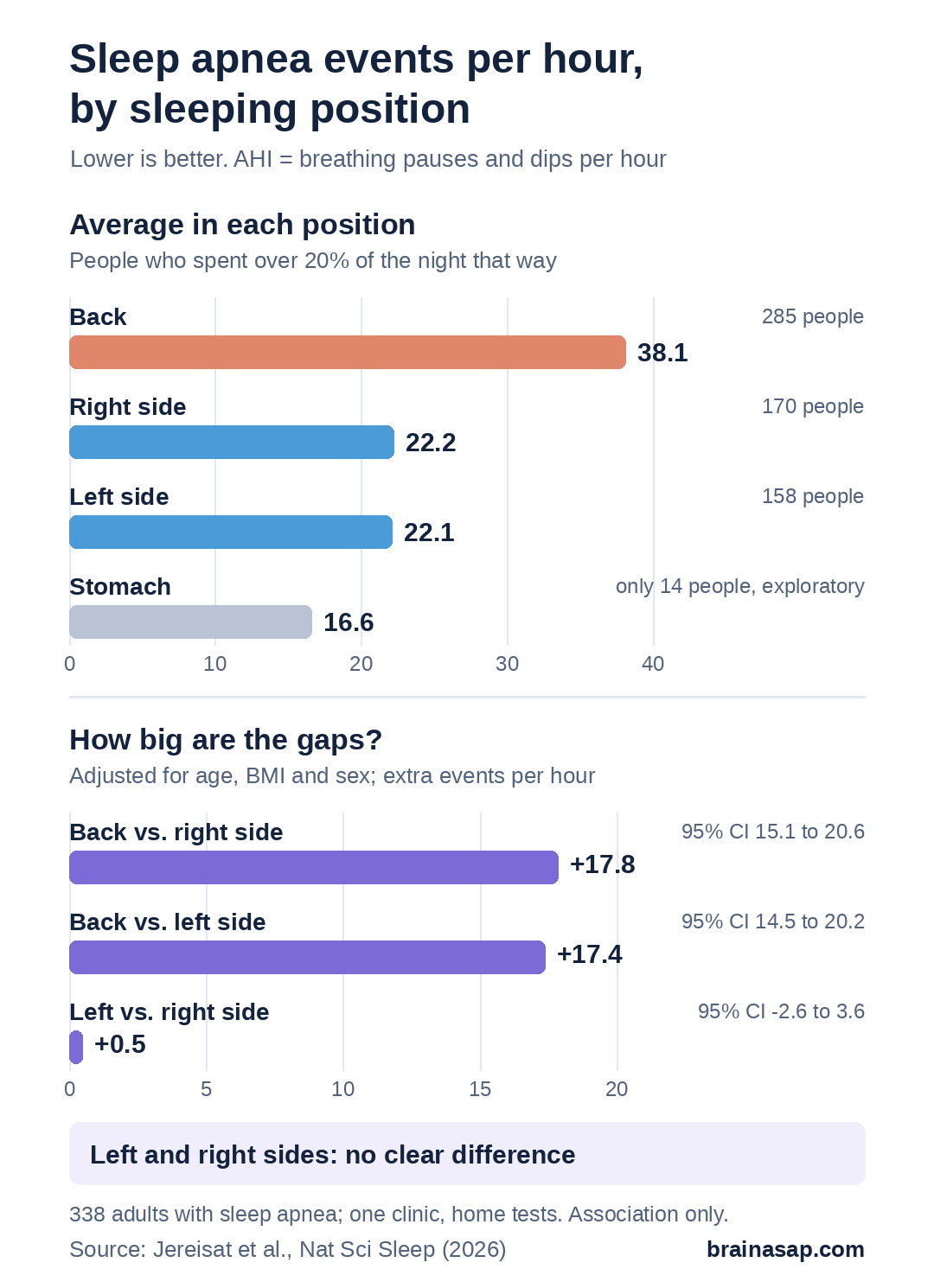
Adjusted for age, BMI, and sex, back sleeping was 17.8 events per hour higher than the right side (95% confidence interval, 15.1 to 20.6) and 17.4 higher than the left side (14.5 to 20.2). Put another way, the average event rate on the back was roughly 1.7 times the rate on either side.
A simpler comparison of the back against all other positions combined pointed the same way: 39.2 events per hour versus 21.9.
Left versus right
Some earlier studies suggested one side might be better, and the question of left versus right comes up often. Here, the two were essentially tied: an adjusted difference of 0.5 events per hour (95% confidence interval, −2.6 to 3.6; p = 0.76). A second analysis limited to people with at least two qualifying positions gave the same answer.
That means the study did not find a difference. It does not prove that none exists, but any difference is unlikely to be large in this group.
Breathing Event Rates by Apnea Severity
In absolute numbers, the gap between back and side was larger in people whose apnea was more severe overall (roughly 11 events per hour in the mild group, 17 in the moderate group, and 19 to 21 in the severe group):
- Mild OSA: about 17.4 events per hour on the back versus about 6.6 to 6.7 on the sides.
- Moderate OSA: about 30.9 on the back versus about 13.2 to 13.5 on the sides.
- Severe OSA: about 67.8 on the back versus about 46.8 to 49.3 on the sides.
Note that even on their sides, people with severe OSA still averaged well above the severe cutoff. Their numbers were much lower on their sides than on their backs, but still high.
Two cautions apply: these group averages are not adjusted, and the severity groups are built from each person’s overall AHI, so higher averages in every position are partly built in. In relative terms the back-to-side ratio actually shrank (about 2.6 times in the mild group, 2.3 in the moderate group, and 1.4 in the severe group).
Stomach sleeping
Stomach sleeping had the lowest average (16.6), but only 14 of 338 people spent enough of the night that way to be counted. The authors describe it as exploratory. Prone (stomach) sleeping has been studied so little, and with so few participants here, that these data cannot say whether it is truly better or worse.
Limits of the study
- Association only: People chose or drifted into their positions. Nobody was told to switch, so the study cannot show that moving someone off their back would lower AHI by 17 events per hour.
- One clinic, one device: Patients from a single community clinic, tested at home. Paper does not describe repeat nights, so night-to-night variation in position and apnea is not captured.
- Some people barely changed position: Comparisons need enough time in each position. Some slept almost entirely in one, which limits fair comparisons for them.
- Missing background details: Records did not allow control for other health conditions, medications, sleep quality, or sleep duration.
- Reporting oddities: A few tables and the abstract label the statistical models slightly inconsistently. The position-specific averages and adjusted contrasts agree.
- Everyone already had OSA: Says nothing about people without apnea or snoring alone.
Sleep Position and Sleep Apnea Treatment
For people with sleep apnea, this adds to a long-standing pattern: the back is the riskiest place to sleep. It also gives a modest answer about left versus right: in these records neither side stood out, so someone who finds one side more comfortable has little data here to move them off it.
The authors note that positional therapy, which uses devices or habits to keep people off their backs, is a reasonable option for people whose apnea is mostly on the back.
They also point to reviews showing it does not match continuous positive airway pressure (CPAP) at lowering overall AHI in many moderate-to-severe cases, though people tend to stick with it more easily. CPAP uses a mask and air pressure to keep the airway open.
If you suspect apnea, that decision belongs in a conversation with a sleep clinician. A randomized trial that actually assigns left versus right sleeping would be the cleaner test.
Citation: DOI: 10.2147/NSS.S627693. Jereisat RA, Qaryouti H, Alsawalha H, Maksoud A, Abdeen Y. The Effect of Different Sleep Positions on the Severity of Obstructive Sleep Apnea: A Retrospective Study. Nature and Science of Sleep. 2026;18:627693.
Study Design: Retrospective, single-center cohort using electronic records and home sleep studies (Zmachine Synergy, with accelerometer-based position), January 2023 to January 2025; linear mixed-effects models with participant random intercepts, adjusted for age, BMI, and sex.
Sample Size: 338 adults with obstructive sleep apnea (of 641 screened); 285 with over 20% of the night on the back, 170 on the right side, 158 on the left side, and 14 on the stomach.
Key Statistic: Back versus right side +17.84 events per hour (95% CI 15.08 to 20.61); back versus left side +17.36 (14.49 to 20.23); left versus right +0.48 (−2.64 to 3.61, p = 0.762).
Caveat: Retrospective association from one clinic’s home sleep tests; position was not assigned, and stomach sleeping (n = 14) is exploratory.