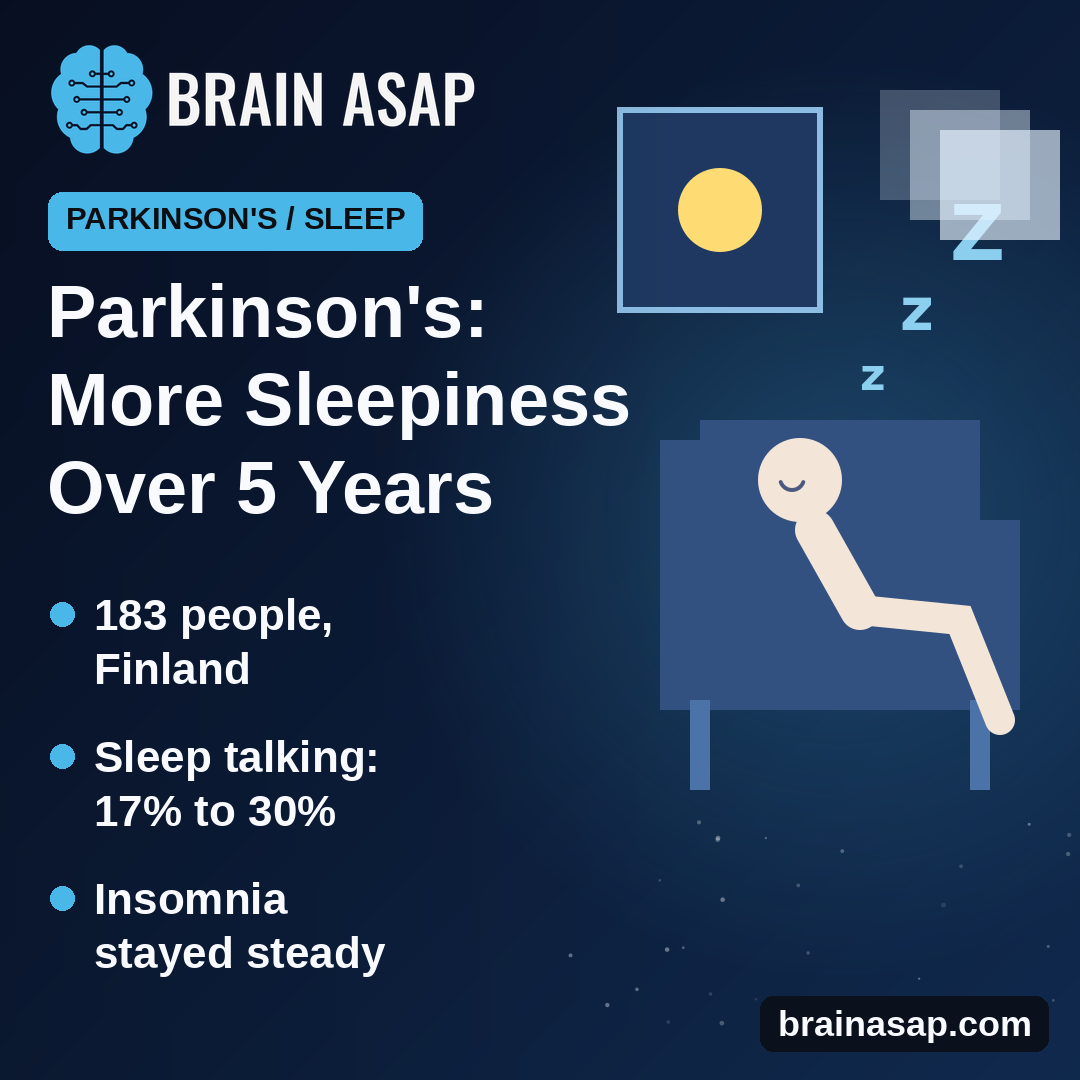
TL;DR: Among 183 people with Parkinson’s in Finland, daytime sleepiness, napping, restless legs, sleep talking and nightmares all became more common over five years. Insomnia stayed about the same.
Key Findings
- Daytime sleepiness: 31% to 39%.
- Daily naps: 21% to 32%.
- Sleep talking at least weekly: 17% to 30%.
- Restless legs and nightmares also rose.
- Insomnia: Steady, at about 68%.
- Sleepiness linked to depression, dopamine agonist drugs and sleep apnea risk.
Source: Journal of Clinical Sleep Medicine (2026) | Partinen et al.
Sleep problems are among the most common non-movement symptoms of Parkinson’s disease, and they can be as disruptive as tremor or stiffness. What is less clear is how they change as the years go by.
This Finnish study asked the same people about their sleep twice, five years apart.
Two Sleep Surveys, Five Years Apart
The researchers mailed a detailed sleep questionnaire to randomly selected members of the Finnish Parkinson’s Association, then again five years later. Of 611 people who answered the first time, 183 completed both and were included.
At the start, these 183 averaged about 66 years old, just over half were men, and they had lived with Parkinson’s for about 5.5 years. By follow-up, that was nearly 10 years.
The questionnaire covered insomnia, daytime sleepiness, napping, restless legs, sleep talking, nightmares, and a screening test for REM sleep behavior disorder (RBD), in which people act out their dreams.
Sleepiness and Night-Time Behaviors Grew
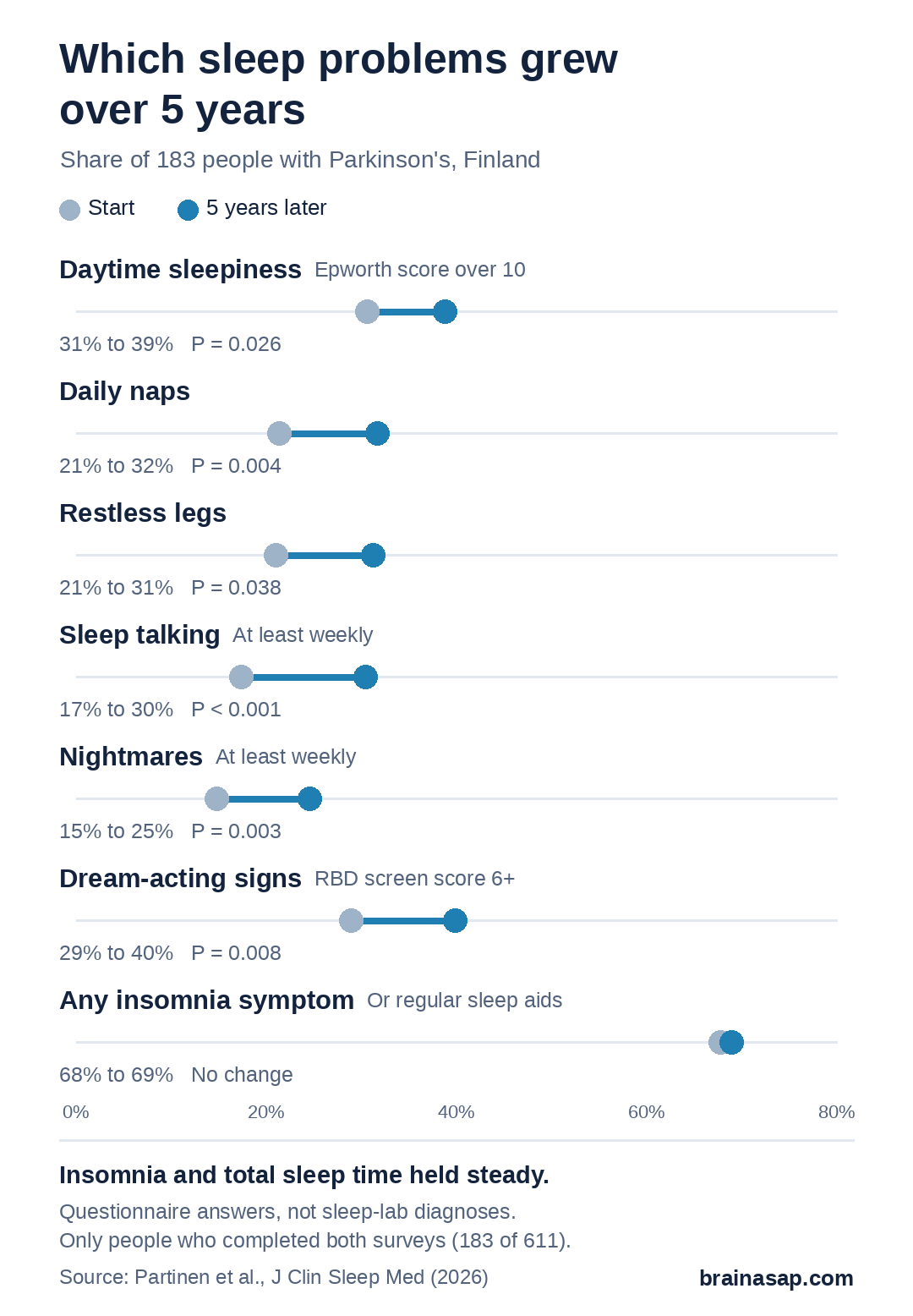
Several problems became clearly more common:
- Daytime sleepiness: 31% to 39% scored high on the Epworth scale.
- Daily napping: 21% to 32%.
- Restless legs: 21% to 31%.
- Weekly sleep talking: 17% to 30%.
- Weekly nightmares: 15% to 25%.
- Positive dream-acting screen: 29% to 40%.
Insomnia and Sleep Length Held Steady
In contrast, trouble falling asleep, waking at night, waking too early and unrefreshing sleep did not change. About 68% had at least one insomnia symptom or used sleep aids, both times. Total sleep stayed around 7 hours, and sleep timing did not shift.
So Parkinson’s does not seem to worsen every kind of sleep problem equally. The pattern points to daytime alertness and REM-sleep behaviors as the areas most likely to change.
What Tracked With Daytime Sleepiness
At follow-up, three factors were linked to excessive sleepiness after accounting for others:
- Depression symptoms: Higher scores, higher odds.
- Dopamine agonist drugs: About 4 times the odds.
- Sleep apnea risk: Higher odds on a sleep-apnea screen.
Levodopa itself was not linked to sleepiness.
Who Dropped Out Matters
- Healthier survivors: People who completed both surveys were younger, earlier in the disease and in better shape. Real changes may be larger.
- Questionnaires only: No sleep-lab tests, so RBD and apnea were screened, not diagnosed.
- No comparison group: Some change could reflect normal aging.
- No movement scores to relate sleep to disease severity.
Ask About Sleep at Every Visit
For people with Parkinson’s and their families, rising daytime sleepiness, sleep talking or dream-acting over the years is common and worth raising with a doctor. Some causes, like certain medicines or untreated sleep apnea, can be addressed.
The next step is studies with sleep-lab recordings over time, which could show whether these changes help track how the disease is progressing.
Citation: DOI: 10.1007/s44470-026-00169-6. Partinen E, Ylikoski A, Hublin C, Partinen M. Changes in sleep characteristics in Parkinson’s disease: a prospective 5-year follow-up study. J Clin Sleep Med. 2026;22:166.
Study Design: Prospective questionnaire cohort, 5-year follow-up, Finnish Parkinson’s Association members.
Sample Size: 183 with complete data at both time points (611 at baseline).
Key Statistic: ESS > 10 rose from 30.6% to 38.8% (P = 0.026); sleep talking 17.4% to 30.4% (P < 0.001).
Caveat: Survivor bias; self-reported questionnaires; no control group.