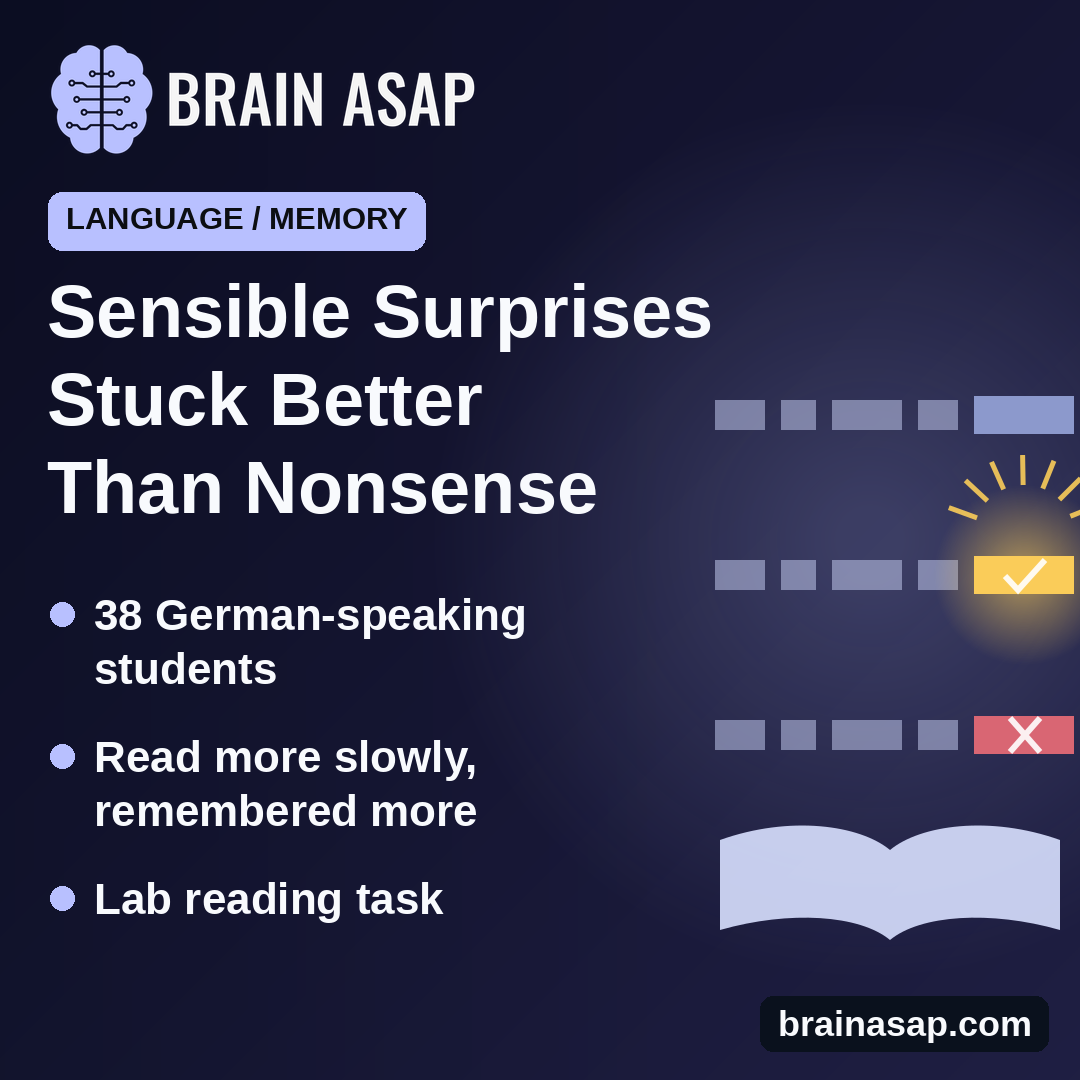
TL;DR: Readers slowed down more for surprising but sensible sentence endings than for impossible ones, and remembered those surprising words better. When people expect some nonsense, they seem to brush it off quickly.
Key Findings
- 38 German-speaking students read sentences word by word.
- Slowest on surprising but sensible endings, faster on expected and on impossible ones.
- Memory: Expected words were remembered best, impossible words worst.
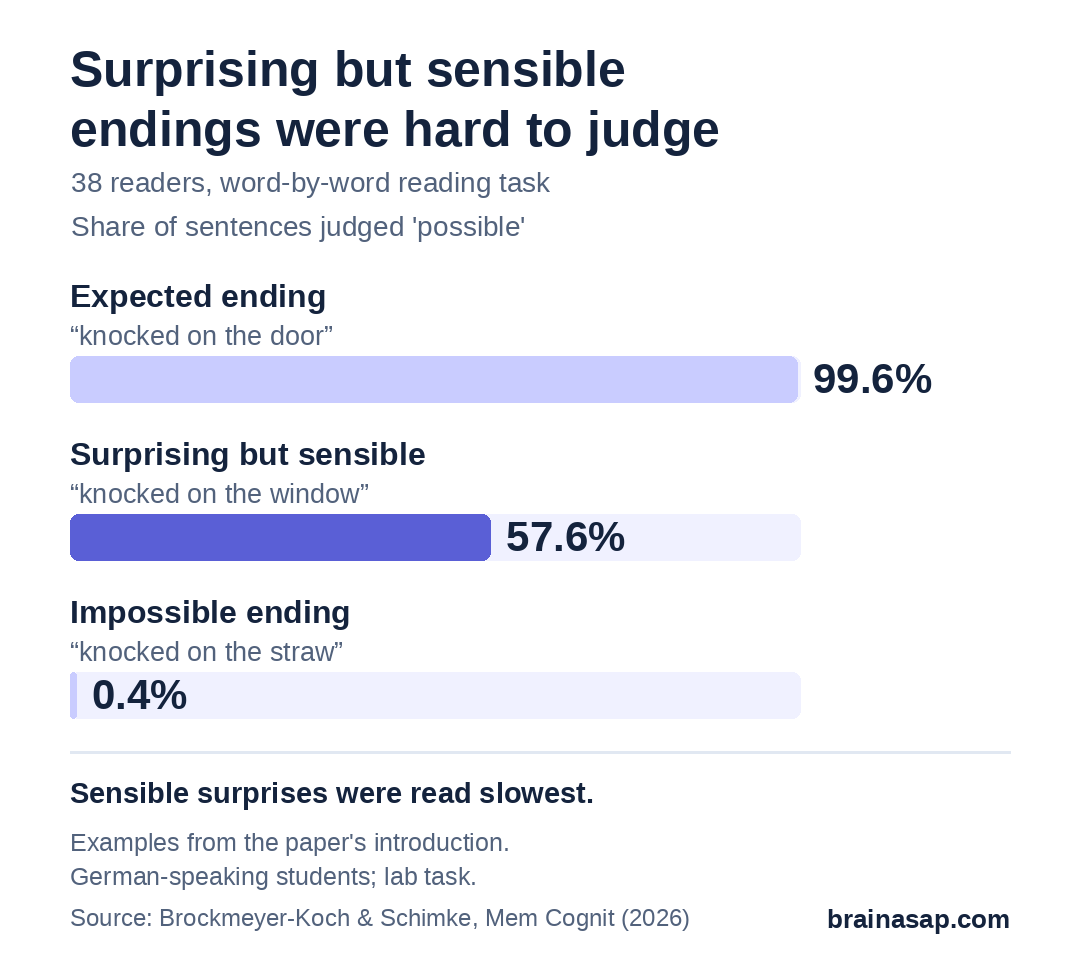
- Hard to judge: Only 58% of surprising-but-sensible sentences were rated “possible.”
Source: Memory & Cognition (2026) | Brockmeyer-Koch & Schimke
Read “Before entering, he knocked on the…” and your brain has already filled in “door.” If the sentence ends with “window,” you are surprised but can make sense of it. If it ends with “straw,” it is simply impossible.
Which kind of surprise makes the brain work harder, and which sticks in memory? Earlier studies disagreed. Two German researchers tested it with a task that pushed readers to think about each sentence.
Three Kinds of Sentence Endings
Thirty-eight native German-speaking students at TU Dortmund University (average age 23) read sentences one word at a time, pressing a key to see each new word. Each sentence ended in one of three ways:
- Expected: The word nearly everyone predicts (“door”).
- Surprising but sensible: Unexpected but possible (“window”).
- Impossible: Makes no sense in the real world (“straw”).
After each sentence, readers judged whether it described something possible. Later, they took a surprise memory test of the final words.
Sensible Surprises Slowed Readers Most
Reading was slowest for surprising but sensible endings, at the final word, at the period and at the plausibility judgment. Impossible endings were read faster, closer to expected ones.
Judging these sentences was also harder, as the plausibility ratings show:
And They Stuck in Memory Better Than Nonsense
In the memory test, expected words were recognized most often and impossible words least often, with surprising but sensible words in between. Surprising words were remembered significantly better than impossible ones.
Why Nonsense Got Brushed Aside
The authors suggest that once readers knew some sentences would be impossible, they could quickly label nonsense as “not worth integrating” and move on. That made reading faster but memory shallower. Surprising but sensible words, by contrast, forced readers to update their picture of the situation, which took longer and left a stronger memory trace.
Limits of One Lab Study
- Students only: 38 young German speakers.
- The task shaped the result: Asking for plausibility judgments encouraged deep processing; other studies without it found different patterns.
- Short sentences on a screen, not natural reading or conversation.
What This Means for Everyday Reading
When we read with care, the ideas that surprise us but still make sense may be the ones we remember, while obvious nonsense gets filtered out. Whether the same holds for news, textbooks or conversation, where we don’t know to expect nonsense, is still an open question.
Citation: DOI: 10.3758/s13421-026-01949-4. Brockmeyer-Koch M, Schimke S. Explaining away the impossible: effects of plausibility on predictive sentence processing and memory. Mem Cognit. 2026.
Study Design: Self-paced reading with plausibility judgments followed by a surprise word recognition test; mixed-effects models.
Sample Size: 38 native German-speaking students in the reading analysis (42 tested); 37 in the memory analysis.
Key Statistic: “Possible” judgments: 99.58% expected, 57.57% surprising but sensible, 0.42% impossible.
Caveat: Student sample; results depend on the plausibility-judgment task.