TL;DR: In a 40-person stroke rehab trial, people who did video-game balance training with a tight cuff on the weak thigh improved balance, walking and leg strength more over 4 weeks than people doing the same training without the cuff. The trial was small, short and had no fake-cuff comparison.
Key Findings
- 40 stroke patients, 4 weeks: Everyone got usual rehab plus 20 minutes a day of balance games; half also wore an inflated thigh cuff during the games.
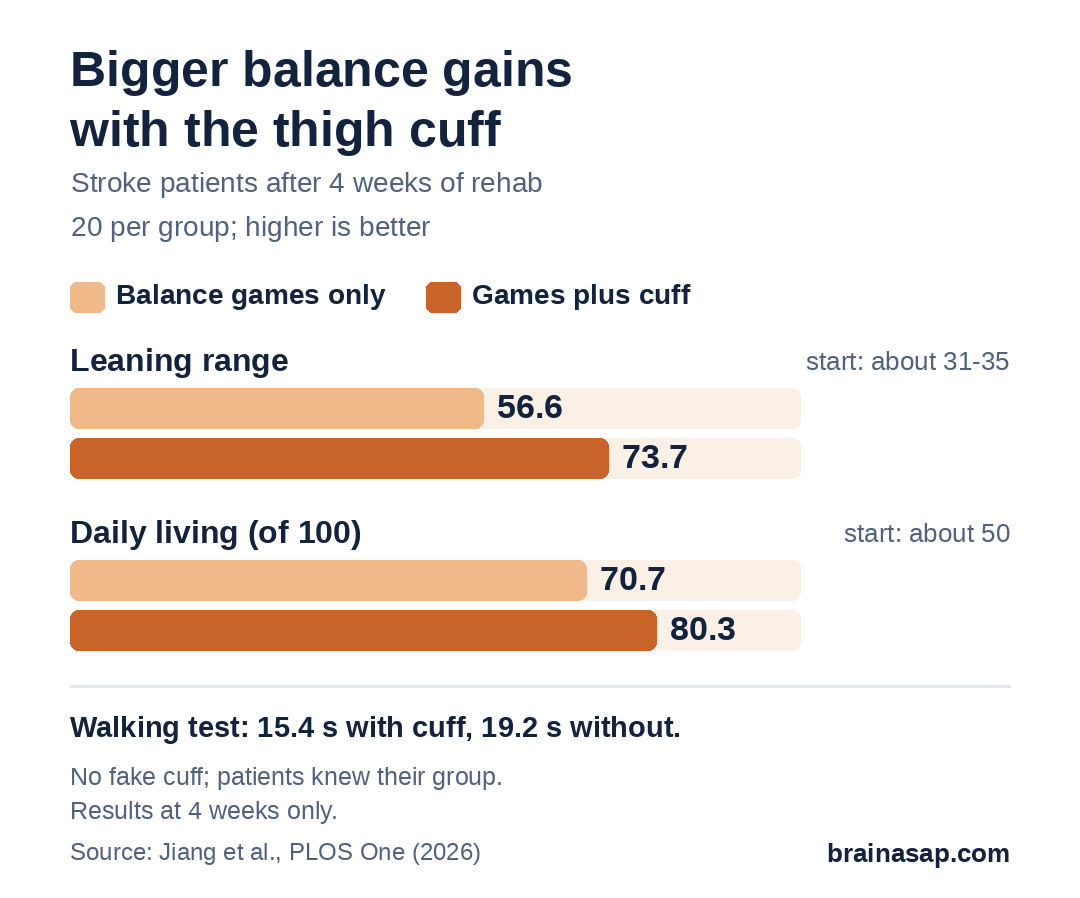
- Better balance with the cuff: Leaning range rose to 73.7 vs 56.6 without the cuff, from similar starting points.
- Faster walking test: 15.4 vs 19.2 seconds to stand, walk 3 meters, turn and sit.
- Higher blood markers: Two growth factors linked to nerve and blood vessel repair rose more in the cuff group.
- No side effects reported: All 40 finished.
Source: PLOS One (2026) | Jiang et al.
After a stroke, a weak leg can make standing and walking unsteady for months. Strength training helps, but many stroke survivors can’t lift heavy enough loads to build muscle quickly.
Blood flow restriction training is one workaround: a cuff squeezes the upper part of an arm or leg during light exercise, which makes easy work feel harder to the muscle. A rehab hospital in Chongqing, China, tested whether adding it to balance training would speed recovery.
Balance Games With and Without a Thigh Cuff
The trial enrolled 40 adults aged 40 to 70, about 5 to 6 weeks after a first stroke on average. Just over half had a stroke caused by a clot; the rest had a bleed. They were randomly split into two groups of 20:
- Balance games only: Usual rehab plus 20 minutes a day of balance training on a platform, steering a game cursor by shifting their weight.
- Balance games plus cuff: The same program, with a 10-centimeter cuff inflated to 160 to 200 mmHg around the top of the weak thigh during the games.
Training ran 5 days a week for 4 weeks. Assessors who measured outcomes did not know which group each person was in.
Bigger Gains in Balance and Walking
Both groups improved, which is expected in the first months after a stroke. The cuff group improved more on nearly every measure:
- Leaning range: How far people could lean without losing balance rose from about 35 to 73.7 with the cuff, vs from about 31 to 56.6 without.
- Timed up-and-go: Fell from 25.7 to 15.4 seconds with the cuff, vs 26.4 to 19.2 seconds without.
- Leg movement score: 22.2 vs 19.9 out of 34, from about 12 in both.
- Daily living score: 80.3 vs 70.7 out of 100, from about 50 in both.
- Sway: Smaller and shorter body sway with eyes open and closed.
Growth Factors Rose More in the Blood
The researchers also measured BDNF, a protein that supports nerve cells, and VEGF, which helps grow blood vessels. Both rose in both groups. BDNF reached 16.6 vs 14.0 ng/mL and VEGF 112.2 vs 105.1 ng/mL, higher in the cuff group.
These are blood levels, though. They do not show what happened inside the brain, and the authors say the markers cannot prove the brain rewired itself.
No Fake Cuff, No Long-Term Follow-Up
- No sham cuff: Patients and therapists knew who wore the cuff, so extra attention or expectations may explain part of the gain.
- Fixed pressure: Cuff pressure was not tailored to each person’s blood flow, which is the usual safety standard.
- Small and short: 20 people per group, one hospital, results only at 4 weeks.
- Mixed stroke types: Clot and bleed strokes may recover differently.
Cuff training was supervised, with blood pressure and oxygen checked every 5 minutes. It is not something to try at home without professional guidance.
Do the Gains Hold Up Against a Fake Cuff?
The early results are encouraging for a cheap add-on to standard stroke rehab. The next trial needs a sham cuff, pressure set to each patient, and follow-up beyond a month to show whether the extra balance and walking gains are real and lasting.
Citation: DOI: 10.1371/journal.pone.0358740. Jiang H, Yang C, Wang P, et al. Effects of blood flow restriction combined with visual feedback training on lower limb function and the serum levels of BDNF and VEGF in patients with stroke. PLoS One. 2026;21(9):e0358740.
Study Design: Single-center randomized controlled trial with blinded assessors (ChiCTR2500104181).
Sample Size: 40 patients (20 per group); all completed.
Key Statistic: Limit of stability 73.67 vs 56.56 after 4 weeks (adjusted difference 15.65; P < 0.001).
Caveat: No sham cuff or patient blinding, fixed cuff pressure, 4-week follow-up only.