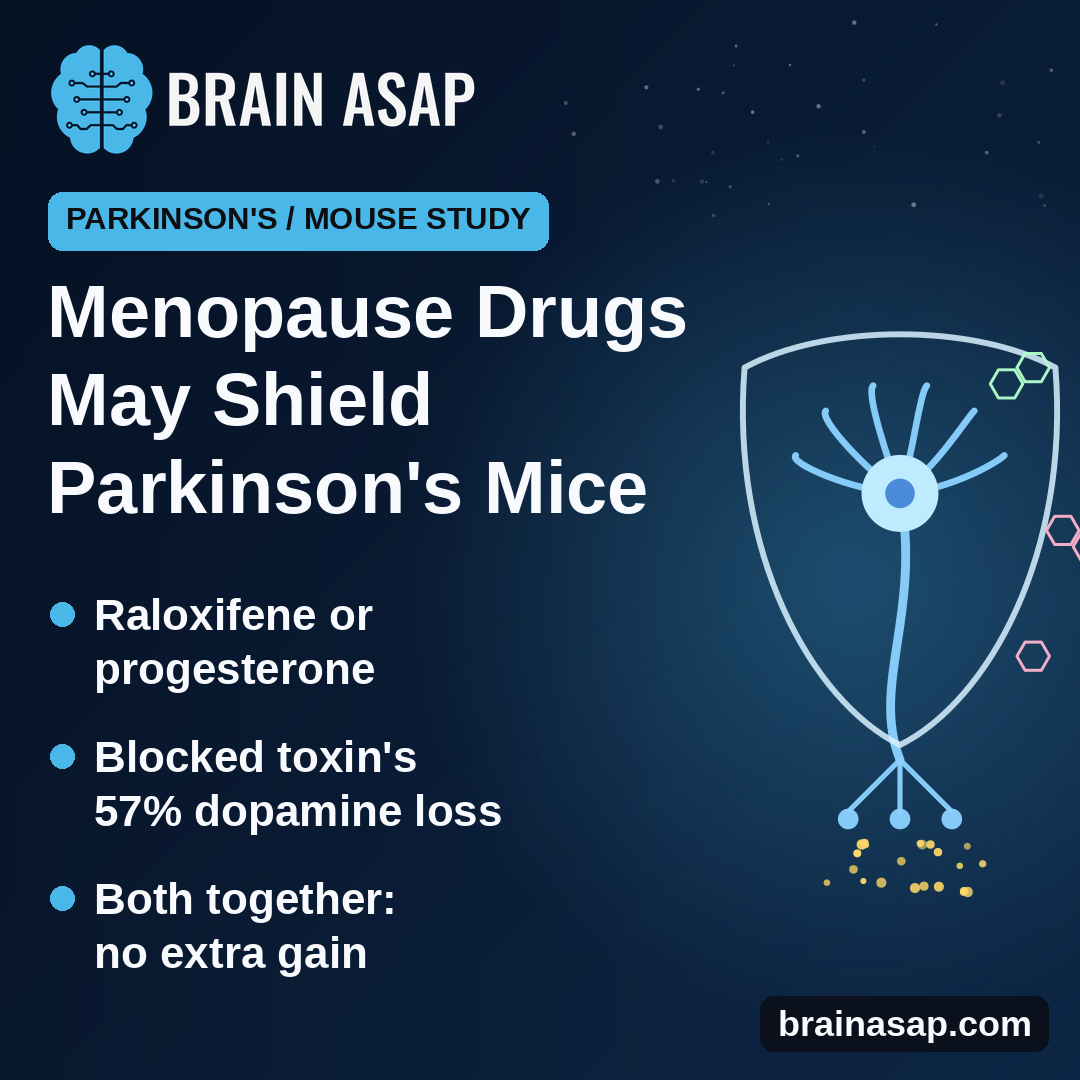
TL;DR: In female mice without ovaries, a model of menopause, the osteoporosis drug raloxifene and the hormone progesterone each protected brain dopamine from a toxin that mimics Parkinson’s. Giving both together worked no better than either alone.
Key Findings
- Toxin cut dopamine by 57%: In the movement-control area of untreated mice.
- Each drug prevented the loss: Raloxifene, progesterone or both.
- Less brain inflammation: A marker of activated support cells stayed down with treatment.
- Little effect on the uterus: Raloxifene raised uterine weight only slightly; progesterone not at all.
- No movement tests: Benefit was measured in brain chemistry only.
Source: Frontiers in Neuroscience (2026) | André et al.
Parkinson’s disease is more common in men, and some researchers think women’s natural estrogen offers partial protection. That possible protection may fade after menopause, when most women with Parkinson’s are diagnosed.
Estrogen itself carries risks for long-term use, so a team at Université Laval in Québec tested two drugs already used in women: raloxifene, which mimics estrogen in some tissues and is prescribed for bone loss, and the hormone progesterone.
Menopause-Model Mice Given a Parkinson’s-Like Toxin
The researchers used young female mice whose ovaries had been removed six weeks earlier, cutting off their own estrogen and progesterone. For 10 days, mice got twice-daily injections of one of four treatments:
- Placebo injection
- Raloxifene
- Progesterone
- Raloxifene plus progesterone
On day 5, half the mice in each treatment group received MPTP, a toxin that kills dopamine-making nerve cells, and the other half got salt water. Groups had 10 to 15 mice each.
Dopamine Loss Was Prevented by Either Drug
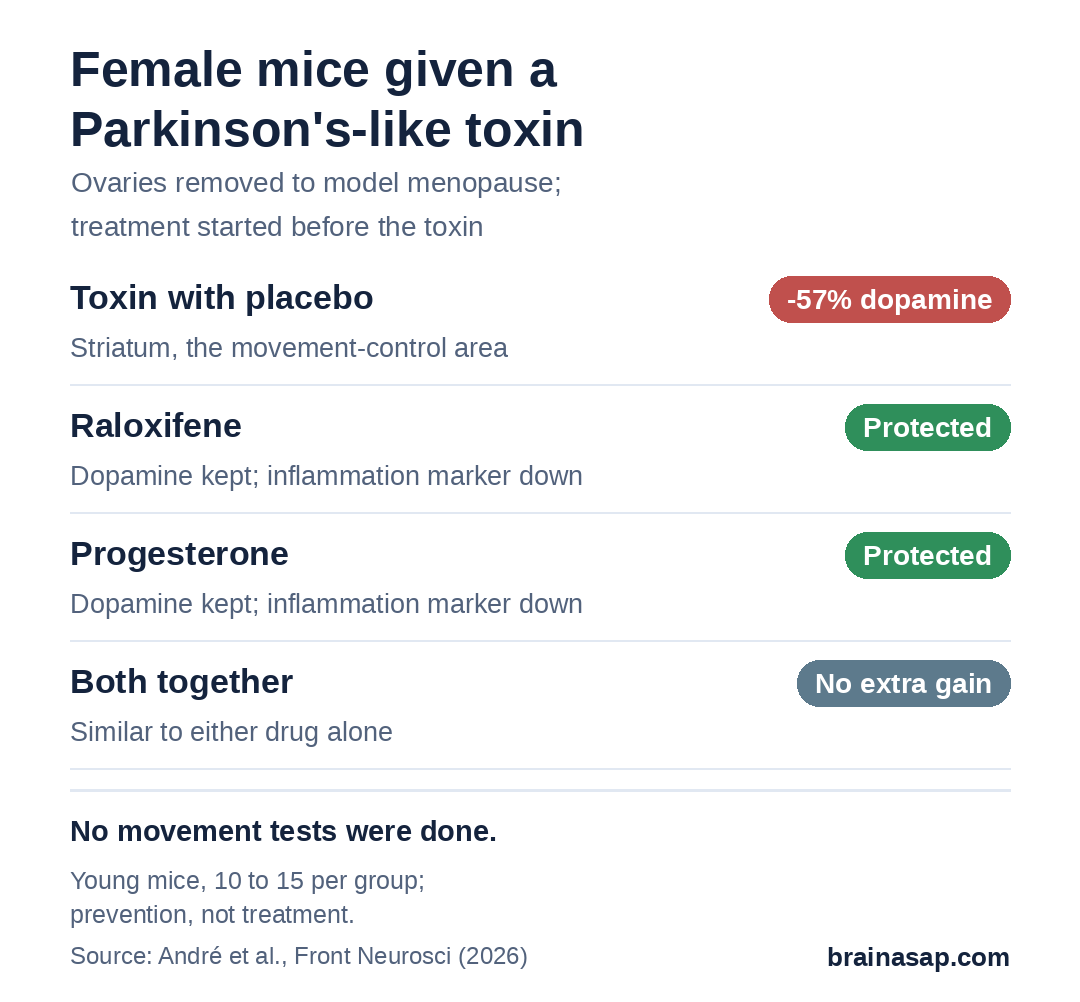
In mice given the toxin and a placebo, dopamine in the striatum, a deep brain area that relies on dopamine to control movement, fell by 57%. Breakdown products of dopamine also dropped. Serotonin, another brain messenger, was unaffected, showing the toxin’s damage was specific.
Raloxifene, progesterone and the combination all prevented the dopamine loss to a similar degree. Combining them did not add protection, though the authors note that the doses used may already have produced the maximum effect.
A Calmer Response From Brain Support Cells
The toxin also raised GFAP, a protein that rises when astrocytes, the brain’s support cells, react to damage. All three treatments kept GFAP from rising. Across toxin-treated mice, higher GFAP went with lower dopamine, which fits the idea that the drugs work partly by damping inflammation.
Safety in the uterus matters for any estrogen-like drug. Raloxifene raised uterine weight slightly, but it stayed below the average of mice with intact ovaries. Progesterone had no effect.
Early Damage in Young Mice, Not Parkinson’s in Older Women
- Prevention design: Drugs started 4 days before the toxin, unlike treating people already diagnosed.
- Early-stage model: 57% dopamine loss is below the roughly 70% loss at which movement symptoms usually appear.
- No movement tests: Only brain chemistry and inflammation were measured.
- Young mice, sudden menopause: Surgery does not mimic gradual, natural menopause or aging.
- Dopamine levels, not cell counts: The study did not count surviving neurons.
Could Existing Menopause Drugs Be Repurposed?
The authors argue both drugs are good candidates for repurposing because they are already approved and well known in women. The key open question is whether raloxifene or progesterone can slow Parkinson’s in older animals with established damage, and then in postmenopausal women.
Citation: DOI: 10.3389/fnins.2026.1870069. André MM, Morissette M, Bourque M, Rieux M, Soulet D, Di Paolo T. Raloxifene and progesterone neuroprotection in a female mouse model of Parkinson’s disease. Front Neurosci. 2026;20:1870069.
Study Design: Controlled experiment in ovariectomized female C57BL/6N mice; 8 groups (4 treatments x MPTP or saline).
Sample Size: 88 mice; 10 to 15 per group.
Key Statistic: MPTP caused a 57% striatal dopamine depletion, prevented similarly by raloxifene, progesterone and their combination.
Caveat: Pretreatment design in young mice; no behavioral outcomes.