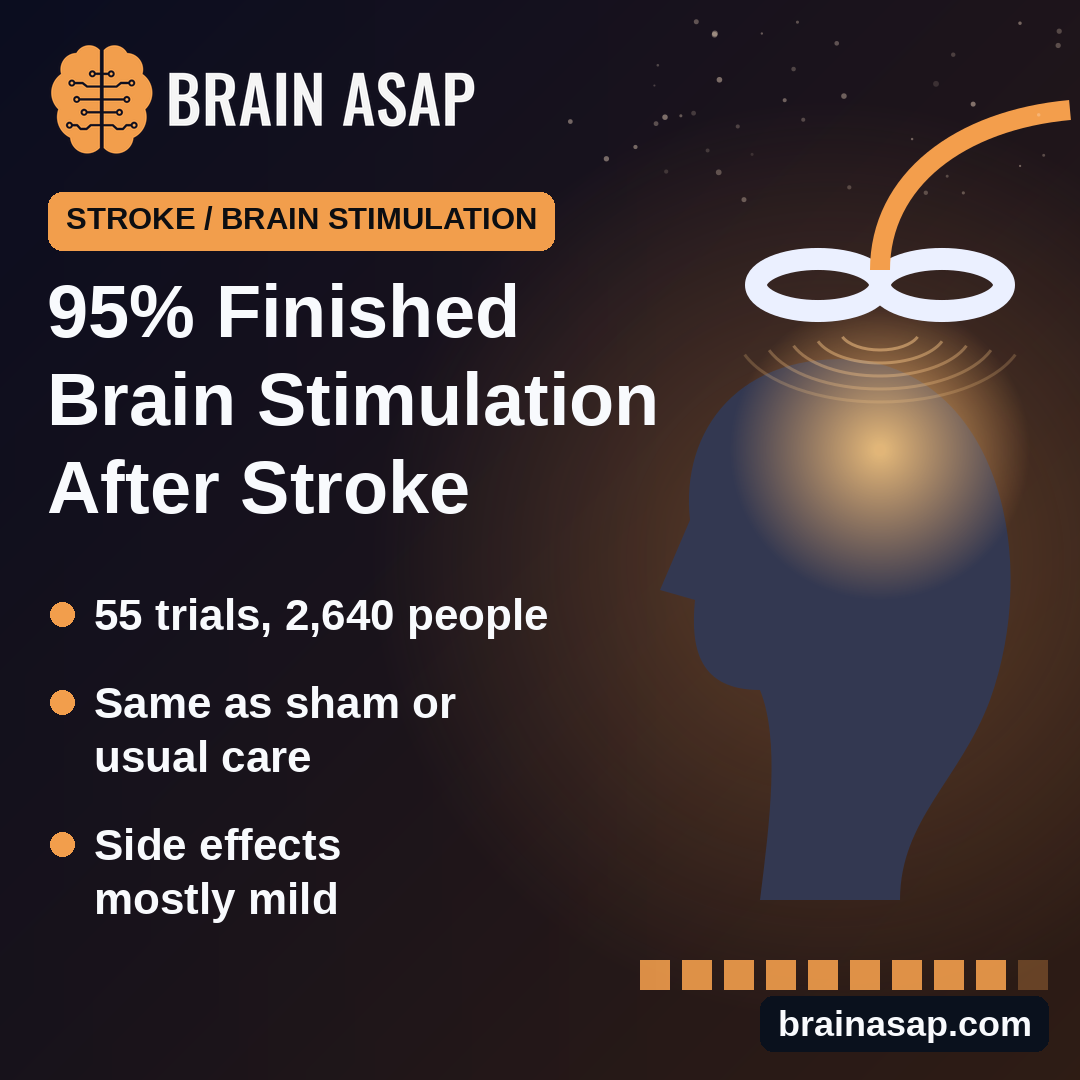
TL;DR: Across 55 trials of brain stimulation for arm recovery after stroke, about 95% of people finished treatment, the same share as those given fake stimulation or usual care. Side effects were mostly mild headaches and skin tingling.
Key Findings
- 55 trials, 2,640 people with arm weakness after stroke.
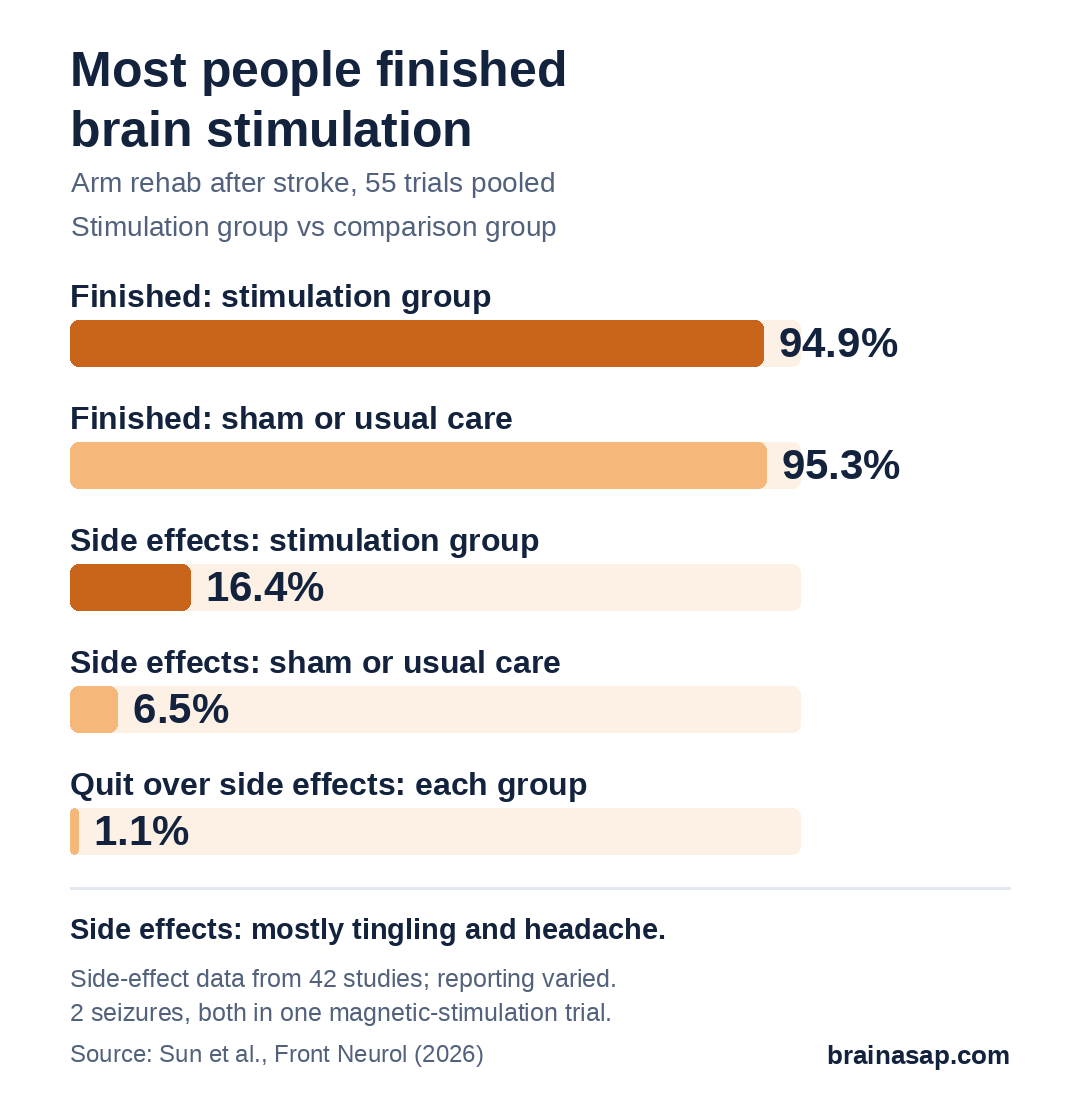
- Finished treatment: 94.9% with brain stimulation vs 95.3% in comparison groups.
- No stimulation type stood out for completion once uncertainty was counted.
- Side effects: Reported in 16% with stimulation vs 7% in comparison groups; 1.1% of each quit because of them.
- Rare serious events: 2 seizures, both in one magnetic-stimulation trial.
Source: Frontiers in Neurology (2026) | Sun et al.
Brain stimulation through the scalp is increasingly added to rehab for a weak arm after stroke. Most research asks whether it works. This review asked a more practical question: do people actually stick with it, and how often does it cause problems?
The short answer is that people finish it about as often as they finish sham or usual care.
Two Main Ways to Stimulate the Brain
The trials used two families of non-invasive brain stimulation:
- Magnetic stimulation (rTMS): A coil held over the head sends magnetic pulses that make nerve cells fire. Theta burst is a faster, shorter version.
- Direct current stimulation (tDCS): Weak electrical current flows between pads on the scalp to nudge brain activity.
In this article, the stimulation group means people given real stimulation alongside their rehab. The comparison group means people given sham stimulation or usual care instead.
The researchers pooled 55 randomized trials with 2,640 participants and 68 stimulation-versus-control comparisons, covering 14 different stimulation types. Most comparisons were in the first months after stroke, and most took place in hospitals.
About 95 in 100 Finished, With or Without Real Stimulation
Completion was 94.9% in the stimulation groups (95% CI 93.3 to 96.4) and 95.3% in the comparison groups. In the network comparison, no stimulation type had clearly better or worse completion than sham or control.
Some patterns showed up in subgroups:
- Direct current vs magnetic: 96.8% vs 93.9% finished.
- By stroke stage: 97.1% in the chronic stage (over 6 months), 95.9% subacute, 92.8% acute.
- Top-ranked types: Intermittent theta burst, stimulation of both brain sides, and dual-pad direct current.
The authors call the rankings hypothesis-generating. The differences were tiny, and four stimulation types came from a single study each.
Side Effects Were Common but Mostly Mild
In the 42 studies that reported side effects, 16.4% of people in the stimulation groups had one, compared with 6.5% in the comparison groups. The most common were skin tingling, headache and skin redness, and nearly all faded on their own.
Only 1.1% of people in either group dropped out because of side effects. The one serious safety signal came from a single magnetic-stimulation trial, where two people had seizures that needed treatment and led to withdrawal.
Direct current had a higher side-effect rate than magnetic stimulation (26.6% vs 11.1%). The authors suspect this partly reflects tDCS trials recording mild skin sensations more carefully, not a real safety gap.
What Completion Rates Can and Can’t Show
- Not a test of benefit: Finishing treatment says nothing about arm recovery.
- Dropouts not always bad: Early discharge after recovery also counts as not completing.
- Uneven safety reporting: Definitions and monitoring varied; side-effect rates differed hugely between studies.
- Bias in some trials: 10 of 55 at high risk of bias, 30 with some concerns.
- Indirect comparisons: Stimulation types were only compared through sham or control, never head to head.
Tolerable Enough to Keep Testing
For stroke survivors offered brain stimulation in a trial or clinic, this review suggests most people get through it, and the usual side effects are minor. Seizure risk with magnetic stimulation still needs screening and monitoring.
The next step is for trials to report side effects the same way and record why people stop, so the field can tell a tolerability problem from someone who simply got better and went home.
Citation: DOI: 10.3389/fneur.2026.1853609. Sun J, Wang Z, Huang Y, Du Y, Zhang S, Shen H, Zhang H, Feng S. Completion rate and safety of non-invasive brain stimulation for upper limb dysfunction after stroke: a systematic review and network meta-analysis. Front Neurol. 2026.
Study Design: Systematic review with single-arm meta-analysis of completion rates and Bayesian network meta-analysis (PROSPERO CRD420261309536).
Sample Size: 55 RCTs, 68 comparisons, 2,640 participants; 42 studies reported adverse events.
Key Statistic: Completion 94.9% (95% CI 93.3 to 96.4) with stimulation vs 95.3% (93.8 to 96.7) in controls; all network credible intervals included 1.00.
Caveat: Completion and safety only, not motor benefit; inconsistent adverse-event reporting; several stimulation types informed by one study.