Lifetime Cognitive Enrichment Delayed Alzheimer’s Dementia
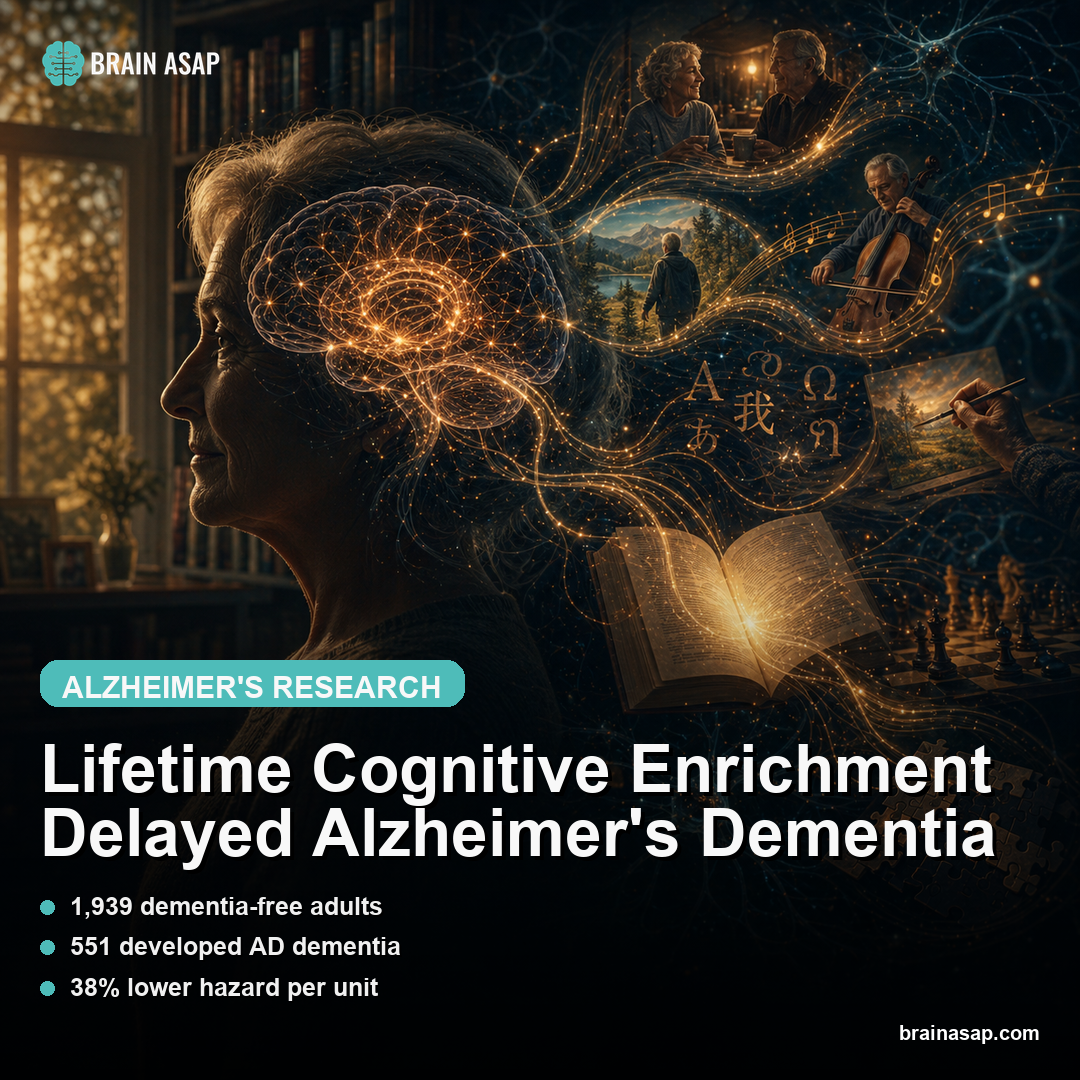
Lifetime Cognitive Enrichment Delayed Alzheimer's Dementia

Lifetime Cognitive Enrichment Delayed Alzheimer’s Dementia TL;DR: In 1,939 Rush Memory and Aging Project participants, higher lifetime cognitive enrichment was linked to 38% lower Alzheimer’s dementia hazard and about 5 years later dementia onset. Key Findings 1,939 dementia-free adults: Participants were older adults from Northeastern Illinois in the Rush Memory and Aging Project, with a …
Read more

L-DOPA Partly Rescued Entorhinal Memory Failure in Alzheimer’s Mice

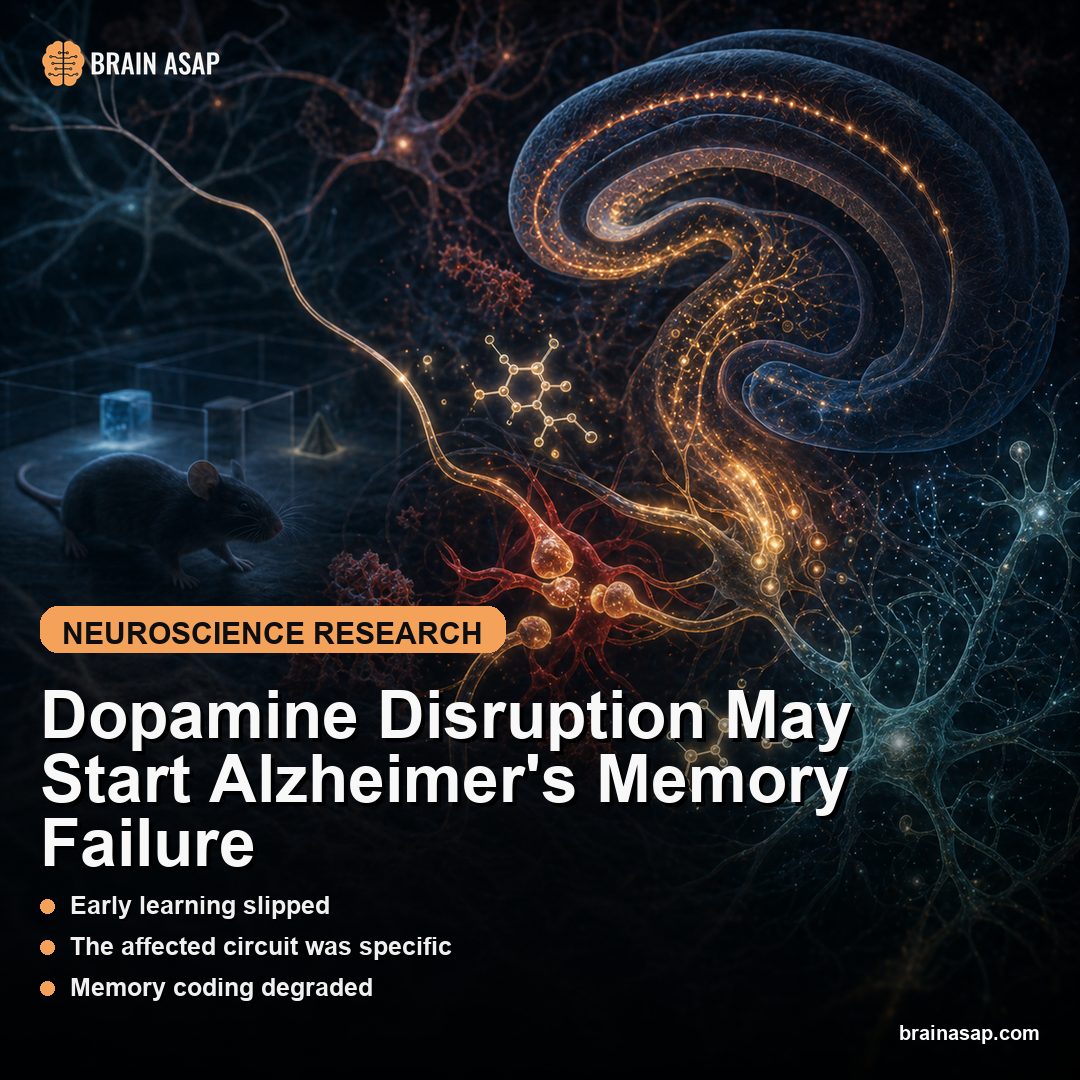
Dopamine Disruption May Start Alzheimer's Memory Failure

Dopamine Disruption May Start Alzheimer’s Memory Failure TL;DR: In an Alzheimer’s mouse model, early memory failure tracked a broken dopamine signal into the lateral entorhinal cortex, and both optogenetic dopamine reactivation and L-DOPA partially restored learning. Key Findings Early learning slipped: Young APP knock-in mice reached 78.6% correct trials in the final learning block, compared …

Read more

Cannabis via Vaporized THC (20-40 mg) Caused Memory Impairment

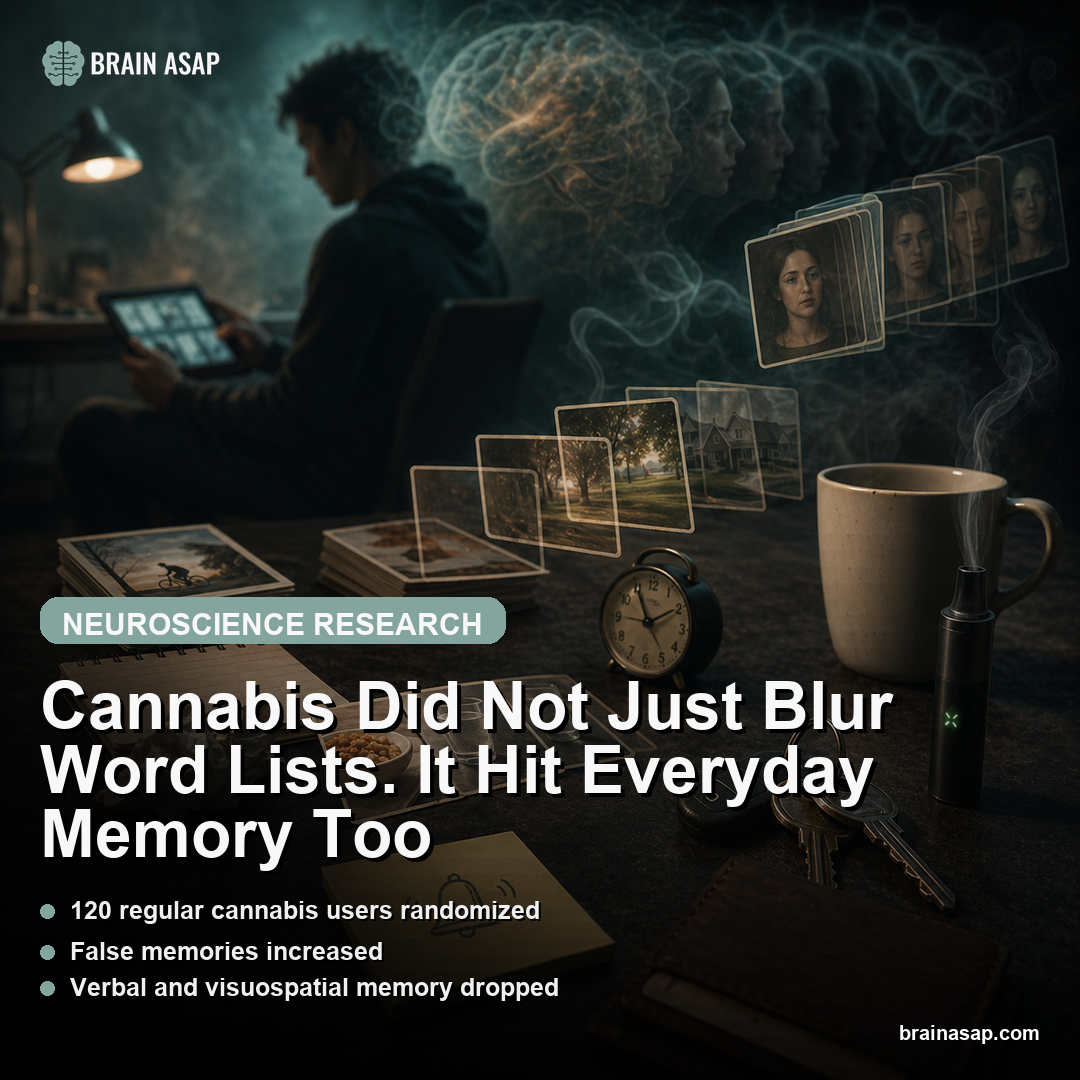
Cannabis Did Not Just Blur Word Lists. It Hit Everyday Memory Too

Cannabis Did Not Just Blur Word Lists. It Hit Everyday Memory Too TL;DR: A randomized vaporized-THC trial found broad acute memory impairment, including false memories, prospective memory, source memory, and temporal order memory, with no meaningful dose split between 20 and 40 mg. Key Findings 120 regular cannabis users randomized: Participants vaporized placebo cannabis, 20 …

Read more

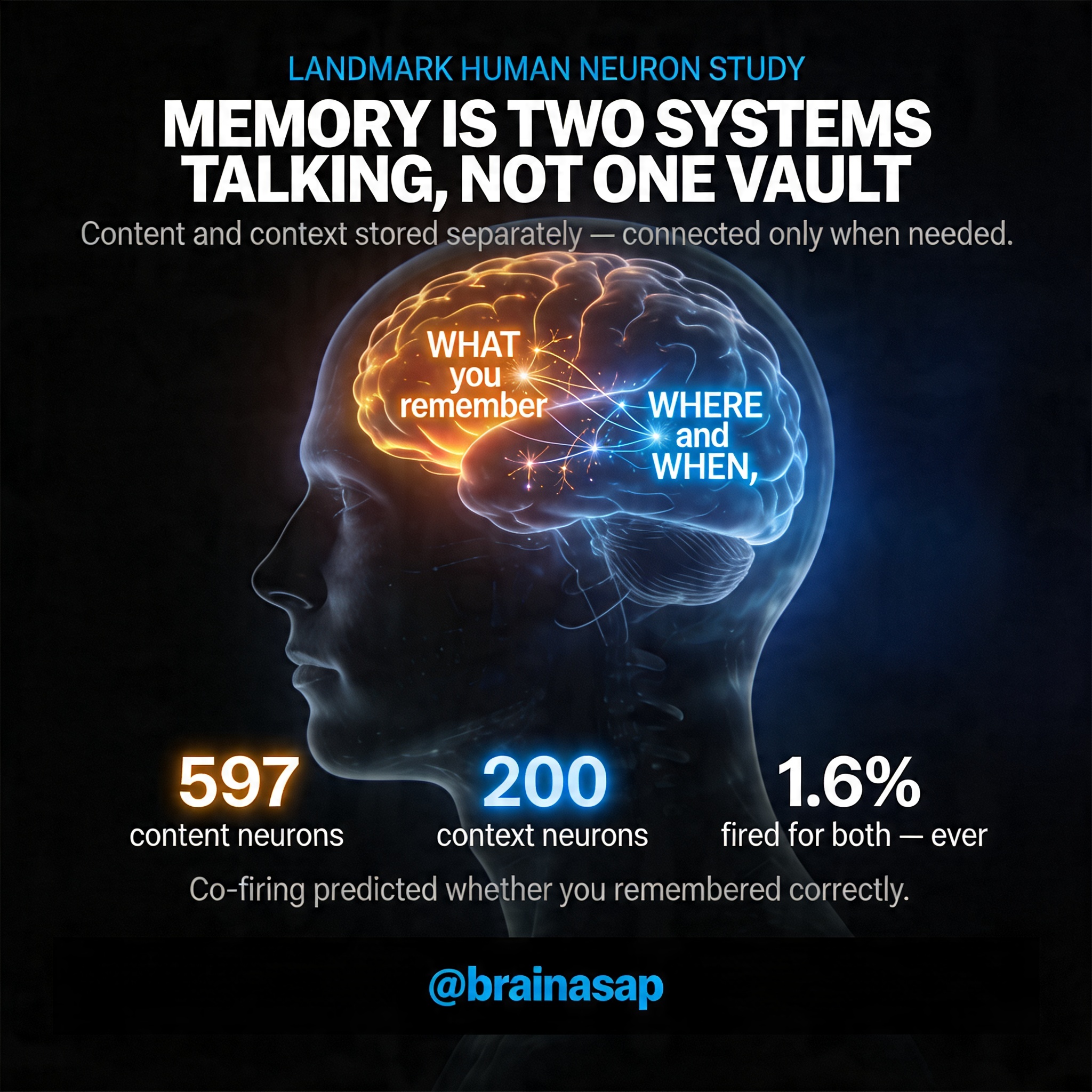
How the Human Brain Stores Memory: Content vs. Context Neurons

How the Brain Separates What We Remember from Why We Remember It TL;DR: The brain stores content (what you remember) and context (when/where) in separate neural populations linked by real-time coordination, not pre-wired conjunctive cells—a design that trades speed for flexibility, allowing you to recognize a friend’s face across any setting or apply a principle …

Read more

New Blood Test Detects Alzheimer’s Disease with 83% Accuracy Years Before Symptoms

Blood Test Detects Alzheimer’s with 83% Accuracy TL;DR: A new blood test using three misfolded plasma proteins can identify Alzheimer’s disease with 83.44% accuracy, outperforming conventional biomarkers and offering a non-invasive screening tool years before cognitive symptoms appear. The holy grail of Alzheimer’s research isn’t a cure—yet. It’s catching the disease before memory starts to …

Read more

Chess Experts Differ in Chunk Memory & Brain Connectivity vs. Novices (2024 Study)

Expert chess players use chunk memory to make better decisions, showing unique brain connectivity that helps them perform well even against tougher opponents. Highlights: Consistent Performance: Expert chess players perform equally well regardless of the difficulty level, unlike beginners whose performance drops with increased difficulty. Stronger Brain Connections: Experts show stronger connections in specific brain …

Read more

Dual N Back Training Improves Working Memory Function

A new study published in Scientific Reports provides insight into which memory training techniques are most effective at improving working memory. The research compared an adaptive n-back training task to the memory palace technique over 20 days of training. Both groups improved on trained tasks, but n-back training showed greater transfer to untrained working memory …

Read more

Low Doses of Caffeine: One Cup of Coffee Alters Brain Waves to Enhance Cognition

A new study finds that drinking a small amount of caffeine in the morning may improve alertness, memory, and attention in healthy young men. The caffeine dose was equivalent to about one cup of coffee. Key Facts: 25 healthy young men drank either a placebo or 50 mg of caffeine (amount in a cup of …

Read more

New Research Upends Long-Standing Theory on How Memories Form

Groundbreaking new research challenges decades of accepted neuroscience dogma on how memories are formed in the brain. The study provides strong evidence that the induction of long-term potentiation (LTP), widely believed to be the cellular mechanism underlying memory formation, relies on structural changes in neurons rather than enzymatic activity as long thought. Key Takeaways: LTP …

Read more

Outsmarting Alzheimer’s: How Your Education and Genes Can Change Your Destiny

Summary: A new study reveals how certain genes and education levels impact Alzheimer’s disease risk, even in individuals destined to develop dementia. Key facts: The APOE gene influences Alzheimer’s onset in people with a genetic mutation causing early-onset Alzheimer’s. Having APOE e4 accelerates onset of decline while APOE e2 delays it. More years of education …

Read more