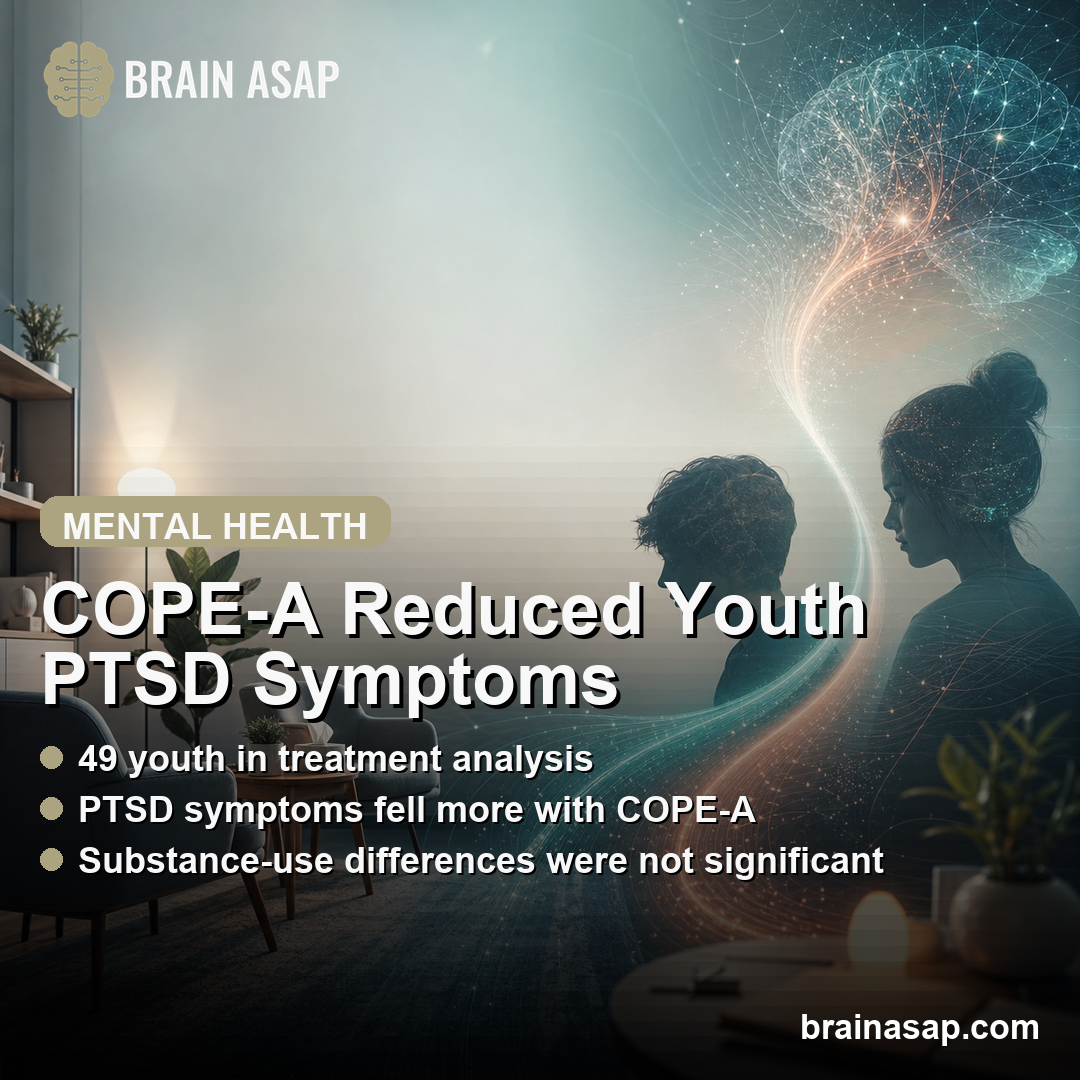
TL;DR: A 2026 randomized trial analysis in European Journal of Psychotraumatology found that COPE-A, an integrated exposure-based therapy for youth with posttraumatic stress disorder (PTSD) and substance use disorder (SUD), reduced PTSD symptoms more than supportive counseling, but substance-use reductions were not significantly stronger than counseling.
Key Findings
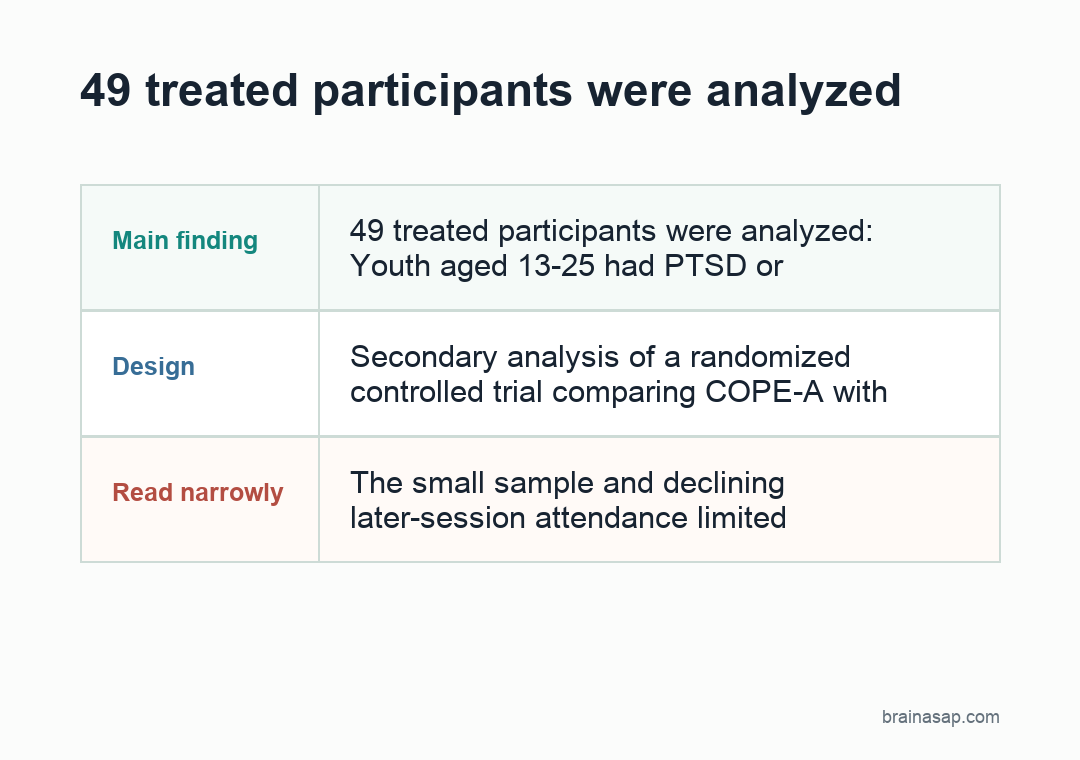
- 49 treated participants were analyzed: Youth aged 13-25 had PTSD or subthreshold PTSD plus problematic alcohol or cannabis use.
- COPE-A combined trauma and substance-use care: The intervention used prolonged exposure, cognitive-behavioral therapy (CBT), motivational interviewing, and substance-use coping skills.
- PTSD scores fell more with COPE-A: Total PTSD-RI scores dropped 17.00 points more than supportive counseling from session 1 to session 11.
- Exposure timing mattered: The largest PTSD separation appeared after session 5, when prolonged exposure began in COPE-A.
- Substance-use differences were not significant: COPE-A showed some within-group reduction in use frequency, but the between-group substance-use comparison did not clearly favor COPE-A.
Source: European Journal of Psychotraumatology (2026) | Dobson et al.
Concurrent Treatment of PTSD and SUD Using Prolonged Exposure – Adolescent version (COPE-A) is a youth-adapted therapy for people dealing with both trauma symptoms and substance use. It includes prolonged exposure for PTSD and CBT-style skills for craving, distress tolerance, communication, and substance-use risk.
The trial analysis did not only ask whether youth improved. Researchers also tested whether PTSD and substance-use symptoms moved together during treatment.
COPE-A Was Tested Against Supportive Counseling
Researchers analyzed session-by-session data from a randomized controlled trial of youth receiving care for co-occurring PTSD and substance use. The current analysis included 49 participants who attended at least one therapy session.
The sample was clinically complex. Participants had a mean age of 19.5 years, nearly all had experienced multiple trauma types, and 87.8% met full DSM-5 PTSD diagnostic cutoffs at baseline.
- Substance profile: Cannabis was the primary substance for 51.0% of participants, and alcohol was the primary substance for 49.0%.
- Treatment comparison: Youth were randomized to COPE-A or person-centered therapy (PCT), a supportive counseling condition.
- Session measures: Researchers measured PTSD symptoms and substance use at therapy sessions, then compared change from session 1 to session 5 and from session 5 to session 11.
The session-5 split was clinically important because prolonged exposure began at session 5 in COPE-A. That timing let researchers ask whether the trauma-focused portion lined up with later PTSD improvement.
PTSD Symptoms Dropped More After Exposure Began
The main PTSD result favored COPE-A. From session 1 to session 11, the COPE-A group had a 17.00-point greater reduction in PTSD symptom severity than the supportive counseling group.
COPE-A participants improved during the early phase, with an 8.77-point reduction from session 1 to session 5. They improved further in the later phase, with a 14.87-point reduction from session 5 to session 11.
Supportive counseling did not show statistically significant PTSD change in either phase. By session 11, mean PTSD-RI scores in the COPE-A group fell below the diagnostic-threshold score discussed by the researchers.
- Intrusions improved: COPE-A produced a 4.29-point greater reduction than supportive counseling from session 1 to session 11.
- Avoidance improved: COPE-A produced a 2.81-point greater reduction in avoidance symptoms over the same period.
- Mood and cognition improved: Negative alterations in cognition and mood fell 7.52 points more with COPE-A than with supportive counseling.
The pattern supports a direct clinical point: trauma-focused exposure was tolerated in this youth PTSD-SUD sample and was linked to meaningful PTSD symptom reduction.
Substance Use Did Not Separate Clearly by Treatment
The substance-use findings were more limited. Researchers tracked both frequency of use and quantity of use for each participant’s main substance of concern.
COPE-A showed a modest within-group reduction in substance-use frequency from session 1 to session 5 and from session 1 to session 11. But the between-group tests did not show a significant advantage over supportive counseling for either frequency or quantity.
The distinction is clinically important. The trial analysis supports COPE-A for PTSD symptom improvement, but it does not show that COPE-A alone outperformed supportive counseling on substance-use outcomes during this treatment window.
- Frequency: COPE-A frequency scores decreased within group, but the treatment-by-time comparison was not significant.
- Quantity: Neither group showed a clear treatment-specific quantity advantage.
- Measurement caveat: Quantity was harder to interpret because alcohol and cannabis amounts had to be standardized into a combined metric.
PTSD and Substance-Use Changes Did Not Track Together
The secondary analysis focused on temporal sequencing. If youth used substances mainly to manage trauma symptoms, early PTSD improvement might be expected to predict later substance-use improvement.
The researchers did not find a PTSD-to-substance-use sequence. Changes in PTSD severity were not significantly associated with concurrent or later changes in substance-use quantity or frequency.
PTSD symptom clusters tended to improve together within the same treatment phase. Intrusions, avoidance, negative mood/cognition, and arousal changes were strongly correlated inside each phase, rather than showing a clean sequence where one cluster reliably improved before another.
- PTSD clusters: Symptom-cluster changes were strongly correlated within each treatment period.
- Substance-use metrics: Quantity and frequency changes were also related within treatment phases.
- Cross-domain link: PTSD change did not significantly predict substance-use change, and substance-use change did not significantly predict PTSD change.
This result does not disprove the self-medication model in general. It means that, in this small youth treatment sample, weekly PTSD improvement did not translate into a detectable substance-use sequence during treatment.
The Clinical Reading Is Supportive But Narrow
The strongest clinical takeaway is about PTSD care. COPE-A reduced PTSD symptoms in youth who were still dealing with substance use, challenging the concern that exposure-based therapy is automatically unsafe or intolerable in this group.
The substance-use result points to a separate treatment target. Integrated trauma care may reduce overall psychiatric burden, but some youth may still need additional or extended substance-use supports.
Main limitation: the study was small. Only 49 treated participants were included, and later-session data became thinner as attendance declined. That limited the ability to run more detailed session-level sequencing models.
The findings are most useful as a careful signal: integrated exposure-based therapy can reduce PTSD symptoms in a complex youth PTSD-SUD sample, while substance-use improvement may require its own targeted treatment leverage.
Citation: DOI: 10.1080/20008066.2026.2630609. Dobson et al. Temporal sequencing of symptom change in youth receiving treatment for posttraumatic stress disorder and substance use: secondary findings from a randomised controlled trial. European Journal of Psychotraumatology. 2026;17:2630609.
Study Design: Secondary analysis of a randomized controlled trial comparing COPE-A with person-centered supportive counseling.
Sample Size: 49 treated youth aged 13-25 with PTSD/subthreshold PTSD and problematic alcohol or cannabis use.
Key Statistic: COPE-A reduced PTSD-RI total scores 17.00 points more than supportive counseling from session 1 to session 11.
Caveat: The small sample and declining later-session attendance limited temporal-sequencing analysis and substance-use effect detection.