TL;DR: A 2026 study in the International Journal of Transgender Health found that transgender respondents in the 2020 EU LGBTI Survey II reported more discrimination and violence than cisgender lesbian, gay, and bisexual respondents across 30 European countries, with disability and ethnic-minority status linked to larger disparities.
Key Findings
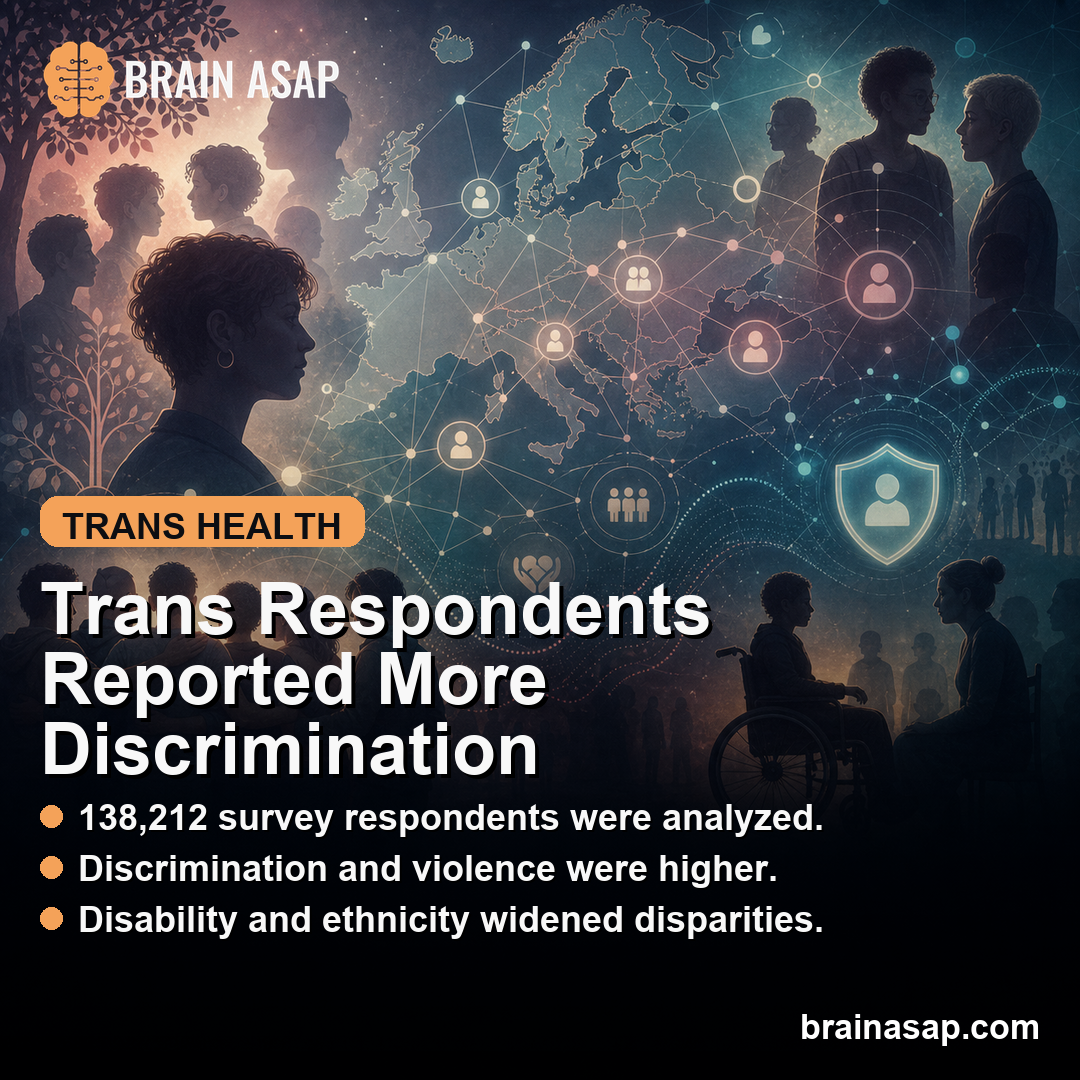
- 138,212 respondents analyzed: the study used the 2020 EU LGBTI Survey II across 30 European countries.
- Trans respondents reported more discrimination: 58% reported discrimination in at least 1 life area in the past year, compared with 40% of cisgender LGB respondents.
- Violence was also higher: 40% of trans respondents reported at least 1 physical or sexual attack in the previous 5 years, compared with 25% of cisgender LGB respondents.
- Healthcare had one of the largest differences: 27.6% of trans respondents reported discrimination in healthcare or social services, compared with 9.7% of cisgender LGB respondents.
- Legal rights rankings did not erase the difference: the trans-cisgender LGB disparity persisted across countries with different LGBTQ+ rights scores.
Source: International Journal of Transgender Health (2026) | Evje et al.
Country-level LGBTQ+ policy rankings can make legal protections look similar while daily exposure to discrimination and violence remains different.
Researchers tested whether transgender people and cisgender lesbian, gay, and bisexual people reported the same levels of discrimination and violence across Europe. Trans respondents reported higher exposure on both outcomes.
Trans respondents reported more discrimination and more violence, even after the analysis accounted for age, finances, ethnic-minority status, disability, and country-level LGBTQ+ rights scores.
138,212 EU LGBTI Survey Responses Compared Trans and Cisgender LGB Experiences
The researchers used the 2020 EU LGBTI Survey II, a large anonymous survey of LGBTQ+ people across Europe. The final analysis included 138,212 respondents from 30 countries after intersex respondents were excluded because they were outside this paper’s scope.
The comparison groups were defined before the models were run:
- Cisgender LGB respondents: 118,543 people who were lesbian, gay, or bisexual and did not identify as trans.
- Trans respondents: 19,669 people, including trans women, trans men, and nonbinary or gender-diverse respondents.
Discrimination was measured as the number of life domains where a respondent reported discrimination in the past year because of their identity. The seven domains included work, housing, healthcare or social services, school or university, restaurants or nightclubs, shops, and job-seeking.
Violence was measured with a single question about how often respondents had been physically or sexually attacked in the previous 5 years.
Those measures are not perfect, but they separate two important outcomes: breadth of discrimination across daily life and repeated exposure to physical or sexual violence.
Trans Respondents Reported More Discrimination in Every Measured Life Domain
Overall, 58% of trans respondents reported discrimination in at least one measured life area during the past year. Among cisgender LGB respondents, the figure was 40%.
The mean discrimination score was also higher for trans respondents: 1.42 domains versus 0.77 domains for cisgender LGB respondents.
Every measured domain showed a significant difference. Some of the clearest differences were practical daily-life settings:
- Healthcare or social services: 27.6% of trans respondents vs 9.7% of cisgender LGB respondents.
- School or university: 26.8% vs 14.3%.
- Shops: 24.4% vs 10.1%.
- Looking for a job: 12.7% vs 3.5%.
The healthcare difference deserves special attention. Discrimination in healthcare is not only a social harm; it can change whether people seek care, disclose relevant information, continue treatment, or trust clinicians.
Physical or Sexual Violence Was Higher for Trans Respondents
Violence followed the same direction: 40% of trans respondents reported at least 1 physical or sexual attack in the previous 5 years, compared with 25% of cisgender LGB respondents. Repeated attacks also differed, with more than 10 attacks reported by 5% of trans respondents versus 2% of cisgender LGB respondents.
The mean violence score was 1.00 for trans respondents and 0.56 for cisgender LGB respondents. Multilevel models still found higher discrimination and violence among trans respondents after controlling for ethnic-minority status, disability, age, financial situation, and country.
This is the central public-health signal: the disparity was not only a legal-rights issue, a country-composition issue, or a demographic artifact. Trans status remained associated with higher reported exposure.
Disability and Ethnic-Minority Status Amplified the Disparity
The study also tested whether the trans-cisgender LGB difference changed for respondents with ethnic-minority backgrounds or disabilities.
Both factors were linked to worse outcomes overall. More importantly, the disparities were larger among trans respondents in those groups.
For ethnic-minority status, the interaction with trans status was significant for discrimination and violence. For disability, the interaction with trans status was also significant for both outcomes.
Plain-language version: respondents who were trans and also reported an ethnic-minority background or disability faced especially elevated exposure to discrimination and violence.
LGBTQ+ research can hide within-group risk when it treats the community as a single block. Trans people were not only different from cisgender LGB people on average; risk also varied within the trans group and across other forms of marginalization.
Country LGBTQ+ Rights Scores Did Not Erase the Trans-Cisgender LGB Gap
The researchers included each country’s 2019 Rainbow Europe ranking, a score from 0 to 100 that summarizes legal standards for LGBTQ+ rights.
Countries varied widely. Malta had the highest score in the dataset at 90, while North Macedonia had the lowest at 11. The average country score was 47.56.
Higher national LGBTQ+ rights were weakly associated with lower discrimination overall. However, the difference between trans and cisgender LGB respondents persisted across the European countries studied.
Legal protections are still relevant. The study does not argue otherwise. It shows that legal rankings alone do not fully capture whether trans people experience safety and equal treatment in daily life.
Country-level LGBTQ+ rights dashboards can miss this subgroup burden. A country can have stronger protections and still leave trans people with a higher burden of discrimination and violence than cisgender LGB people.
Survey Measures Leave Important Limits
The strengths are obvious: a very large cross-national sample, recent survey data, and multilevel models that separated individual-level and country-level predictors.
The limits are just as important.
- Opt-in survey: the sample may not represent all LGBTQ+ people in each country.
- Discrimination breadth: the discrimination score counted domains, not how often discrimination happened within each domain.
- Single violence item: violence was measured with a single broad question, which can miss important detail.
- Identity categories: the authors note that gender and sexuality measures could not fully capture the variety of trans respondents’ sexualities and experiences.
Those limits should narrow the claim, not erase it. The analysis still shows a consistent pattern across a very large dataset: trans respondents reported more exposure to harm than cisgender LGB respondents.
Policy implication: LGBTQ+ equality tracking should include trans-specific, self-reported outcomes, while keeping the limits of opt-in survey data visible.
Policy planners, clinicians, educators, and researchers should not treat broad legal rankings or community averages as substitutes for subgroup data. Where sample sizes allow, outcomes should be separated by disability, ethnic-minority status, and gender identity.
The next step is better measurement: more representative sampling where possible, clearer violence questions, repeated surveys over time, and healthcare-specific measures that separate access, avoidance, and mistreatment.
Cautious takeaway: the study does not provide objective incidence rates for discrimination or violence. It shows that, within this large self-selected European LGBTQ+ survey, trans respondents reported higher exposure than cisgender LGB respondents across multiple domains.
Citation: DOI: 10.1080/26895269.2024.2440856. Evje et al. Transgender people experience more discrimination and violence than cisgender lesbian, gay, or bisexual people: A multilevel analysis across 30 European countries. International Journal of Transgender Health. 2026;27(2):736-750.
Study Design: Cross-sectional multilevel analysis of the 2020 EU LGBTI Survey II, with individual-level predictors and country-level LGBTQ+ rights scores.
Sample Size: 138,212 respondents, including 118,543 cisgender LGB respondents and 19,669 trans respondents.
Key Statistic: 58% of trans respondents reported discrimination in at least 1 life area in the past year, compared with 40% of cisgender LGB respondents; 40% vs 25% reported at least 1 physical or sexual attack in the previous 5 years.
Caveat: The survey was anonymous and large but opt-in, so the results describe reported exposure within this European LGBTQ+ survey rather than objective population incidence rates.