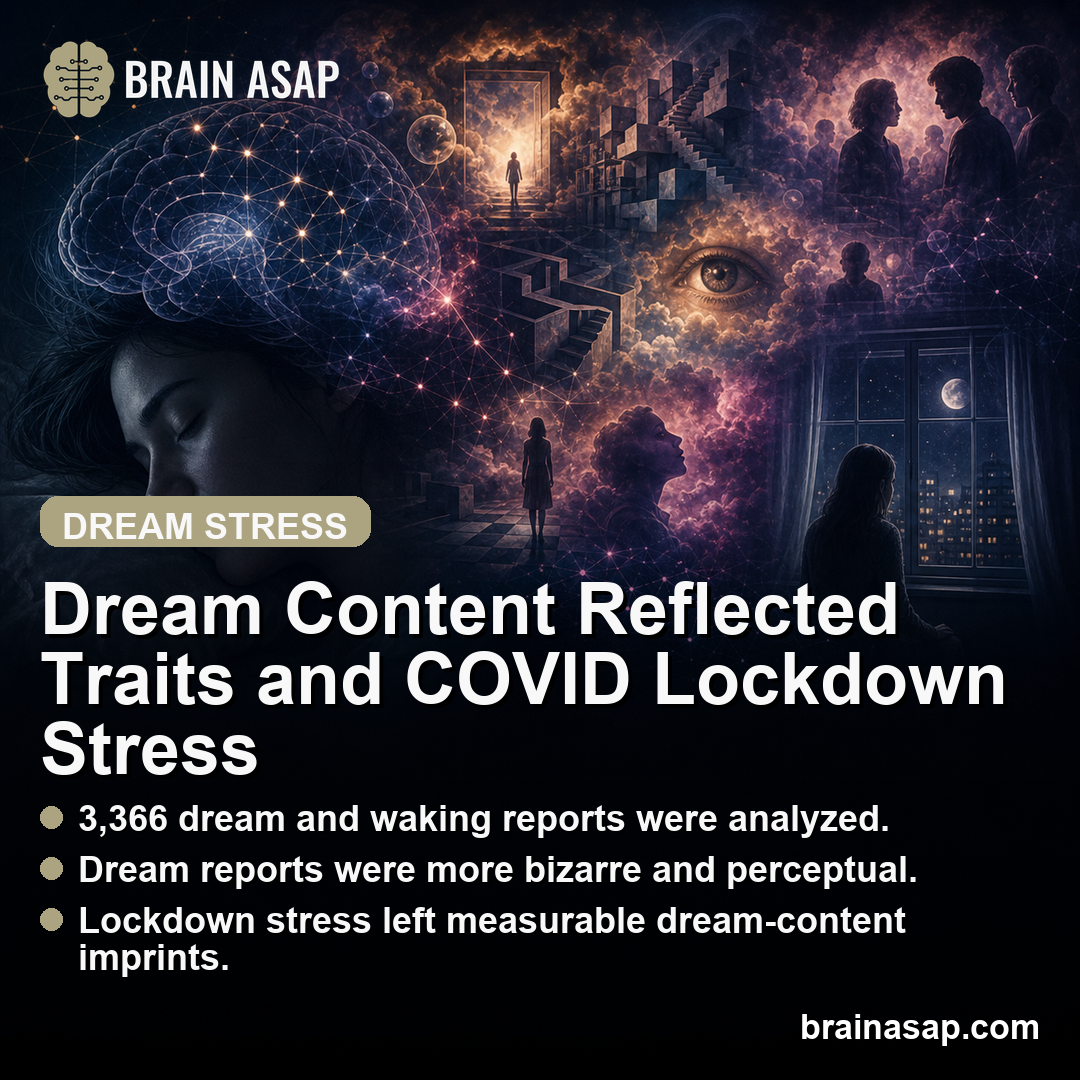
TL;DR: A 2026 study in Communications Psychology analyzed 1,687 dream reports and 1,679 waking reports, finding that dreams were more visual, spatial, social, bizarre, and emotionally negative than waking experiences.
Key Findings
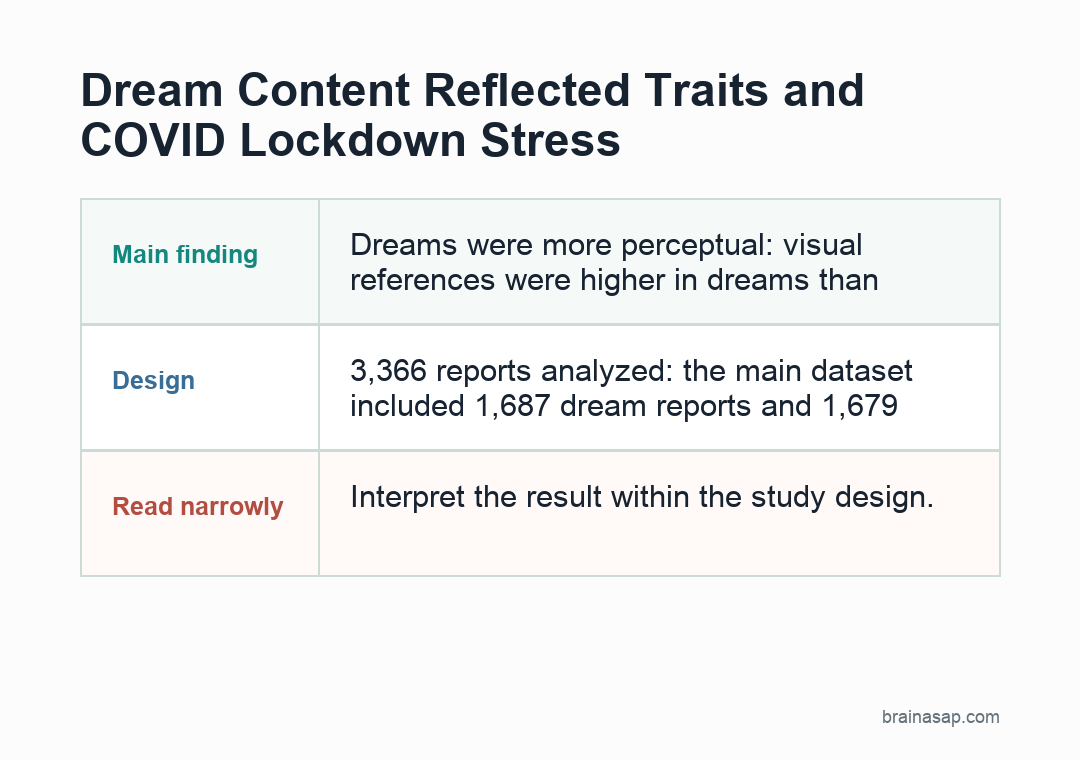
- 3,366 reports analyzed: the main dataset included 1,687 dream reports and 1,679 waking reports from 207 adults collected between 2020 and 2024.
- Dreams were more bizarre: dream reports showed a large increase in bizarreness compared with waking reports, with Cohen’s d = 2.85.
- Dreams were more perceptual: visual references were higher in dreams than waking reports (d = 1.52), as were spatial features (d = 1.40) and setting changes (d = 1.29).
- Traits shaped content: positive attitude toward dreaming predicted higher dream arousal, bizarreness, visual perception, and spatial features, while mind-wandering predicted more bizarre dreams.
- Lockdown left a measurable imprint: an independent 80-person COVID lockdown dataset showed more dream references to limitations, social interactions, settings, body, emotional arousal, fantasy, drama, and jobs.
Source: Communications Psychology (2026) | Elce et al.
The useful part of this study is scale. Researchers converted thousands of first-person reports into comparable dimensions rather than interpreting a few memorable dreams by hand.
Traits such as mind-wandering, sleep quality, and attitude toward dreaming also helped predict what people dreamed about.
The researchers used language-model-assisted scoring and lexical analysis to quantify the content of thousands of reports. Their goal was not to interpret one person’s dream, but to ask whether stable traits and real-world events leave statistical fingerprints in dream content.
The Study Compared 1,687 Dreams With 1,679 Waking Reports
The main dataset came from 207 Italian adults with regular sleep-wake patterns and no sleep-related, neurological, or psychiatric diagnosis. Participants were 18 to 69 years old and provided reports from both sleep and wakefulness.
The researchers analyzed 1,687 dream reports and 1,679 waking reports from this main dataset. They also used a separate 80-person lockdown dataset collected in Italy during the first COVID-19 restrictions in 2020.
Participants recorded reports soon after waking, which protects dream data from a known recall problem.
Delayed recall can flatten details, remove sequence, and turn a strange experience into a cleaner story, so timing can substantially affect data quality.
The study used two complementary content methods:
- Semantic dimensions: 16 predefined features, including visual perception, space, setting changes, thought, arousal, valence, bizarreness, and agentivity.
- Lexical domains: 32 word-based domains clustered into environment-related, community-related, and individual-related content.
- Validation: AI-generated scores agreed strongly with human raters across all 16 semantic dimensions, with correlations above 0.60.
This design let researchers compare dreams with waking reports in the same general language framework. It also let them test whether dream content was shaped by traits, sleep patterns, and the COVID lockdown period.
Dream research often has to choose between depth and scale. A clinician can read one report carefully, but thousands of reports require a more systematic method.
Here, the automated scoring was not treated as magic. Researchers compared language-model ratings with human ratings and participant self-ratings, then used the agreement checks as a guardrail.
Dreams Were More Visual, Spatial, and Bizarre
The clearest contrast was between externally grounded waking reports and scene-like dream reports. Dreams contained more visual content, more spatial detail, more social interactions, more setting changes, and more bizarreness.
The effect sizes were large for several dimensions. Dream reports exceeded waking reports for visual references (d = 1.52), spatial features (d = 1.40), setting changes (d = 1.29), social interactions (d = 1.40), and bizarreness (d = 2.85).
Waking reports went the other way. They contained more thought and metacognitive content, more agentivity, more time awareness, and more references to bodily needs.
In plain terms, waking reports emphasized thought and self-direction. Dream reports emphasized scenes unfolding around the sleeper.
That does not make dreams less meaningful. It suggests that dreaming may reorganize personal material into a more perceptual, less self-directed mode of experience.
Mind-Wandering and Sleep Quality Helped Predict Dream Features
The trait results were more specific than a general claim that “personality affects dreams.” The strongest patterns involved attitude toward dreaming, mind-wandering, perceived sleep quality, and visuospatial memory.
A more positive attitude toward dreaming predicted higher dream arousal, bizarreness, spatial features, visual perception, geometric patterns, and nature-related navigation. These effects appeared selectively in dream narratives rather than waking reports.
Mind-wandering also stood out. Greater mind-wandering predicted higher dream bizarreness (beta = 0.27) and more frequent setting shifts (beta = 0.23), supporting the idea that spontaneous thought during the day and dreaming during sleep may share cognitive machinery.
Sleep quality had a narrower role. Lower perceived sleep quality was associated with more bizarre dreams and more matter- and appearance-related references, while objective sleep patterns were only weakly related to content overall.
The objective sleep findings were not empty, though. Longer light sleep was associated with more setting shifts in dreams, which fits the broader pattern linking dream bizarreness to scene changes.
That keeps the sleep result modest. Sleep architecture did not explain dream content broadly, but some sleep features still lined up with specific dream characteristics.
COVID Lockdown Added Constraint and Emotional Intensity
The independent lockdown dataset gave the study a way to test whether a shared external stressor appeared in dream content. It did, but not as a simple replay of news headlines.
During strict lockdown, dreams contained more references to limitations, social interactions, settings, body, emotional arousal, fantasy, drama, work, and time.
The increase in job-related themes was especially large, with jobs appearing in 54.33% of lockdown dream reports compared with 32.66% in the main dream dataset.
Across the years after the pandemic peak, several features moved back toward baseline. Dream bizarreness declined over time, emotional valence became more positive, and arousal and limitation references decreased.
The recovery trajectory adds more information than a one-week snapshot. It suggests that shared stressors may enter dreams, then fade as the emotional pressure of the event changes.
The authors describe this as a recovering trajectory rather than proof that lockdown caused any particular dream. The design is observational, but it shows that a major external event can leave measurable traces in dream semantics.
The Findings Come From Reports, Not Direct Dream Recordings
The main limitation is ordinary but important: dream reports are remembered and narrated after waking. They may reflect how people reconstruct experience, not only how the experience unfolded during sleep.
The COVID analysis is also correlational. The lockdown comparison and later normalization pattern are informative, but they cannot prove that restrictions directly caused each dream feature.
The sample was also Italian and relatively healthy by design. People with sleep disorders, neurological disorders, psychiatric diagnoses, pregnancy, recent substance abuse, or sleep-affecting medications were excluded from the main dataset.
The exclusions make the findings cleaner for studying typical dreaming, but they limit how far the results can be generalized to clinical sleep problems, nightmares, trauma-related dreams, or psychiatric populations.
Even with those limits, the study gives a useful map.
- Dream-wake contrast: Dreams showed stable differences from waking reports rather than random fragments.
- Trait link: Individual differences in mind-wandering, sleep quality, and attitude toward dreaming helped predict content.
- Shared stressor: The COVID lockdown dataset showed a detectable imprint from a common period of stress.
Citation: DOI: 10.1038/s44271-026-00447-2. Elce et al. Individual traits and experiences predict the content of dreams. Communications Psychology. 2026;4:69.
Study Design: NLP-assisted semantic analysis of dream and waking reports, with a main 207-person dataset and an independent 80-person COVID lockdown dataset.
Sample Size: 1,687 dream reports and 1,679 waking reports in the main dataset, plus an independent 80-person COVID lockdown dataset.
Key Statistic: Dreams were much more bizarre than waking reports (Cohen’s d = 2.85) and more visual (d = 1.52), while waking reports were more thought-focused (d = -1.77).
Caveat: Dream reports are remembered and narrated after waking, and the COVID lockdown analysis is correlational rather than causal.