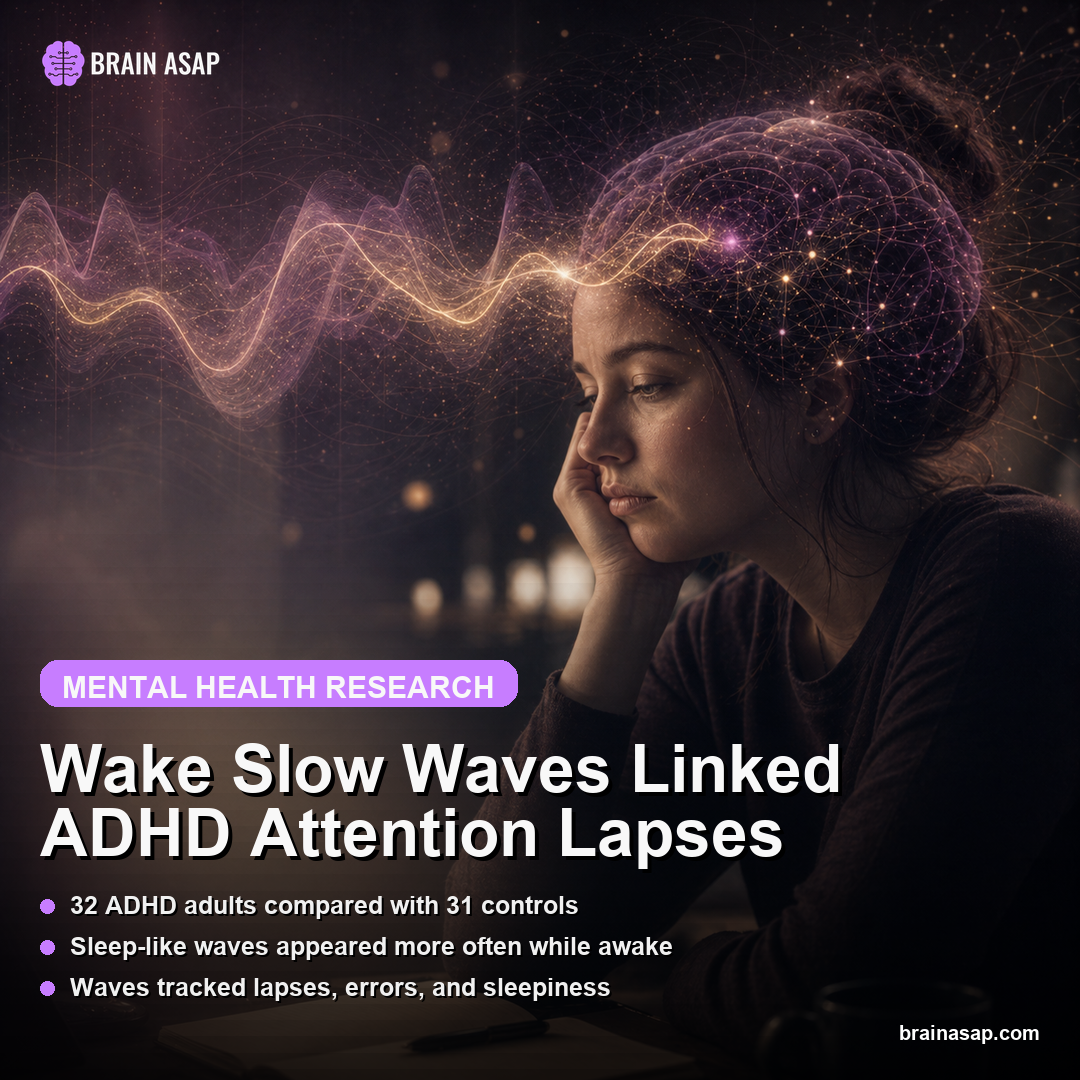
TL;DR: A 2026 study in The Journal of Neuroscience found that adults with ADHD showed more sleep-like brain waves, known as slow waves, while awake, and those brief local sleep states helped explain lapses in attention and vigilance.
Key Findings
- 32 ADHD adults tested: The study compared 32 medication-free adults with ADHD with 31 neurotypical adults.
- Sustained attention task: Participants completed a task requiring ongoing vigilance while researchers measured electroencephalography (EEG), a scalp recording of brain electrical activity.
- More sleep-like brain activity: ADHD participants showed more frequent slow-wave brain activity during wakefulness.
- Lapses tracked brain waves: Slow-wave episodes were linked to attention lapses, slower reaction times, increased errors, and subjective sleepiness.
- Possible treatment target: Prior work tested sleep-related stimulation as a way to reduce next-day waking slow-wave brain activity, but this was not tested here.
Source: The Journal of Neuroscience (2026) | Pinggal et al.
ADHD is usually framed as attention going everywhere at once.
Wake slow waves are sleep-like brain-wave patterns that suggest another possibility: parts of the brain can briefly drift toward sleep while the person is trying to stay on task.
Electroencephalography, or EEG, records electrical activity from the scalp. That made it the right tool for detecting brief sleep-like brain-wave shifts while participants were still awake and trying to perform.
When Awake Brains Produce Sleep-Like Waves
Sleep-like slow waves are not the same thing as falling asleep. They are brief local brain-wave shifts that can appear during demanding tasks, especially when the brain is tired.
The ADHD test is whether those local brain-state dips happen more often and whether they help explain inconsistent performance.
In this adult EEG sample, more frequent wake slow waves tracked with poorer vigilance.
This gives ADHD research a state-based explanation for some moment-to-moment variability.
The same person can perform adequately for a stretch, then miss a target when a local sleep-like event briefly disrupts the task network.
In practical terms, the readout is not a personality trait or a motivation score. It is a fast brain-state event that appears during the task window where attention succeeds or fails.
That timing is why EEG adds information that a retrospective symptom scale cannot capture.
Medication-Free Adults Faced a Vigilance Task
Researchers compared 32 adults with ADHD who had stopped medication with 31 neurotypical adults. All participants completed a sustained attention task while EEG captured slow-wave activity.
That design keeps the focus on moment-to-moment vigilance. Instead of asking only how distracted someone feels, it looks for a physiological interruption in waking attention.
Medication-free testing also helps reduce one source of ambiguity. Stimulants can alter arousal, reaction time, and EEG activity, so stopping medication made the comparison cleaner for detecting the underlying wake-state readout.
Slow Brain Waves Helped Explain Errors and Sleepiness
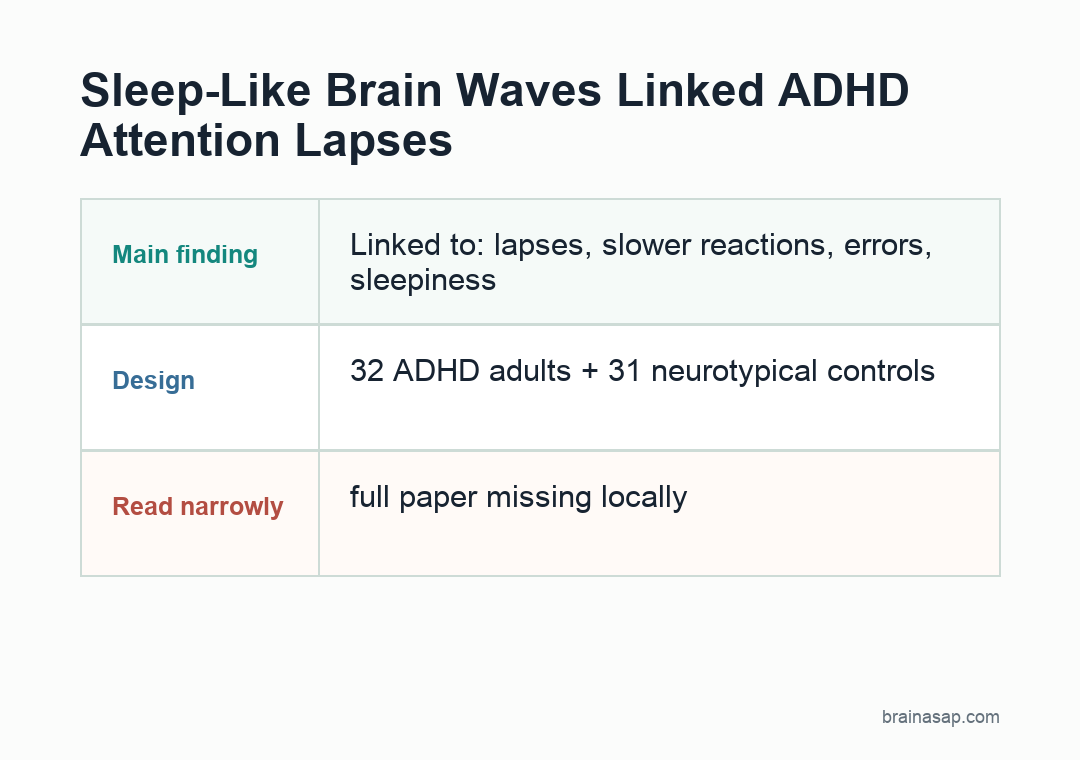
More frequent sleep-like brain activity in ADHD was linked to more lapses, slower reaction times, increased errors, and greater feelings of sleepiness.
The pattern makes wake slow waves a plausible mediator between ADHD and task performance.
The finding also fits lived experience: ADHD attention can feel unstable rather than simply absent, with performance fluctuating even when the person is trying hard.
- Brain-state readout: EEG detected sleep-like slow-wave brain activity while participants remained awake.
- Behavioral link: those waves were associated with lapses, slower responses, and errors.
- Subjective link: participants with more slow-wave activity also reported more sleepiness.
- Mechanism boundary: the readout explains one route into vigilance failure, not every symptom grouped under ADHD.
The Sleep Connection Does Not Make ADHD Just Sleepiness
The study does not reduce ADHD to poor sleep. ADHD is heterogeneous, and sleep problems are only one part of a larger attention, arousal, motivation, and executive-control picture.
But the result gives arousal biology a sharper role. If local sleep-like events interrupt vigilance, some attention problems can come from the brain’s state regulation as much as from distraction.
Clinically, this separates motivation from state stability. A person can be motivated, trying hard, and still lose performance if local brain activity briefly shifts toward a sleep-like state during a vigilance task.
Wake Slow Waves Are a Brain-State Mechanism
The study supports a measurable mechanism for attention variability, not a standalone diagnostic test.
Wake slow waves help explain one route into lapses, but ADHD symptoms also involve executive control, motivation, reward sensitivity, emotional regulation, medication effects, and sleep history.
The clinical claim has to stay specific. Wake slow waves are a candidate measurable mechanism of ADHD attention variability, and future work can test whether sleep-targeted or arousal-targeted interventions reduce them.
How to Read the Wake Slow-Wave ADHD Evidence
The evidence base is an adult ADHD EEG study comparing waking sleep-like brain-wave activity during a sustained attention task in medication-free ADHD adults and neurotypical controls.
That design is well matched to the test because slow waves are fast physiological events, not traits that can be captured by a questionnaire alone.
The sample also sets the boundary: 32 adults with ADHD who had stopped medication and 31 neurotypical adults.
The result should not be generalized automatically to children, medicated adults, sleep-deprived shift workers, or ADHD subgroups with different comorbidities.
The direction of the association is the anchor: adults with ADHD showed more frequent sleep-like slow-wave brain activity, and those episodes were linked to attention lapses, slower reaction times, errors, and sleepiness.
The study does not prove that reducing slow waves will improve ADHD symptoms.
It identifies a target for intervention studies: if slow waves help mediate lapses, then lowering them should improve vigilance in the tasks where they appear.
Sleep and Arousal Measures Belong in Future ADHD Trials
The study identifies a concrete arousal mechanism for inconsistent attention. Slow waves during wakefulness give researchers a measurable physiological readout that can sit between sleep biology and ADHD task performance.
The next step is intervention testing. If slow waves help mediate lapses, researchers can ask whether improving sleep, altering task design, or using stimulation approaches reduces waking slow waves and improves vigilance.
A stronger design would separate several possible drivers of wake slow waves:
- Sleep quality: fragmented or short sleep can raise next-day local slow-wave activity.
- Circadian timing: testing time can change arousal level and vigilance stability.
- Medication washout: stimulant timing can alter EEG activity and reaction-time variability.
- Task fatigue: longer vigilance blocks can increase sleep-like activity during wakefulness.
Those variables help explain why wake slow waves appear in some adults with ADHD more than others.
Task design belongs in that follow-up too.
If slow-wave brain activity rises during long, monotonous vigilance demands, researchers need to know whether shorter blocks, different reward schedules, or scheduled breaks change the physiology as well as the behavior.
The intervention test should also be symptom-specific.
If a treatment lowers waking slow waves, the strongest expected benefit would be on vigilance stability, reaction-time variability, and lapses, not necessarily every ADHD symptom domain.
That would still be clinically meaningful. In adult life, brief lapses can affect driving, studying, meetings, medication routines, and work tasks that require steady monitoring rather than creative bursts of attention.
The paper also suggests why standard ADHD scales can miss important physiology.
A questionnaire can capture subjective inattentiveness, but EEG can reveal whether the brain is repeatedly slipping into local sleep-like states during the exact moments when performance fails.
That distinction is central for trials.
A treatment can improve self-reported focus, reaction-time stability, sleepiness, or EEG slow-wave burden in different proportions, so future studies should measure those outcomes separately instead of assuming one ADHD score captures the whole mechanism.
Citation: DOI: 10.1523/JNEUROSCI.1694-25.2025. Pinggal et al. Sleep-Like Slow Waves during Wakefulness Mediate Attention and Vigilance Difficulties in Adult Attention-Deficit/Hyperactivity Disorder. The Journal of Neuroscience. 2026
Study Design: Adult ADHD EEG study comparing waking sleep-like brain-wave activity during a sustained attention task in medication-free ADHD adults and neurotypical controls.
Sample/Model: 32 adults with ADHD who had stopped medication and 31 neurotypical adults.
Key Statistic: Adults with ADHD showed more frequent sleep-like slow-wave episodes, which were linked to attention lapses, slower reaction times, errors, and sleepiness.
Caveat: Single-study evidence; interpret with the source design and sample.